
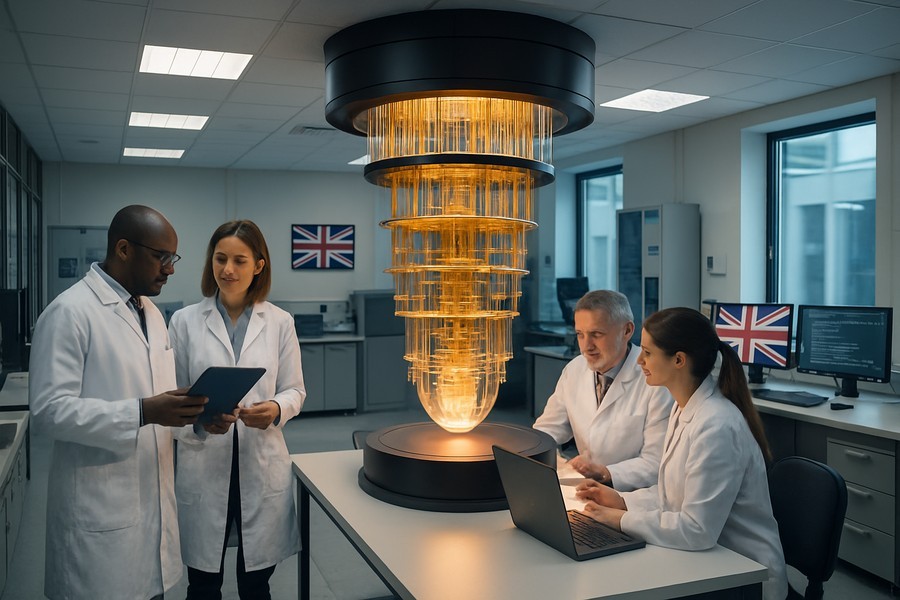
Quantum Computing: A Force for Good and a Source of National Pride
With the growing concern that the United Kingdom's scientific field is losing its grip as ideas are being capitalized on overseas, the government has stepped up. With a pledge to invest a whopping £1bn in the purchase of quantum computers from local companies, the government aims to secure its status as a global quantum computing powerhouse.
Recently, a prominent university in Cambridge revealed its plans to house the country's strongest quantum computer. This rapidly advancing field has stirred a buzz amongst scientists and investors in the city.
"Quantum computing talents should be leveraged for good," states Dr. Carmen Palacios-Berraquero, a tech entrepreneur who shares the same sentiments as Rachel Reeves, the Chancellor. She recently voiced her concerns about the potential for artificial intelligence to be manipulated by countries with differing values. Reeves considers AI as the "defining technology of our time".
Quantum Computing: The Future is Now
Quantum computers, anticipated to be significantly faster and more powerful than conventional systems, could lay the groundwork for the next technological revolution. Dr. Palacios-Berraquero, who leads a top UK quantum company, highlights the immense responsibility that comes with such a potent technology, particularly concerning its ethical use.
Palacios-Berraquero's comments came after the Chancellor expressed her desire to halt the trend of UK's high-tech inventions and talents moving overseas. The government plans to stimulate the quantum field to generate approximately 100,000 jobs within the UK, given that these businesses remain in the country. This ambitious plan is supported by a £2bn government fund.
The quantum company led by Palacios-Berraquero, based on the West Campus of Cambridge University, has been expanding rapidly. The company tripled in size within a year and now employs nearly 80 people. However, the possibility of quantum companies moving overseas always looms overhead. Despite this, Palacios-Berraquero is confident that there is still an opportunity to establish British household names in the quantum field.
Investing in Quantum: A Strategic Move
In 2023, a 10-year Quantum Strategy was launched by the government, promising a £2.5bn investment. However, significant funding that truly invigorated the industry was seen to be coming from the United States. The trend of UK tech firms heading abroad has sparked serious warnings. A report published last year described an economic growth crisis, particularly in the science and technology sectors, as promising companies moved overseas.
Financial rewards from these investments often land in foreign hands, as seen with a radio frequency detection company that struggled to sell its equipment to the UK government. The company, which sold to the US Department of Defense, is now owned by a US private equity firm.
As part of the government's strategy, it promises to purchase £1bn worth of quantum computers from the first UK companies to produce them on a commercial scale. The government's role as a customer has a massive impact on the industry.
The Quantum Challenge
However, a £2bn taxpayer investment in an emerging industry presents a political challenge. While the return on investment seems like a no-brainer, it raises questions about government spending. Dr. Brierley, CEO and founder of Riverlane, highlights the innovations quantum computing could bring, such as understanding how plants synthesize their own fertilizer. This could open up new ways of producing fertilizer, mimicking nature's processes.
The intense competition for talent in the quantum field emphasizes the importance of attractive immigration and visa policies, along with competitive salaries. Both the Labour government and the Conservatives have stated their support for the UK quantum industry. The Liberal Democrats have also pledged to spend 3.5% of GDP on research and development.
With the rapid pace and global race in the quantum industry, the level and type of government support could be crucial. How this plays out will certainly be a significant factor in the future of quantum computing in the UK.
