
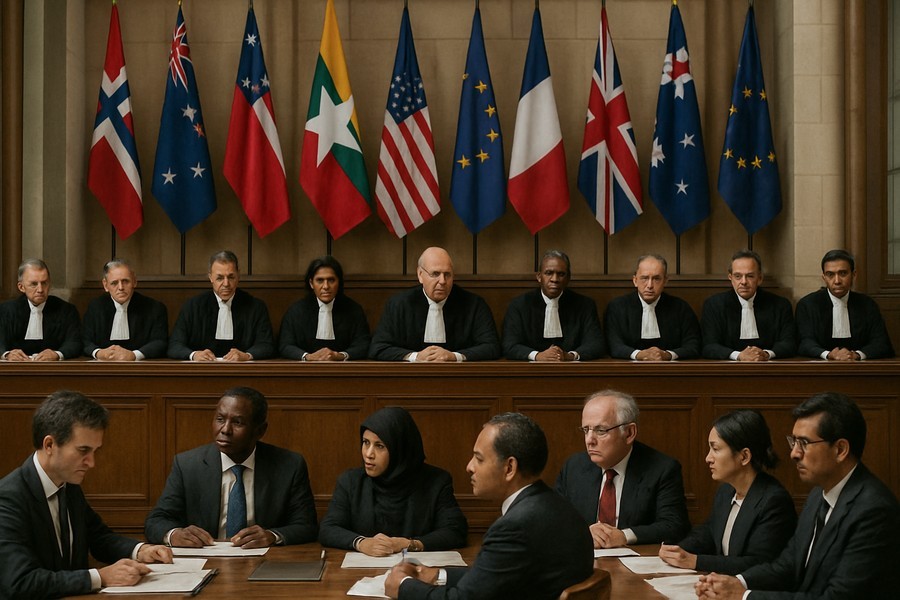
Global Court to Assess Allegations of Genocidal Acts Against Rohingya by Myanmar
A global court has begun looking into allegations of genocide committed against the Rohingya ethnic group in Myanmar. This move has been anticipated for a significant period of time.
The case was first presented by a West African nation, Gambia. They argued that an operation carried out by the military of Myanmar in 2017 breached the guidelines of the 1948 Genocide Convention.
Myanmar's Denial
The Southeast Asian nation, now under military control, has rejected these allegations.
In the opening statements, the Justice Minister of Gambia, Dawda Jallow, stated that his nation initiated the case because of their "sense of responsibility" rooted in their own history with military rule. He emphasized the necessity of raising a moral voice against oppression and crimes against individuals and groups, regardless of when and where they occur.
Justice Minister Jallow requested the Rohingya members, who had made the journey to the Great Hall of Justice, to stand and be recognized by the judges. They all stood in silence.
History of the Conflict
The conflict began when Myanmar's military initiated a campaign in Rakhine state in 2017, following an insurgency by a Rohingya group. The security forces of the country were accused of carrying out mass rapes, murders, and burning thousands of homes. This lead to over 700,000 Rohingya being displaced into neighboring Bangladesh.
Currently, around 1.2 million members of this marginalized group are living in disorderly, overcrowded camps where children are recruited by armed groups and girls as young as 12 are forced into prostitution. The abrupt and severe cuts in foreign aid imposed last year have shuttered thousands of schools in these camps, which have led to children starving to death.
One of the refugees who had traveled from a camp in Bangladesh to the Netherlands for the hearing said they lack the basic necessities that all human beings should have.
Myanmar's Representation
Initially, Myanmar was represented by the Nobel Peace Prize laureate Aung San Suu Kyi, who rejected the allegations that her country's military committed genocide. She claimed that the mass migration of the Rohingya people was an unfortunate consequence of a conflict with insurgents.
The pro-democracy advocate is currently in prison after being found guilty of charges which her supporters consider to be fabricated, following a military coup.
Myanmar challenged the court's jurisdiction, arguing that Gambia was not directly involved in the conflict and could not bring forward a case. However, both nations are signatories to the genocide convention, which was ratified after World War II. The court rejected Myanmar's argument in 2022, allowing the case to proceed.
Impact of the Case
The court's decision on this case could potentially pave the way for other countries, like South Africa, to bring forward similar cases. South Africa has accused Israel of committing genocide, an allegation that Israel strongly denies.
An expert on international law explained that the court's decision in the Myanmar case will influence the South African case. She said that while the legal criteria for genocide are very stringent, it is possible that the judges may broaden the definition.
A verdict of genocide would support the ongoing investigation by another court in The Hague, the International Criminal Court. In 2024, the court's chief prosecutor asked the judges to issue an arrest warrant for the head of Myanmar's military regime for crimes against the Rohingya. This request is still under consideration.