
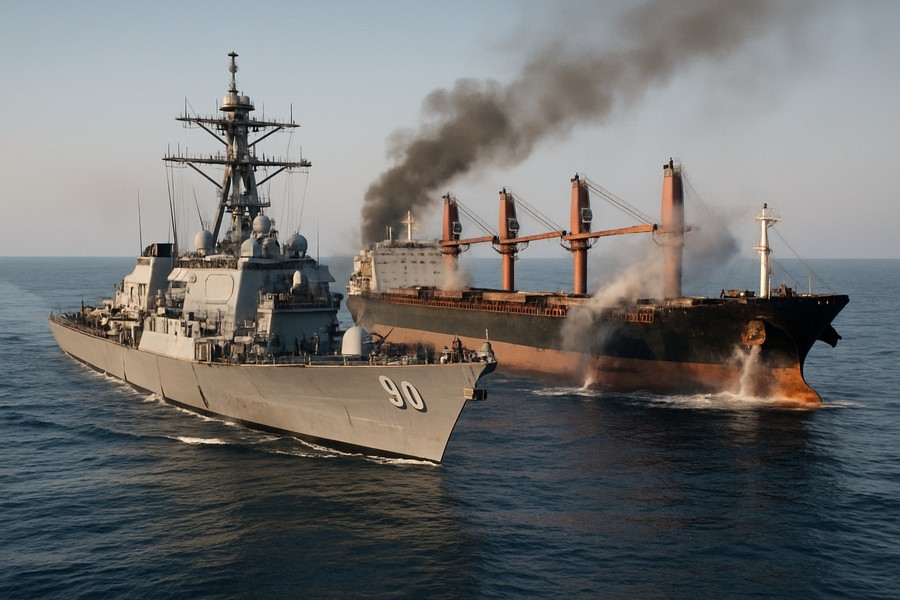
US Naval Forces Take Decisive Action Against Iranian Ship
Over the past weekend, an American naval vessel took decisive action against a cargo ship sailing under the Iranian flag in the northern part of the Arabian Sea. This is an unusual instance of force being used to uphold the American blockade on Iran. It illustrates the readiness of the US to fully implement its blockade and shows that its training exercises can translate into real-world applications.
Earlier in the year, a similar situation with Venezuela led to a lengthy Atlantic chase that ended with the US forces boarding a tanker. In contrast, the recent incident was a clear demonstration of the Navy's use of force and a revealing look at its blockade enforcement procedures.
President's Statement on the Incident
The President mentioned in a social media post that the Iranian ship didn't fare well during this encounter. He explained that the US Navy halted the ship by severely damaging its engine room.
Details of the Encounter
On a recent Sunday, a US Navy destroyer encountered the M/V Touska, an Iranian cargo vessel, as it was making its way through the Arabian Sea towards Iran. The Touska was warned repeatedly that it was violating the US blockade on Iran.
Typically, any vessel suspected of contraband or potential blockade violations is investigated. The crews are interrogated about the ship's origin, destination, and cargo. In many cases, this information is sufficient to either clear the ship or turn it away. If the Navy decides to board a vessel, it usually does so with the ship's consent after checking cargo and manifests.
However, the Touska proved to be an exception. Despite repeated warnings over six hours, the vessel did not comply. This led the Navy to direct the crew to evacuate the engine room, after which they fired several rounds into the engine room, disabling the ship's propulsion.
Use of Force in Blockade Enforcement
The use of force to disable a ship, particularly by targeting its propulsion, is a recognized next step if a ship tries to run a blockade. Although not common in sanctions enforcement, it is an anticipated action.
In such scenarios, the challenge lies in determining the vessel's intentions as it approaches the strait. The steps followed in this case, from issuing warnings to shooting the engine, are quite similar to procedures followed by the US Coast Guard and Navy when dealing with suspected drug trafficking vessels.
If a ship refuses to comply, the Coast Guard is authorized to disable its engine and board the vessel. However, the boarding of a large vessel like the Touska is difficult due to its size and speed and the potential risk of hostility from the crew.
Aftermath of the Action
Following the disabling of the cargo ship, a unit of US Marines boarded it. Depending on the level of risk and the scenario, different personnel can be deployed in a boarding operation.
It remains unclear what will happen to the Touska going forward. The President indicated that the ship is in US custody and is currently being searched. However, no information has been provided regarding the crew or any potential casualties.
Now that the Touska is under US control, the Navy might tow it away or release it, depending on what they find in the cargo. The ship is owned by the Islamic Republic of Iran Shipping Lines, which has been sanctioned due to alleged ties to Iran's ballistic missile program.
Implications of the Incident
The interception of the Touska has been labeled an act of piracy and a ceasefire violation by Iran's military. It marks a significant escalation between the US and Iran as a two-week ceasefire is set to expire soon.
Negotiations are shaky, and Iran has closed the Strait of Hormuz. This is the first time Iran has announced a full closure of the strait, and it's the first large-scale naval blockade the US has implemented since the Cuban Missile Crisis.
While at least 25 commercial ships have been turned away under the blockade, the Touska is the first known vessel to resist. This raises the possibility of more confrontations if negotiations deteriorate further or fail entirely. The frequency of such interdictions could put a strain on naval ships and Marine boarding teams.