
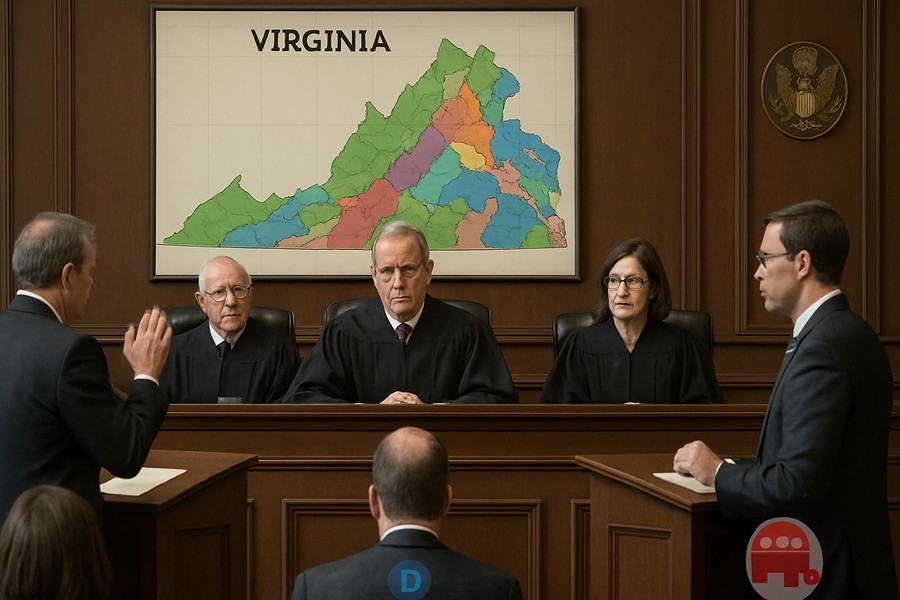
Virginia's High Court Deliberates Over Redistricting Map Leaning Towards Democrats
In Virginia, a dispute over a revised congressional map, which seems to favor Democrats, has reached the state's Supreme Court. The reason for the court's involvement is a legal challenge put forward by Republicans who are opposing the new map. This map, which was accepted by voters recently, could potentially grant Democrats an extra four seats in the U.S. House.
Republicans are arguing that the Democratic-majority General Assembly went against process rules by putting the constitutional amendment before voters for mid-decade redistricting. The court may concur with this viewpoint, which could nullify the amendment and make the recent statewide vote insignificant.
Redistricting Battle Across the Nation
The court case in Virginia is just the latest development in a nationwide struggle over redistricting. This struggle is between Republicans and Democrats, who are both trying to gain an upper hand in the upcoming November election. This election will decide if the Republicans can hold on to their slim majority in the U.S. House.
Last year, the former President encouraged Republicans in Texas to redraw district lines to their advantage in a bid to secure more House seats. This sparked a domino effect, with similar actions happening in other states. This led to voters approving Virginia's new map just last week.
Next Stop: Florida
Now, the focus is shifting to Florida. The Republican Governor has added congressional redistricting to the agenda for a special legislative session, controlled by the GOP, which starts on Tuesday. The ex-President has expressed his support for Florida's redistricting efforts, while criticizing the amendment in Virginia led by Democrats. He described it as very detrimental to the nation.
So far, both major parties have been neck and neck in this battle. Republicans believe they could gain up to nine more seats with redrawn districts in Texas, Missouri, North Carolina, and Ohio. Meanwhile, Democrats think they could secure as many as ten additional seats with new districts in California, Utah, and Virginia. However, there are still legal hurdles to overcome in Virginia and Missouri.
Virginia's Current Representation
Currently, Virginia is represented in the U.S. House by six Democrats and five Republicans. These representatives were elected from districts determined by a court after a bipartisan redistricting commission failed to agree on a map following the 2020 census. The newly approved districts could enhance Democrats' odds of winning ten districts.
The key question before the state Supreme Court is whether these districts should be invalidated due to the process used by lawmakers. The redistricting commission in the state was created by a voter-approved constitutional amendment. Therefore, to redraw districts, lawmakers had to propose a new constitutional amendment. This involved the approval of a resolution in two separate legislative sessions, with a state election in between, to place an amendment on the ballot.
Legal Hurdles and Challenges
Earlier this year, a judge in rural Tazewell County, in southwestern Virginia, declared that lawmakers didn't adhere to their own rules when they added the redistricting amendment to a special session last fall. The judge also stated that lawmakers didn't initially approve the amendment before the public began voting in the previous year's general election. Furthermore, the state didn't publish the amendment three months before the election, as required by law. As a result, the judge declared the amendment invalid and void.
However, the Virginia Supreme Court has temporarily suspended the judge's order and allowed the redistricting vote to go ahead before hearing arguments on the case. Republicans have lodged at least two more legal challenges, which are currently making their way through the courts.