
A Historic Space Probe Nearly Goes Silent Before a Major Milestone
A Brief Break in Contact
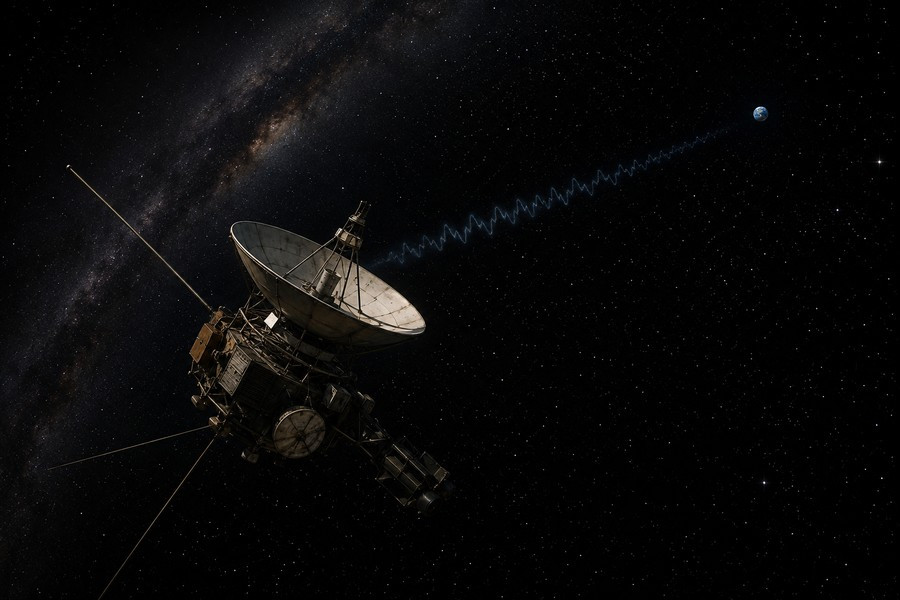
An aging space probe is nearing a historic point in its journey, but it recently stopped communicating with Earth. The probe is expected to become the first human-made object to travel one full light-day from Earth.
Engineers failed to detect the probe’s radio signal during two planned communication attempts. The attempts took place 24 hours apart. The signal returned about a day after the second attempt, and contact has continued since then.
Engineers are still trying to learn what caused the communication problem. They discovered that one group of thrusters had stopped working during the outage. The spacecraft’s backup thrusters turned on automatically, as designed.
This automatic change placed the probe into a stable safety mode. In that setting, regular work pauses while engineers examine the problem and decide what steps to take next.
A Spacecraft Built to Keep Going
The probe was launched in the late 1970s and has traveled about 16 billion miles, or 26 billion kilometers, from Earth. Even after decades in space, it continues to send back information from beyond the Sun’s protective region.
Engineers communicate with the probe through a worldwide network of large radio antennas. These antennas are placed in different locations so that spacecraft can remain in contact with Earth as the planet turns.
The recent loss of contact was unusual, but the probe’s systems were able to protect it without direct help from Earth. Its computers detected a possible thruster problem and switched to the backup group.
“This is the first time the spacecraft has reacted in this way,” said the manager overseeing the mission. The team has also recognized that the probe is now at an age when unexpected problems are becoming more likely.
What a Light-Day Means
The probe is expected to reach a distance of one light-day from Earth soon. At that point, it will be about 16.09 billion miles, or 25.89 billion kilometers, away.
A light-day is the distance light can travel in 24 hours. Because radio signals travel at the speed of light, a message sent to the probe will take one full day to arrive. A reply will take another day to return.
- A message from Earth takes about 24 hours to reach the probe.
- A response from the probe takes about 24 more hours to return.
- A complete exchange can take roughly two days.
That delay makes every command and response difficult to manage. Engineers must plan carefully because they cannot quickly adjust the spacecraft if a problem appears.
Saving Power Far From Home
The probe began its mission with 10 science instruments. Several have been shut down over the years to reduce its power use and extend its life.
Its electricity comes from the heat created as plutonium slowly breaks down. That heat is changed into electrical power, but the supply becomes weaker over time. The spacecraft loses about 4 watts of power each year.
To protect the mission, engineers recently completed a major power-saving operation known as the “big bang.” The effort turned off three devices and replaced them with three alternatives that use less electricity.
Without that change, the spacecraft would have needed to shut down another science instrument within a few years. The power-saving move should allow the probe to continue working longer than expected.
Still Studying Deep Space
The probe is traveling through interstellar space, the region beyond the Sun’s heliosphere. The heliosphere is a vast bubble made by particles and magnetic fields flowing outward from the Sun.
Even as its power declines, the spacecraft continues to gather valuable information about this distant area. Its measurements help scientists study conditions far beyond the planets and learn more about the space between stars.
Reaching one light-day from Earth will not cause the probe to enter a new environment. Nothing major is expected to change around it at that moment. Instead, the milestone will show how far the spacecraft has traveled and how long it has survived in the harsh conditions of deep space.
For now, engineers remain in contact with the probe and continue investigating the signal loss. Its recent trouble is a reminder that the spacecraft is aging, but its return to communication also shows that it can still respond and keep working at an extraordinary distance from home.