
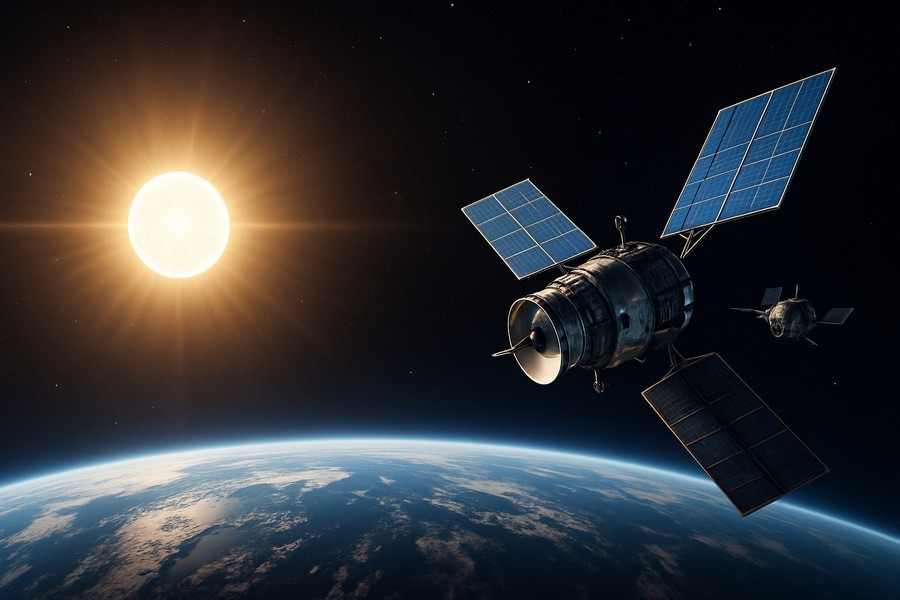
Urgency for the Launch of a New Satellite for Space Weather Monitoring
A spacecraft is getting ready to blast off, with a mission to keep a watchful eye on the sun and help safeguard the Earth from space weather threats. The satellite, known as Space Weather Follow-On L1 (SWFO-L1), comes at a crucial time as the current group of sun-watching satellites, which includes ACE, SOHO, DSCOVR, are nearing the end of their lifespan.
"We need to take action now. The existing satellites have been in service longer than their expected lifespan", said Richard Ullman, Deputy Director, NOAA Office of Space Weather Observations.
For years, we've relied on a few satellites stationed a million miles away to alert us about potentially disruptive space weather. But, these satellites are past their prime.
Why Monitoring the Sun is Important
Solar storms can cause more than just beautiful auroras. They can fire off eruptions of charged particles that speed across space and hit Earth's magnetic field. These events, known as coronal mass ejections (CMEs), can disrupt GPS signals, endanger astronauts, damage satellites, and in severe cases, cause power blackouts.
The only reason we have time to prepare for these solar storms is thanks to spacecraft positioned at a strategic location known as Lagrange Point 1, or L1. From this point, about a million miles between Earth and the sun, satellites have a front-row view of the complex space weather environment including the solar wind. By monitoring the speed, density, and magnetic orientation of the solar wind, these satellites can provide us with a warning 15 minutes to an hour before a solar storm hits Earth.
"These alerts are crucial for safeguarding against the potentially devastating effects of space weather", said Irene Parker, who is performing the duties of the Assistant Administrator, NOAA Satellites.
Aging Fleet of Satellites: A Cause for Concern
Until now, monitoring the sun has primarily been the responsibility of older missions. NASA's ACE spacecraft, launched nearly 30 years ago and intended to operate for just five years, is still in service. The joint NASA-NOAA DSCOVR mission, launched six years ago to replace ACE, has been struggling with reliability issues and is currently offline due to a software issue.
Our dependence on an almost 30-year-old spacecraft underscores the fragility of our space weather monitoring network. If these missions fail without a replacement, the consequences could be dire.
"We're barely holding on in terms of funding and getting new observations out there", said Space Weather Physicist Tamitha Skov. "We've grown accustomed to single-point failures. It doesn't scare or frustrate us anymore, it's just the way things are."
Introducing SWFO-L1
The new mission is designed to bolster this frail system, ensuring that real-time solar wind monitoring continues uninterrupted if ACE finally fails or DSCOVR cannot be recovered. Once it reaches L1, SWFO-L1 will measure the solar wind, magnetic fields, and high-energy particles emanating from the sun. These readings will be sent in real time to NOAA's Space Weather Prediction Center in Boulder, Colorado, where forecasters issue alerts and warnings to everyone from airlines to power grid operators.
"It can't prevent an incoming threat, but it can give us time to prepare", Parker said. "SWFO-L1 will provide our forecasters at the NOAA Space Weather Prediction Center with the advanced tools they need to protect our country's critical systems."
What sets SWFO-L1 apart is its focus. While spacecraft like NASA's Parker Solar Probe or ESA's Solar Orbiter are changing our understanding of solar physics, SWFO is dedicated to operations. Its primary goal is reliability: ensuring there is always an eye on the sun, feeding data into space weather models.
"We at the Space Weather Prediction Center are extremely excited for the SWFO-L1 spacecraft to not only launch but get in position and start receiving solar wind observations into our operations", said Shawn Dahl, Forecaster, Space Weather Prediction Center, NOAA's National Weather Service.
A New Era in Space Weather Monitoring
For the scientists who have been advocating for new investments in space weather monitoring, the launch marks the start of a new chapter.
"This launch is not just about a new satellite, it's about building a more resilient future, ensuring that technologies we depend on are protected from the sun's most extreme events", Parker said.
And for the rest of us, whether we rely on GPS navigation, satellites for communication, or just want to enjoy the auroras, it means the sun will stay firmly in our sight.