
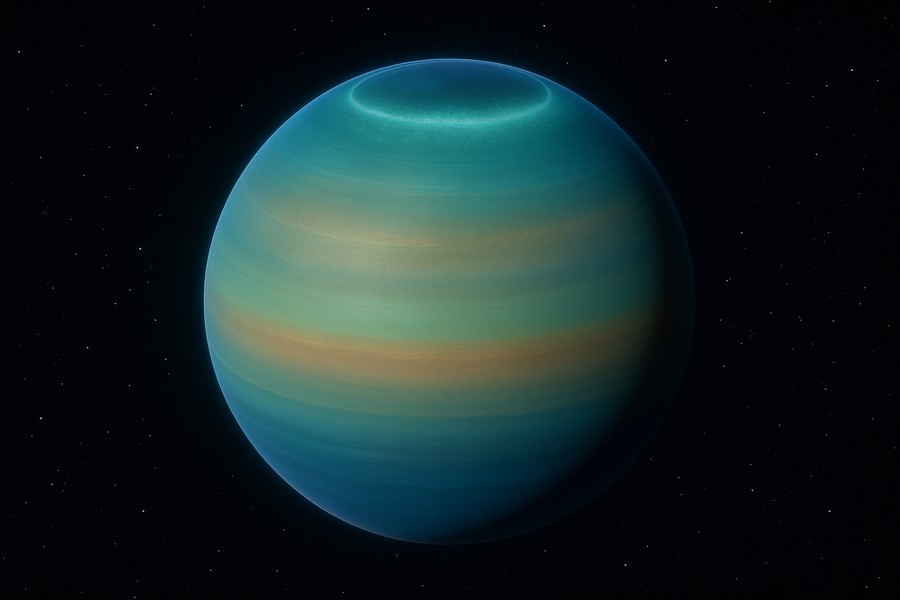
The Fascinating Exploration of Uranus's Upper Atmosphere
A recent study led by a team of scientists in the United Kingdom has made groundbreaking discoveries about the upper atmosphere of Uranus. They've successfully mapped the temperature and ion density in the ionosphere, the area of the atmosphere that's about 5000 km above the planet's cloud tops. This is the region where the atmosphere becomes ionized and interacts heavily with the planet's magnetic field.
This research offers the most comprehensive image yet of where Uranus's auroras form, how its unusually tilted magnetic field influences them, and how the planet's atmosphere has continued to cool for the past few decades. It's been found that the temperatures reach their peak between 3000 and 4000 km, while ion densities max out around 1000 km. These findings reveal clear variations connected to the complex geometry of the magnetic field.
Unprecedented Three-Dimensional View of Uranus's Upper Atmosphere
The scientists involved in this study are thrilled because this is the first time they've been able to view Uranus's upper atmosphere in three dimensions. The study's sensitivity allows them to track the upward movement of energy through the planet's atmosphere. They can even see how its skewed magnetic field influences this movement.
Findings from the study affirm that the upper atmosphere of Uranus continues to cool, extending a trend that started in the early 1990s. The team measured an average temperature of around 426 kelvins (about 150 degrees Celsius), which is lower than values recorded by ground-based telescopes or previous spacecraft.
Unearthing the Mysteries of Uranus's Magnetic Poles
The study also discovered two bright auroral bands near Uranus's magnetic poles. They observed a distinct decrease in emission and ion density in a portion of the region between the two bands, a feature that's likely connected to transitions in magnetic field lines. Similar darkened regions have been observed at Jupiter, indicating that the magnetic field's geometry controls the movement of charged particles through the upper atmosphere.
The team's lead researcher emphasized that Uranus's magnetosphere is one of the most unusual in the Solar System. It's tilted and offset from the planet's rotation axis, which results in complex aurora movements across the surface. The study has shown how far these effects reach into the atmosphere.
Understanding the Energy Balance of Ice Giants
By revealing the vertical structure of Uranus in such detail, this study is helping scientists understand the energy balance of ice giants. This is a crucial step towards characterizing giant planets beyond our Solar System. The team's findings not only shed light on the mysteries of our own solar system but also pave the way for further exploration of the universe.