
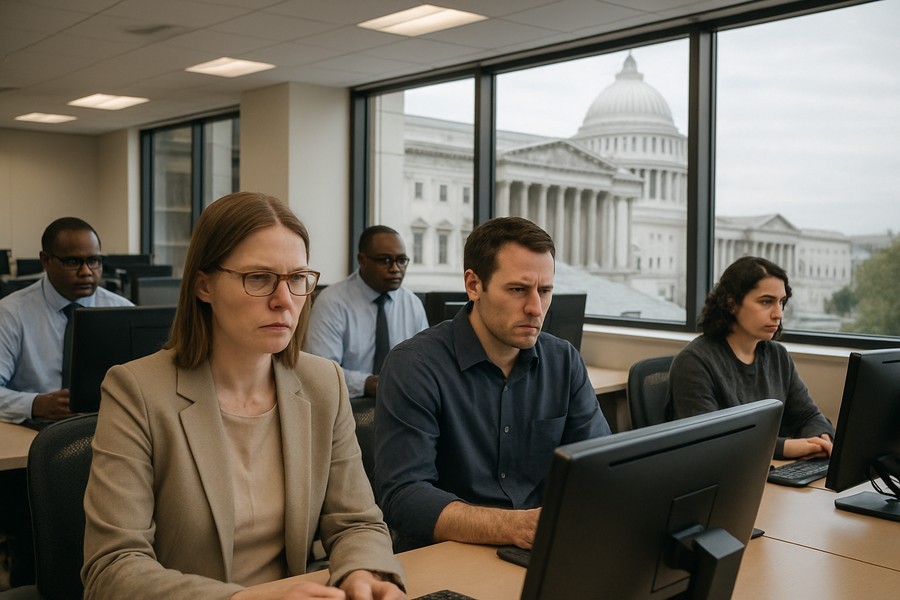
Pay Raise for Civilian Federal Employees Not Included in Recent Budget Proposal
It appears that civilian federal employees might not be getting a pay increase next year. The latest budget plan has been released, and it doesn't mention anything about a salary bump for this group. Confirmation of this came from a representative of the office that handles the country's budget.
Usually, the annual budget proposal includes a suggested pay raise for both civilian federal workers and military members. However, this year, only military personnel are expected to receive a pay increase, with suggested rates between 5-7% depending on rank. The budget proposal emphasizes the importance of rewarding military personnel for their service.
The Role of Congress
While the budget proposal outlines the government's priorities, the final decision on funding allocations is up to Congress. In previous years, lawmakers have made changes to the suggested pay increases for federal employees.
Last year, civilian federal employees saw a modest 1% pay increase, the smallest since 2021. Federal law enforcement personnel, however, received a more substantial 3.8% raise, matching the military's pay increase for the same year.
Democratic Response
Democrats have been vocal about their desire for a more significant pay increase for federal employees in the upcoming year. They have proposed a bill that would provide a 4.1% pay increase for civilian federal employees. Critics argue that the current administration has consistently undermined federal employees with harmful policies and inadequate pay raises. The lack of a proposed pay increase in the latest budget only continues this trend, with significant cuts proposed for key federal agencies and no significant investments to retain the workforce.
Prior Budgets and Pay Increases
Last year's budget proposal also didn't mention a pay increase for federal employees. It was later in the year when an alternative pay plan was proposed, suggesting a 1% increase for most civilian employees and a 3.8% raise for federal law enforcement personnel. This is often the approach taken to avoid larger automatic increases under existing legislation.
Focus on Defense
The administration's budget priorities seem to favor defense spending over civilian agencies. The proposed budget asks for a whopping $1.5 trillion in defense spending, a 42% increase from the previous year. This is the largest defense budget request in decades.
Conversely, the budget proposes a $73 billion cut in non-defense spending, which translates to a 10% decrease from the current spending levels for civilian agencies. The proposal suggests transferring some responsibilities of civilian agencies to state and local governments.
Reducing the Federal Workforce
The administration has been working hard to reduce the size of the federal workforce. The newly released budget supports this goal by eliminating non-essential jobs, removing underperformers, and limiting hiring to essential roles. This strategy has already resulted in a significant reduction of federal workers, with around 300,000 leaving government service last year.
While it's unclear how much further the administration plans to reduce the federal workforce, the budget estimates indicate that while some agencies may see staffing increases, most are expected to remain below previous staffing levels.
A Focus on Younger Workers
There is a shift in the demographics of federal employees, with a decreasing number of workers under the age of 30. The administration has shown interest in attracting early-career workers to government roles. Several initiatives are aimed at encouraging younger individuals to consider public service, at least temporarily.
Current-Year Spending Disputes
The release of the budget comes amidst ongoing disagreements over current-year spending and funding for homeland security. In response to a record-long partial government shutdown, an executive order was recently signed to ensure that all homeland security employees receive their paychecks.