
Why the World May Stop Adding Extra Seconds to Clocks
For centuries, people have measured time by watching the sky. When the sun reaches its highest point over the main north-south line at the historic observatory in Greenwich, England, it marks noon by an old system known as Greenwich Mean Time. This idea helped shape the world’s time zones.
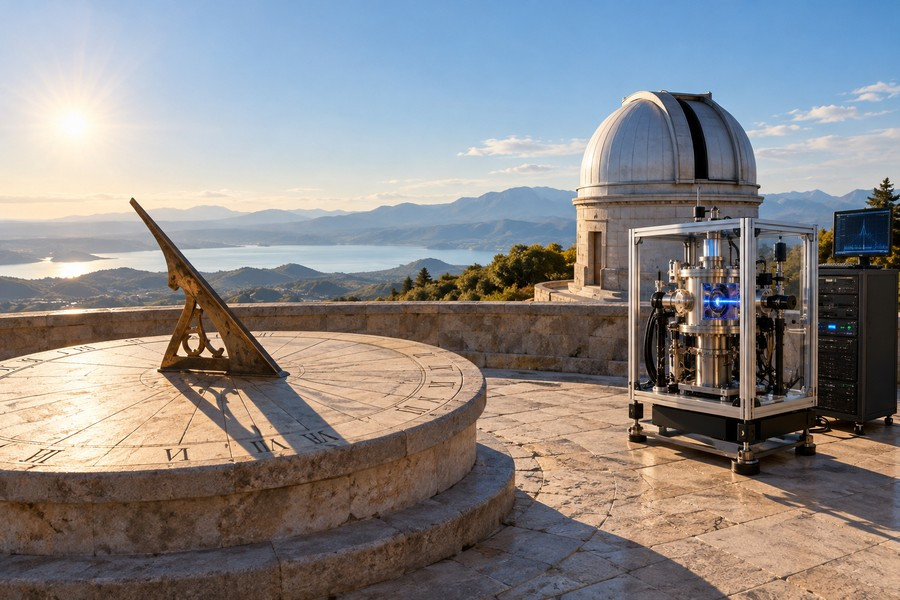
Long before modern clocks, people used simple sundials. A stick placed in the ground created a moving shadow as the sun crossed the sky. That close link between the Earth’s movement and human timekeeping may soon become less important.
A Tiny Change With Big Effects
World measurement officials are considering a plan to stop adding what is called a leap second to official clocks. The change would separate the world’s main time standard from the Earth’s uneven rotation.
A leap second is an extra second added to clocks when needed. It helps keep two time systems close together:
- Astronomical time, which is based on the Earth’s rotation and the position of the sun and stars.
- Atomic time, which is measured by highly accurate clocks that track the steady movement of atoms.
The Earth does not spin at exactly the same speed all the time. Its rotation changes because of the moon’s pull, movement deep inside the planet, and shifts in oceans, ice, and water. Melting ice near the poles can also affect the planet’s movement.
Because of these changes, the Earth is not a perfectly reliable clock. Atomic clocks are much steadier. Leap seconds have been used to keep the two systems from moving too far apart.
Why Leap Seconds Cause Trouble
Most people never notice when a leap second is added. The change is much smaller than a leap year, which adds an extra day to the calendar. However, computer systems can struggle with a clock that suddenly shows an unusual extra second.
Leap seconds are added at irregular times, and computer operators receive only limited notice. This can create problems for systems that depend on exact timing, including:
- Data centers and computer servers
- High-speed financial trading systems
- Telecommunications networks
- Power grids
- Online booking systems
- Other critical digital services
Past leap seconds have caused major technology failures. Online discussion and professional networking services went down after one adjustment, while an airline booking system also stopped working properly. A later leap second caused short outages and delays for customers using cloud-based computer services.
Large technology companies have argued that leap seconds create too much risk for modern systems. They say removing them would make digital timekeeping easier to manage.
A Vote on the Future of Time
An international group responsible for measurement standards is expected to vote on whether to remove leap seconds. The group includes 69 member countries. If approved, the change would begin in the late 2020s.
The idea has been discussed for more than two decades. In an earlier vote, member countries supported creating a plan to phase out leap seconds by the middle of the next decade.
When atomic clocks were first introduced, keeping them close to astronomical time was important. Navigation systems depended more heavily on the position of stars and other objects in the sky. Modern satellite navigation has changed that situation. Most systems now rely on highly accurate electronic timing instead.
Some countries have opposed ending leap seconds. One concern comes from a satellite navigation system that still uses them, while other major navigation systems do not. Another country once objected because Greenwich played such an important role in the history of global timekeeping. That opposition has since changed.
The Risk of a Negative Leap Second
The debate has become more urgent because the world may soon face a new problem: a negative leap second. Instead of adding one second, clocks would need to remove one.
Over very long periods, the Earth’s rotation is slowing. In the shorter term, however, the planet has recently shown signs of spinning faster. If that trend continues, the difference between atomic time and astronomical time could require a second to be deleted.
A negative leap second has never been used. Digital systems are not well prepared for it, and removing a second could cause serious errors in time-stamped records, computer programs, communications systems, and other technology.
Preparing for such a change could require a major financial effort. The cost may be similar to the worldwide computer work done to avoid problems linked to the change from the 1900s to the 2000s.
Not Everyone Wants the Change
Some scientists say the problems caused by leap seconds are being overstated. They point out that the current system already works and keeps official time connected to the Earth’s rotation.
Ending leap seconds would require companies and governments to inspect their software, update their systems, and possibly redesign important equipment. Supporters of the current system also say there is value in keeping time connected to sunrise, sunset, and the natural movement of the planet.
Human life still follows the daily cycle of daylight and darkness. Sleep patterns, work schedules, and many other parts of life depend on the sun’s rhythm, even when modern technology makes that connection less visible.
A Possible “Leap Hour”
The proposed solution would allow atomic time to slowly move away from astronomical time. No more leap seconds would be added to clocks.
There would still be a limit. The difference between the two systems could not grow beyond 3,600 seconds, or one hour. Reaching that gap would likely take more than 3,000 years.
Future generations would then have to decide how to handle the growing difference. They might eventually need to make a much larger adjustment, sometimes described as a “leap hour.”
For most people, ending leap seconds would probably happen quietly in the background. Daily routines would remain tied to daylight, while computers and official clocks would follow a steadier atomic system.