
Canada and China Unveil Trade Agreement, Reducing Tariffs
The leaders of Canada and China have unveiled plans to reduce tariffs, indicating a renewed phase of their countries' relationship following a significant meeting in Beijing.
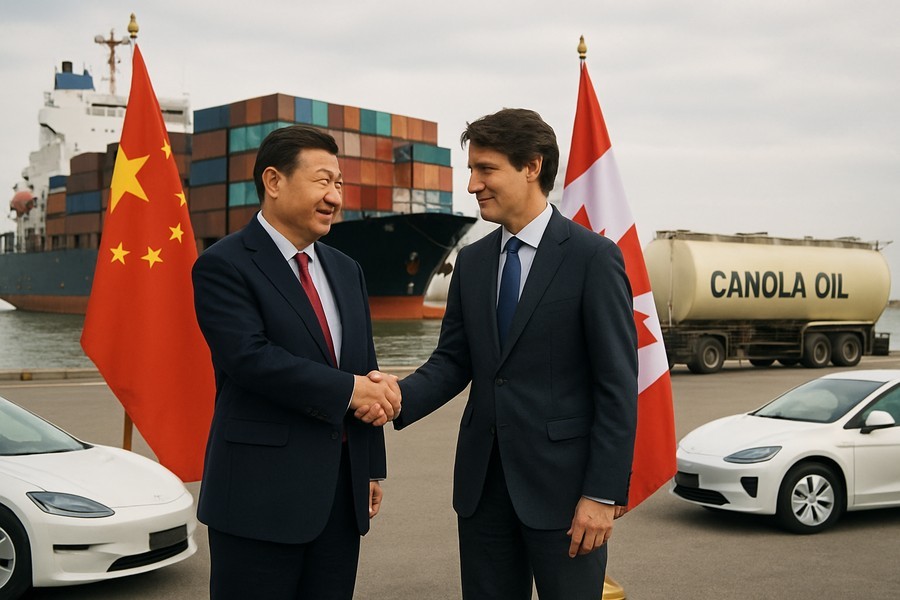
China is set to decrease charges on Canadian canola oil from 85% to a mere 15%. In return, Canada will apply a 6.1% tariff on Chinese electric vehicles, which is a favorable rate compared to other nations.
Trade Breakthrough
This agreement is a significant step forward following years of tension and retaliatory tariffs between the two nations. The Chinese leader celebrated this "new direction" in their relationship. The Canadian leader also benefits from this deal, marking his first visit to China in almost ten years.
He has been aiming to broaden Canada's trade relationships beyond the US, its largest trading partner, due to the instability brought on by fluctuating tariffs.
Implications for the Future
This deal could potentially lead to an increase in Chinese investments in Canada. The leader of Canada hinted that this could be a result of the US’s inconsistent tariff policy, which has now pushed one of its key allies closer to its biggest competitor.
He mentioned that Canada's relationship with China has become more "stable" recently, and that his dialogues with Beijing were "practical and respectful".
Addressing Differences
Nevertheless, he acknowledged that Canada and China do not see eye-to-eye on all matters. He highlighted Canada's "non-negotiable points," including human rights, concerns about election interference, and the need for "boundaries".
"We must accept the world as it is, not as we would like it to be," he commented when asked about China's human rights record.
Setting an Example
Many believe this visit could serve as a model for other nations worldwide who are also grappling with the impact of the US's tariffs. On the other hand, the Chinese leader has been striving to portray China as a stable global partner, advocating for more practical ties or, in Beijing's words, a "mutual benefit" for all.
His efforts appear to be paying off, as leaders from South Korea and Ireland have recently paid visits to Beijing, with visits from the UK prime minister and the German Chancellor anticipated soon.
Changing World Dynamics
According to the Canadian leader, the "world has changed dramatically," and how Canada positions itself "will shape our future for decades to come." He further added that this Canada-China partnership paves the way for a "new world order" following their meeting in Beijing.
Trade Tensions and Tariffs
Tariffs have been a significant bone of contention between the two countries. In the past, Canada imposed a 100% tariff on Chinese electric vehicles, which was similar to US restrictions. In retaliation, Beijing imposed tariffs on over $2bn of Canadian farm and food products, leading to a 10% decrease in Chinese imports of Canadian goods.
Under the new deal, Canada will allow 49,000 Chinese electric vehicles into the Canadian market at the 6.1% tariff rate, addressing Canadian automakers' concerns about an influx of affordable Chinese EVs. Alongside providing relief for canola producers, tariffs on Canadian lobsters, crabs, and peas will also be reduced.
China is Canada's second-largest trading partner, although it trails far behind the US in terms of volume. Strengthening economic ties with China is increasingly critical for Canada. Upon his arrival in Beijing, the Canadian leader met with top executives from prominent Chinese businesses, including an electric vehicle battery manufacturer and an energy company.
The two countries signed several agreements on energy and trade cooperation, marking a "reset of a relationship" that may be "modest in ambition" but "much more realistic about what we can reasonably obtain", according to a former Canadian diplomat and vice-president at the Canadian Global Affairs Institute.
