
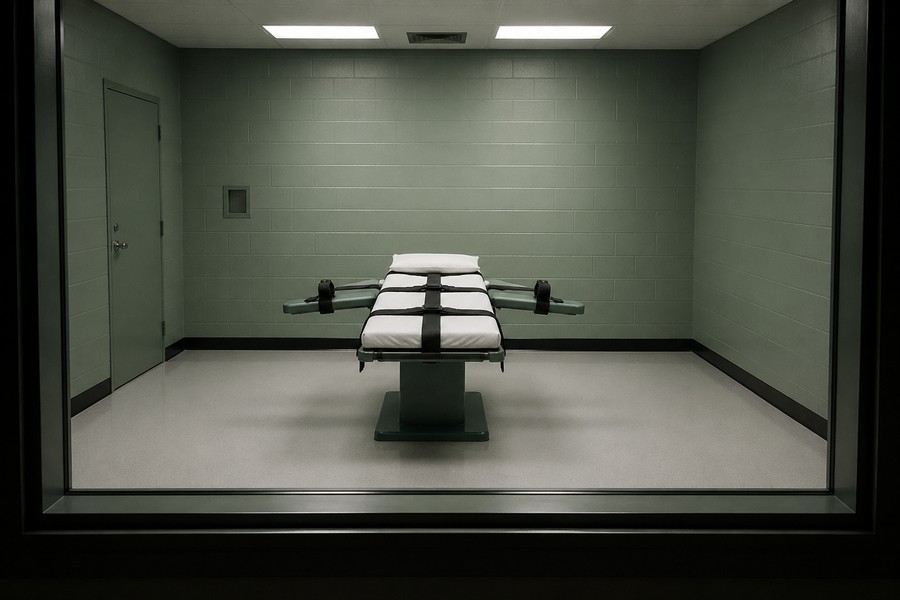
Three States Schedule Capital Punishment on the Same Day
In a highly unusual alignment within the American justice system, three different states are preparing to carry out death sentences on the exact same day. Inmates in Tennessee, Alabama, and Oklahoma are all scheduled to die by lethal injection, marking a rare occurrence of multiple executions happening simultaneously across the country.
While individual states frequently manage their own capital punishment schedules, it is very uncommon for multiple jurisdictions to conduct executions on the same day. The last time three prisoners were executed on a single day occurred over a decade ago, involving cases in Louisiana, Ohio, and Texas. Another instance of three scheduled executions was set to happen a few years after that, but only one of those was ultimately carried out due to legal interventions and technical difficulties in the other states. Some states have maintained a much higher frequency of capital punishment, with one southern state carrying out dozens of executions over a recent multi-year period.
Tennessee Proceeding Involves Decades-Old Case and Medical Challenges
In Tennessee, authorities are moving forward with the execution of Anthony Darrell Hines. Hines was convicted of the stabbing death of Catherine Jean Jenkins, a 54-year-old motel maid who was working in Kingston Springs. The crime occurred decades ago, and Hines was sentenced to death shortly afterward. Although he later won an appeal that granted him a new sentencing hearing, the second proceeding resulted in the same death sentence.
Now 66 years old, Hines has raised significant concerns regarding the state's ability to carry out the lethal injection safely. His defense team filed appeals highlighting his fragile physical state. Having survived two strokes, Hines suffers from muscle wasting and has very thin veins, which his lawyers argue could make inserting an intravenous line extremely difficult and painful. These arguments point to a recent execution attempt in Tennessee that had to be abandoned. In that previous instance, medical staff spent more than an hour trying to insert a backup line into an inmate's arm, hand, foot, and collarbone area. The state's governor eventually halted that procedure and granted a one-year reprieve.
Despite these arguments, the state's highest court rejected Hines' appeals, indicating that the previous failed attempt was an isolated event rather than proof of systemic issues. The state has not publicly confirmed whether the same medical personnel will oversee Hines' execution.
Alabama Inmate Declines Appeals for Child Murder Conviction
In Alabama, Jeremy Williams is scheduled to be executed after making the decision to drop all of his remaining legal appeals and requesting that his sentence be carried out. The 42-year-old pleaded guilty to the abuse and murder of a five-year-old girl, Kamarie Holland, who lived in Georgia.
The details of the case presented by prosecutors are highly severe. Williams paid the victim's mother $2,500 to allow him to abuse the child. He recorded the abuse on video and kept her body after taking her life. Local prosecutors described the actions as an extreme level of cruelty. The victim's father remembered his young daughter as a joyful child who loved wearing princess costumes and bringing laughter to those around her.
The child's mother is currently serving a 20-year prison sentence after pleading guilty to charges related to human trafficking. If the execution goes forward, it will be the first in Alabama for the year. A previous execution attempt in the state involving a different method was halted after a federal judge ruled the proposed procedure unconstitutional. Williams was also previously named as a suspect in the death of his infant daughter in Alaska, though charges in that matter were not initiated until many years later.
Oklahoma Board Rejects Clemency for Murder Conviction
The third execution is scheduled to take place in Oklahoma, where Carlos Cuesta-Rodriguez is set to die by lethal injection at a state penitentiary in McAlester. The 70-year-old was convicted of the shooting death of his girlfriend, Olimpia Fisher, at their home in Oklahoma City.
During the legal proceedings, evidence showed that Fisher was preparing to leave the relationship when Cuesta-Rodriguez shot her in one eye. He then waited approximately eight minutes while she screamed for help before firing a second, fatal shot into her other eye. State legal officials argued that he intentionally made her suffer to exert control over her life.
The state's pardon and parole board voted 3-1 against recommending mercy. While Cuesta-Rodriguez did not personally request clemency and expressed regret for his actions, his attorneys petitioned the board to reduce his sentence to life in prison. They argued that he suffered from severe mental health issues, including post-traumatic stress disorder, major depression, and brain damage, which they connected to a difficult childhood in Cuba. However, state officials declined to intervene, moving the execution forward.
Overview of the Scheduled Executions
The three cases represent very different legal histories and crimes, yet they have converged on the same calendar date due to the timing of state court decisions:
- Tennessee: Anthony Darrell Hines, convicted of a motel maid's murder decades ago, whose appeals focused on potential medical complications with intravenous lines.
- Alabama: Jeremy Williams, who pleaded guilty to the abuse and murder of a five-year-old girl and voluntarily waived his right to further legal appeals.
- Oklahoma: Carlos Cuesta-Rodriguez, convicted of the shooting death of his girlfriend, whose plea for a reduced sentence was rejected by state authorities.