
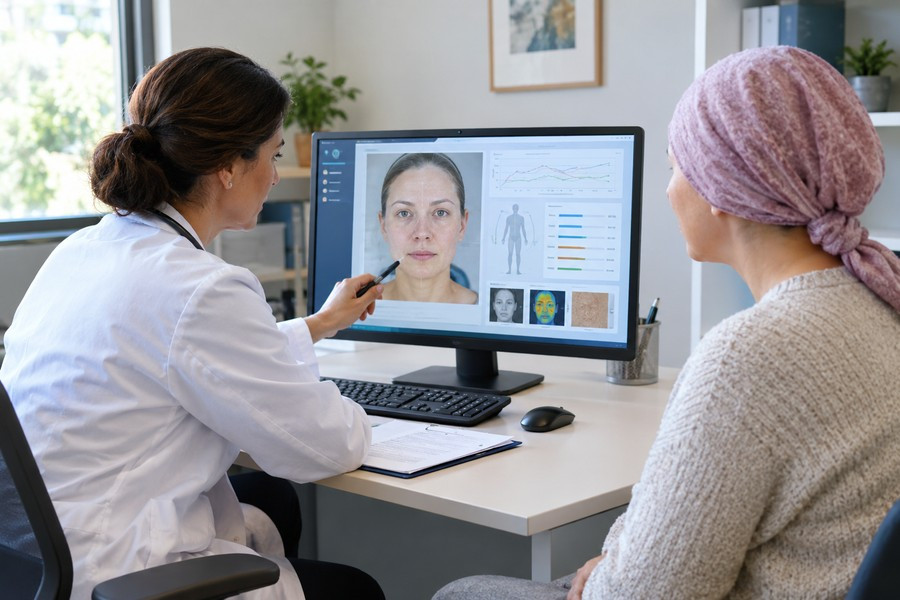
A Face Photo May Offer Clues About Cancer Patients’ Health
A single face photo may contain signs linked to a cancer patient’s health and chances of survival. Researchers have built artificial intelligence tools that study facial features to estimate a person’s biological age and predict their risk of dying within a short period.
Biological age is different from the number of years a person has lived. It is an estimate of how much the body has aged. The researchers say their tools could someday give doctors another piece of information when they assess a patient or consider treatment options. The technology is not meant to replace medical exams or a doctor’s judgment.
Two Tools Look At Different Facial Features
The team first trained a model using more than 40 million face images from people of many ages and ethnic backgrounds. They then built two tools for different tasks. One estimates biological age from a photo. The other estimates survival risk for cancer patients by combining facial details with other health information.
The age tool focuses on areas such as the temples, forehead, skin above the eyes, and the lines running from the nose to the corners of the mouth. The survival tool looks more closely at the bridge of the nose and the area beneath the eyes.
The researchers were struck by how these features echoed descriptions written by an ancient Greek doctor. He described a sharp nose, sunken eyes, and hollow temples as possible signs of severe illness and a greater risk of death. The AI tools were trained on face images and information about age and death, not on historical writing.
What The Patient Results Showed
In one test, the survival tool placed 122 cancer patients in its highest-risk group. More than half of them, or 52.5%, died within 90 days of the assessment. In the lowest-risk group, only about 2% of 975 patients died within that same period.
The age tool also found differences between groups. Among 1,060 patients whose estimated biological age was more than 20 years above their actual age, 21% died within 90 days. In comparison, about 6% of 4,195 patients whose estimated biological age was at least 10 years below their actual age died during that period.
The researchers also tested whether changes to a person’s appearance affected the tools. Cosmetic surgery, injected treatments, and makeup did not appear to change how well the models performed.
More Testing Is Needed
The findings point to a link between facial appearance and health outcomes in the cancer patients studied. But a link does not prove that the face itself explains why a patient is more likely to die. The age tool estimates age from appearance; it does not directly measure how the body is aging inside.
Outside experts said the results were promising, but they stressed that the tools need more testing before doctors could use them. The study did not show whether the predictions provide useful information beyond what a doctor can learn by examining a patient’s overall health and physical strength.
Researchers also need to find out whether the tools work equally well for people with different skin colors, ages, and facial features. Testing across more patient groups and hospitals would help show whether the results can be trusted in a wider range of settings.
A Possible Extra Clue, Not A Diagnosis
If future studies confirm the results, facial analysis could help flag patients who may need a closer medical review. Early signs of faster aging or higher risk might lead to further tests. For now, the tools should be viewed as an early research finding, not as a way to diagnose illness or decide treatment on their own.
The research focused on people with cancer. It remains unknown whether similar tools could provide meaningful information about the health or longevity of people who do not have cancer. More research is needed to answer that question and to show whether facial analysis can improve care in real medical settings.