
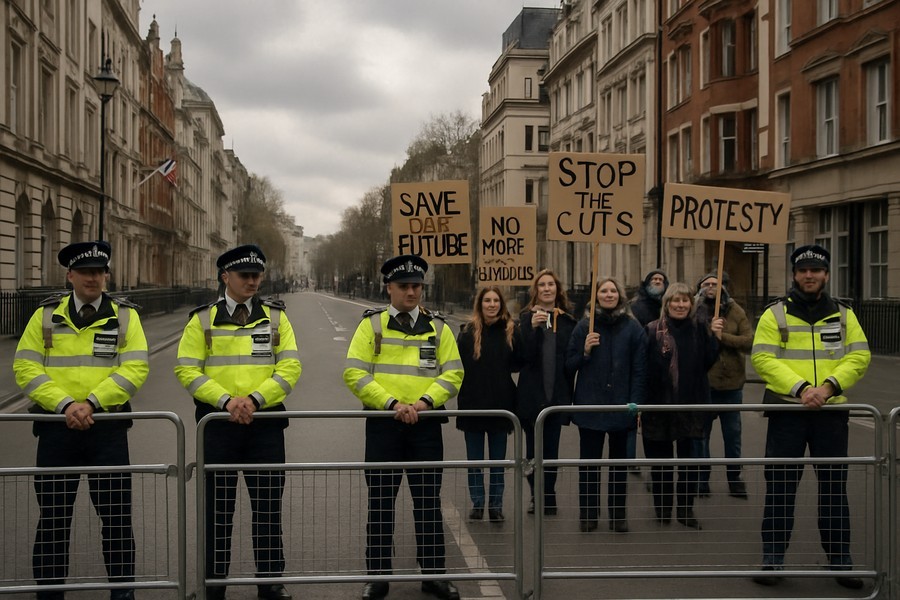
Government Approves Police Request to Prohibit Controversial March
In a move aimed at preventing substantial public unrest due to the ongoing unrest in the Middle East, an imminent march in London, known as the Al Quds Day march, has been halted. This decision came about after the police expressed concerns about the potential for disorder and conflict.
The police voiced worries over the large numbers of marchers and those planning to counter-protest. They also indicated that the march was largely organized by groups sympathetic to Iranian political leadership.
Organizers Insist on Peaceful Intentions
The group behind the annual march, the Islamic Human Rights Commission, insists that their intentions are peaceful and pro-Palestinian. In light of the ban, they plan to hold a stationary demonstration instead. This is the first time a march has been prohibited since 2012, a decision the police did not take lightly.
Representatives from the Islamic Human Rights Commission expressed disappointment over the ban, claiming it's a setback for freedom of speech. The Home Secretary responded to this, stating that strict conditions will be enforced if a stationary demonstration proceeds. She stressed that any attempts at spreading hate and division will be met with the full force of the law, rather than peaceful protest.
Details of the Ban
The police public order lead explained that the ban covers the Al Quds march as well as any associated counter-protests. The ban commenced in the afternoon of Wednesday and will last for a month. The march is particularly contentious as it originates from Iran and is organized by a group supportive of the Iranian government.
Despite not having banned a march since 2012, the police have successfully managed numerous protests, including several major pro-Palestinian demonstrations. However, the unique risks and challenges posed by this march warranted a ban. The potential for high numbers of both protesters and counter-protesters, along with the extreme tensions between different factions, were key considerations. The volatile situation in the Middle East, including attacks on British allies and military bases by the Iranian regime, also factored into the decision.
Previous Marches Resulted in Arrests
In the past, the Al Quds marches have resulted in arrests for supporting terrorist organizations and committing hate crimes. However, the decision to ban this year's march is based solely on a risk assessment of this specific protest and counter-protests. The police stressed that their role is not to police taste or decency or favor one political view over another, but to do everything within their power to minimize violence and disorder.
The Seriousness of a March Ban
Banning a march is a significant measure that can only be taken if the police deem it likely to cause serious public disorder, and if placing restrictions on it wouldn't prevent such disorder. This decision requires the approval of the Home Secretary. Neither the police nor the Home Secretary have the power to ban static demonstrations, although they can impose conditions.
A former Chief Superintendent of the police, who now sits on a board scrutinizing the force, called the ban a very serious decision, likely based on police intelligence. He insisted on trusting the police's judgement in this matter.
The Chief Secretary to the Prime Minister also commented on the decision, emphasizing the government's care in making such interventions. He stressed the importance of freedom of speech, as long as protests are legal and peaceful.
About the Al-Quds March
Al-Quds Day, named after the Arabic term for Jerusalem, is typically observed on the last Friday of Ramadan. It was first held shortly after the 1979 Iranian Revolution, with marches taking place globally, the largest of which is held in Iran. The Islamic Human Rights Commission, the march's organizers, describe it as an international demonstration in support of Palestinians and all oppressed people worldwide.
Calls to ban the march increased following a Hamas-led attack on Israel. However, the decision to ban this year's march has been met with resistance from some quarters, who view it as an infringement on freedom of expression and assembly. This annual demonstration has taken place peacefully for the last 40 years, according to the organizers.
Despite the ban, one arrest has already been made in relation to an alleged offense under the Public Order Act. During last year's march, a total of ten people were arrested.

