
US-Born Pope Challenges Current Administration's Policies
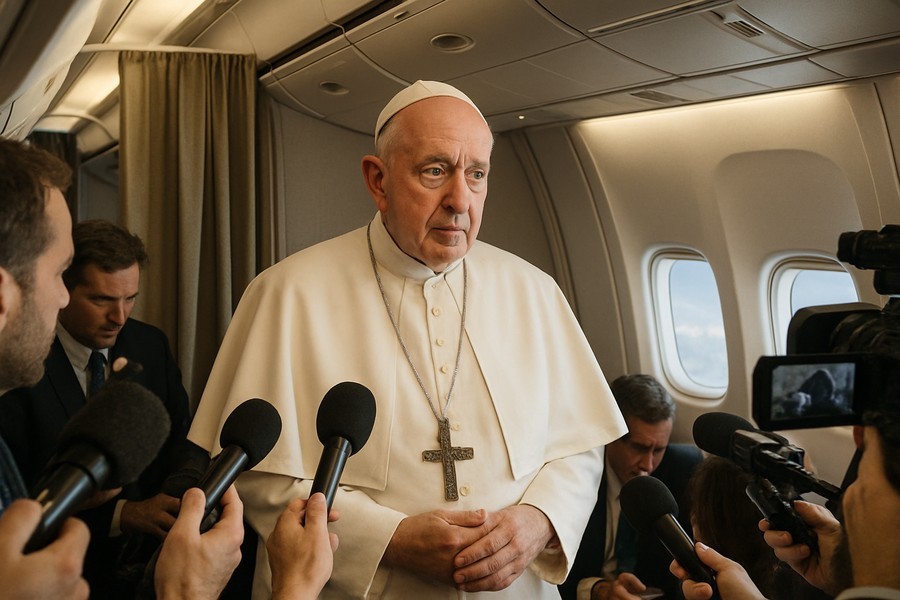
On his recent visit to Africa, the first American-born Pope, whose papal name is Leo, made a significant decision. He could either stay silent or confront the online tirade launched against him by the current President. He boldly chose to address the situation.
Direct Confrontation
While on his flight to Algeria, Pope Leo decided to confront the administration head-on—an unusual move for a Pope. He expressed that he was not intimidated by the current administration and would not shy away from expressing God's teachings boldly.
He stressed that the Gospel's message should not be distorted, a reference to the administration's policies. He also highlighted the loss of innocent lives and his belief in a better way forward.
This confrontation has positioned Pope Leo as a prominent international figure opposing the President. This marks a unique conflict between a US-born Pope and a US President who has repeatedly launched attacks against him.
A Man of Peace
Despite this conflict, Pope Leo, known for his gentle demeanor, did not initiate this dispute. He has devoted his life to the Order of St. Augustine, which emphasizes unity, community, and vows of poverty, chastity, and obedience.
Since assuming his role, Pope Leo has prioritized listening and implementing gradual changes rather than making dramatic announcements or orders. He has also underscored the importance of international institutions like the United Nations and the rule of law, particularly at a time when the President has suggested he is not subject to these norms.
Speaking Out
Pope Leo, though more reserved than his predecessor Pope Francis, has shown his strength and determination due to the US military action in Iran. He has chosen to call out the President directly, an action rarely taken by popes. His statement that "God does not listen to the prayers of those who wage war" seemed to reference the US Defense Secretary's eagerness to view the Middle East conflict in religious terms.
Popes have historically opposed war and advocated for peace. Pope John Paul II, for example, was a strong critic of the 2003 US-led invasion of Iraq. However, having an American Pope changes the dynamics. Pope Leo, being a native English speaker – the first since the 12th century – can communicate directly with the American audience and the administration.
Message of Peace in Africa
During his visit to Africa, Pope Leo continued to advocate for peace. In a peace meeting in Bamenda, Cameroon, he delivered a globally impactful speech. He decried those who exploit religion for personal, military, or political gains, dragging the sacred into the realm of darkness.
Pope Leo has been critical of the administration even before the recent fallout. The President's use of an AI image of himself as the Pope created controversy, reminding people of a similar incident where he depicted himself as a Jesus-like figure shortly after criticizing the Pope. It is notable that despite Pope Leo being the first American Pope in the Catholic Church's 2,000-year history, there has been no direct contact between him and the President.
Just War Theory
The Vice-President, JD Vance, a Catholic convert, attended Pope Leo's inauguration, offering him an invitation to visit the US. He recently joined the ongoing dispute, cautioning the Pope about discussing theology and advising him to consider the "Just War" theory when discussing the Iran conflict.
This theory is used often by military analysts to justify armed conflicts ethically and morally. Interestingly, Saint Augustine of Hippo, one of the primary architects of the theory, is the spiritual father of the religious order to which Pope Leo belongs.
Empires Rise and Fall
Despite these confrontations, the Vatican is likely to take the Vice President's criticisms seriously, given his recent conversion to Catholicism. He has previously used a teaching of St. Augustine to justify the administration's immigration policies, which Pope Leo has criticized.
Pope Leo assumed his position soon after the President's re-election. Before this, the idea of an American Pope was deemed unlikely due to the potential alliance of the Church with a global superpower. However, the President's re-election changed the cardinals' perspective, leading to the appointment of Robert Prevost, known for his extensive experience in Latin America.
Historically, the 1978 conclave elected Pope John Paul II, the first Polish and non-Italian Pope in 400 years, during the height of the Cold War. His role was crucial in the fall of Communism in Eastern Europe. Similarly, the current situation draws parallels, reminding us that empires rise and fall.