
New Solar Blanket Brings Space Station Upgrade Near Completion
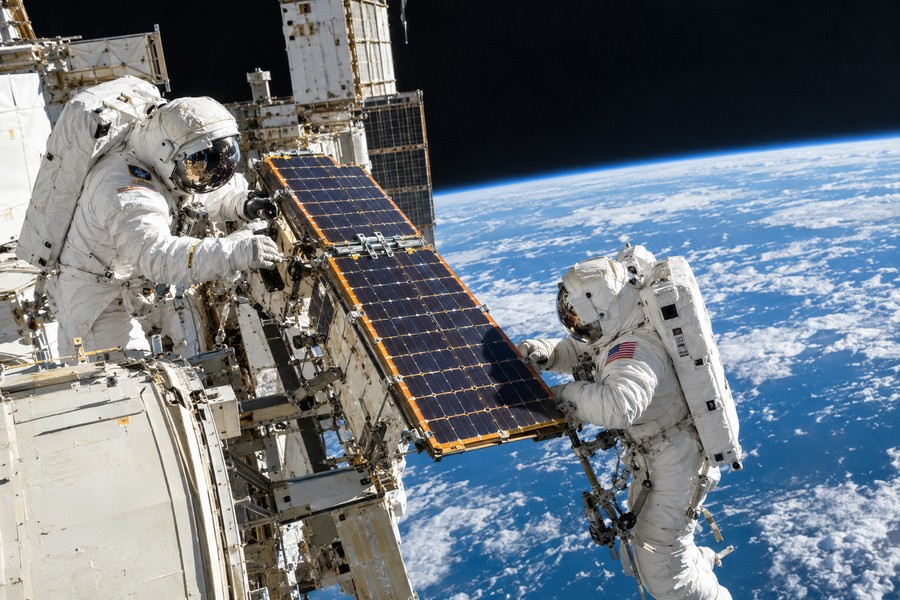
Two astronauts completed the first of two spacewalks to add the final pair of new solar blankets to the International Space Station. The work is part of a long-running effort to strengthen the station’s aging power system.
Anil Menon and Joshua Kutryk installed the seventh roll-out solar array on the left side of the station’s power truss. The team finished the main installation ahead of schedule, then prepared equipment for the last array, which is set to be added during another spacewalk.
A Careful Connection in the Dark
The astronauts waited until the station was passing through darkness before connecting the new array to the station’s electrical system. During that part of the orbit, the solar panels were not producing power, making it safer to connect the cables.
Menon and Kutryk attached four cables to link the new array with one of the station’s power channels. After the connections were complete, Menon removed a final restraint. The folded solar blanket then opened on its own, reaching its full length of about 60 feet in roughly 10 minutes.
The array adds about eight kilowatts to the station’s power capacity. Engineers monitoring the system saw the new equipment working as expected.
Built to Unfold Without Motors
Each new array, known as an IROSA, is designed to roll out without a motor. The blanket contains stored energy that pushes it open in a steady motion. Its movement is similar to a tape measure winding out, or a snap bracelet springing open.
Before deployment, the array was folded in half and weighed about 750 pounds. It was around 10 feet long in that folded shape, making it a large and heavy object for the astronauts to move outside the station.
Menon rode at the end of the station’s 58-foot robotic arm while carrying the folded array to its mounting point. Flight controllers on the ground operated the arm. They planned its movements so it would turn around the array’s center of mass, reducing the effort Menon had to use to hold it steady.
The astronauts placed the folded array on a support frame that had been assembled earlier. They then opened its two halves and fastened them together before connecting the electrical cables and releasing the blanket.
More Power for the Station
The station’s original solar arrays have lost some of their output as they have aged. The new panels are smaller, but their modern solar cells make them more efficient.
Before the first roll-out arrays were installed, the station’s original panels produced about 152 kilowatts of power. The six new arrays already in place raised that total to about 200 kilowatts. Once both remaining arrays are installed, the station is expected to have about 215 kilowatts available.
That power supports many parts of life and work on the station, including:
- Life-support equipment
- Scientific research
- Visiting spacecraft
- Other station systems and operations
The added power is intended to help keep the station running through its planned retirement and controlled departure from orbit.
One More Spacewalk to Go
The last array is stored on the far right end of the power truss. The station’s robotic arm cannot reach that location, so the astronauts will have to move the folded panel by passing it between them in stages until it reaches the waiting support frame.
Once it is in place, the crew plans to follow steps much like those used for the seventh array: secure the panel, join its folded sections, connect it to the power system, and let it unfold.
The final pair of arrays arrived at the station folded inside an unpressurized cargo area aboard a delivery spacecraft. The station’s robotic arm removed them and placed them on the left side of the power truss, where they waited for the spacewalks.
A Milestone for the Crew
The spacewalk lasted seven hours and 11 minutes. It was Menon’s fourth time working outside the station and Kutryk’s first. The pair also completed several extra tasks to prepare for the final installation.
Menon praised Kutryk’s work after they returned to the airlock. Kutryk said the solar upgrade helps the station continue its work and supports future space exploration, including the hope that crews will one day carry out spacewalks on the Moon.