
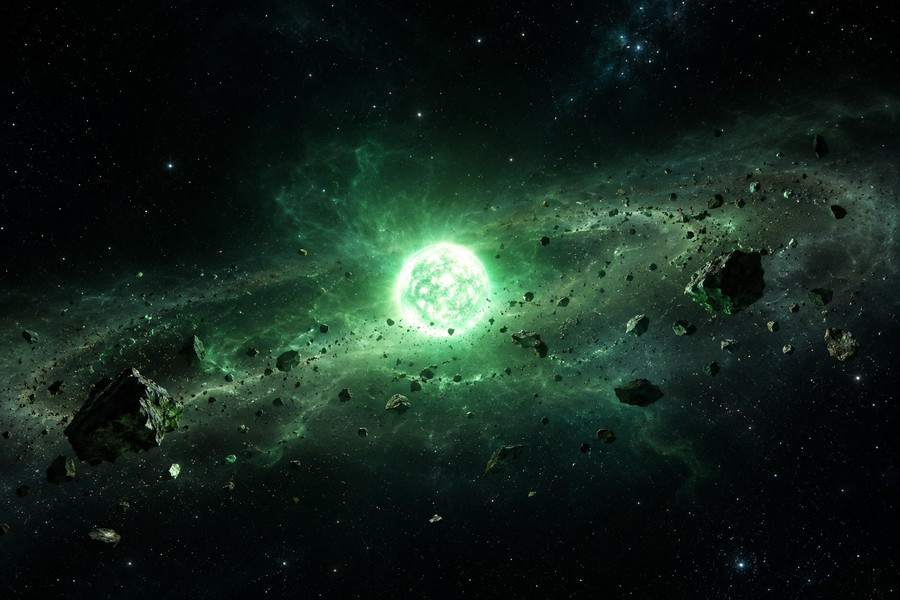
A Green White Dwarf Reveals the Strange Colors of Dead Stars
Stars are usually described by colors such as red, yellow, white, or blue. Those colors are mainly linked to a star’s surface temperature. Hotter stars tend to look blue or white, while cooler stars can appear orange or red.
But the universe may offer a much wider range of star colors. Astronomers have found evidence of a white dwarf that appears green to the human eye. The unusual color seems to come from rocky material that the dead star consumed from its former planetary system.
A Dead Star With a New Glow
A white dwarf is the leftover core of a star like the Sun. Near the end of its life, a star pushes away its outer layers. This creates a glowing cloud of gas and leaves behind a small, extremely dense core.
These objects are often called the “dead” or “zombie” stars of the universe. Even though they no longer produce energy through normal nuclear burning, they can remain extremely hot. Most white dwarfs look white or pale blue because much of their light comes from short, blue wavelengths.
The new findings show that temperature is not the only factor that controls a white dwarf’s appearance. The star’s atmosphere and the material mixed into it can also change the color seen by a distant observer.
Why White Dwarfs Can Change Color
The atmosphere of a cool white dwarf can be incredibly dense. In some cases, it can reach a density similar to water and be millions of times denser than the Sun’s outer atmosphere.
Under these unusual conditions, small amounts of elements such as carbon, calcium, and sodium behave differently than they would in a less crowded environment. These elements can absorb a wider range of light.
When certain colors are absorbed, the light that remains can give the white dwarf a very different appearance. Instead of looking white, orange, or blue, the star may appear pink, purple, yellow, cyan, or green.
Color Clues Hidden in Starlight
Astronomers cannot view these distant stars as if they were nearby objects. Instead, they study each star’s spectrum. A spectrum is created when starlight is separated into its different colors.
This pattern acts like a fingerprint. It can reveal which elements are present in the star’s atmosphere and how those elements affect the light. The spectrum can then be compared with models of how human eyes see color.
This method showed that white dwarfs can fall into several color groups based on the makeup of their atmospheres.
- Carbon-rich white dwarfs may appear pink or purple.
- White dwarfs that consume planetary debris may look yellow.
- Cool stars with hydrogen and helium can take on a cyan or pale blue shade.
- Stars containing certain amounts of sodium may appear green.
The White Dwarf That Looks Green
One star stood out because its color was close to chartreuse green. The star is known as WD J1330+6435 and is about 284 light-years from Earth. Its temperature is roughly 7,232 degrees Fahrenheit, or 4,000 degrees Celsius.
The star appears to have swallowed rocky material from planets or other objects that once traveled around it. That material contained calcium, lithium, and sodium.
After entering the white dwarf’s atmosphere, the elements changed the way the star’s light traveled through space. Sodium absorbed much of the orange light. With that part of the spectrum reduced, the remaining light created a ghostly green appearance.
From a planet orbiting such a star, the sky could contain a view unlike anything found in our solar system: a green sun-like object shining above the landscape.
A White Dwarf With a Deep Pink Color
Another unusual object, called WD J1011+2845, may be one of the reddest white dwarfs ever observed. This star is about 48 light-years away, making it relatively close to Earth.
Its unusual color may be linked to a deep convection zone. This moving layer carries carbon from the star’s interior toward its surface. The carbon changes the way light escapes, producing a strong salmon-pink shade.
The result is not a simple color caused only by the star’s temperature. Instead, the star’s internal movement and chemical makeup work together to reshape its light.
Rare Colors Across the Galaxy
Most white dwarfs still appear white when viewed as a group. A study of 151 nearby white dwarfs found only five with clearly unusual colors. Two appeared yellow, while three looked pink.
That small sample suggests that about one in every thirty white dwarfs across the universe may have an unusual color. This may seem rare, but the universe contains enormous numbers of white dwarfs. Even a small percentage could mean that many strange-looking stars are waiting to be found.
The average white dwarf remains white. However, the discovery of green, pink, purple, and yellow examples shows that dead stars can be far more colorful than expected. Their final appearance may preserve clues about their atmospheres, their inner chemistry, and the planets and rocky objects they consumed before reaching the end of their lives.