
Space Scientists Uncover an Unprecedented 'Cosmic Laser' Located Billions of Light-Years Away
Although it might seem like a concept right out of a 1950s science fiction book, 'cosmic lasers' do exist. In a surprising discovery, space scientists have found the brightest and most distant cosmic laser ever known.
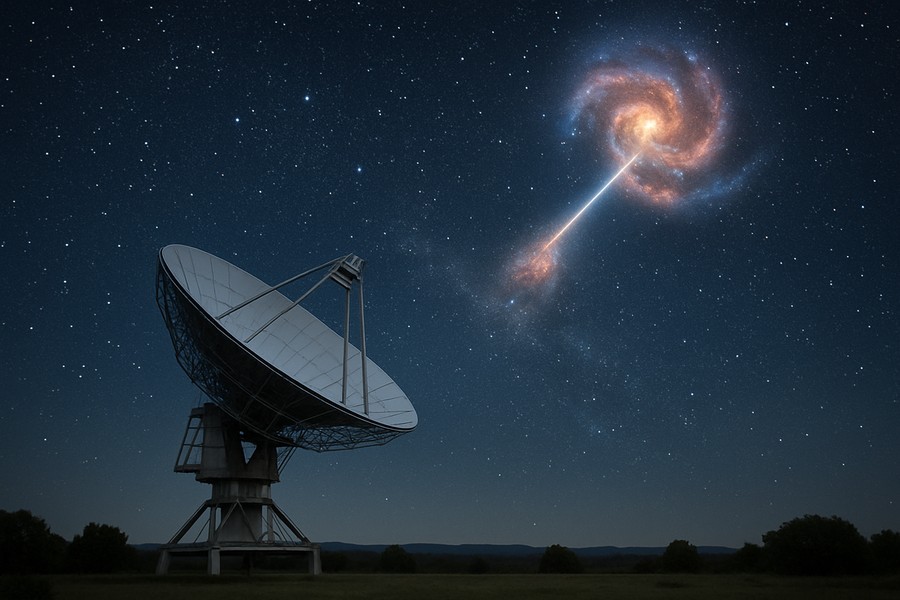
This colossal 'gigamaser', located about 8 billion light-years away, is the result of an enormous galactic smash-up that's causing compressed gas to activate hydroxyl molecules, which then emit powerful radio waves of the same wavelength.
Discovery of the 'Mammoth Microwave Laser'
This extraordinary 'mammoth microwave laser' was located with the help of a radio telescope situated in South Africa, which was further aided by a naturally occurring phenomenon known as gravitational lensing.
An enthusiastic scientist explains it in a simple way: "Imagine a laser radio signal from halfway across the universe. During its travel to Earth, the radio waves get further amplified by an unrelated galaxy that's perfectly aligned in the path. This galaxy acts as a lens, in the same way a water droplet on a window pane would, because its mass bends the local space-time."
He further adds, "So, it's like a radio laser passing through a cosmic telescope before being detected by our powerful radio telescope – a chance alignment of all these factors led us to this amazing discovery."
Understanding Lasers and Masers
Though the term 'laser' is commonly used today, it originally started as an acronym for 'light amplification by stimulated emission of radiation'. If you substitute the word light with microwave, you get a 'maser.'
Lasers and masers are created under very similar conditions. They require a large number of atoms or molecules in an excited state, along with photons of a specific energy moving around. When a photon hits an atom or molecule, it can cause the emission of another photon at the same energy level. These extra photons can then trigger the release of even more photons, thus amplifying the emission.
Phenomena that Cause Astrophysical Masers
Natural astrophysical masers can occur in systems such as comets heated by stars, planetary and stellar atmospheres, areas where stars are forming, and remnants of supernovae. More powerful emissions, termed megamasers, can be generated by more energetic events, like supermassive black holes or colliding galaxies.
The recently discovered example, known as HATLAS J142935.3–002836, goes beyond the megamaser status and falls into an even rarer category known as a gigamaser. These are billions of times brighter than your average maser.
Formation of a Gigamaser
To release such an enormous amount of energy, an incredible source of power is needed. In this particular case, it's two galaxies colliding and becoming one. The intense gravitational interactions compress gas and cause a surge in the formation of new stars. Photons from these young stars stimulate hydroxyl molecules that are present, amplifying their microwave emission and resulting in a gigamaser.
The light from this event has journeyed 7.82 billion light-years to reach the radio telescope, surpassing the previous distance record of 'just' 5 billion. It's also the brightest observed so far, primarily due to the magnification of the gravitational lens the light passes through on its way here.
This remarkable discovery underscores the potential of the radio telescope to explore high-redshift hydroxyl megamasers. This will enhance our understanding of these phenomena and offer valuable indicators for investigating different aspects of galaxy outflows and merging activity.