
Revolutionizing Electric Vehicle Charging: A Quick Fix from China
Imagine you're on a road trip with your electric vehicle (EV), and it's time to recharge. You exit the highway, locate a charger, plug in your EV... and then, you patiently wait. If luck is in your favor, it might only take 30 minutes. But sometimes, it takes even longer.
However, one innovative company in China has found a way to get you back on the road in just a few minutes. I recently had the chance to witness this process firsthand with an executive from an EV manufacturing company.
Experience the Magic of Battery Swapping
Not long ago, I found myself comfortably seated in a spacious SUV with the executive in the driver's seat. He started a conversation with the vehicle. "Hello, Nomi."
"I'm here," the car replied in an adorable, child-like voice. The executive asked the vehicle to start a battery swap, and the car took control.
We drove into a small structure resembling a one-car garage, but without front and back walls. The car guided the driver to release the brake, remove his hands from the steering wheel, and to keep the doors closed.
"If you feel nervous, I'm here," it reassured us. Then, the car automatically backed into the port.
"This is fully-automated battery swapping," said the executive.
Gone are the days of waiting for your EV to recharge. Your car is about to receive a fresh battery.
Overcoming the Challenge of Long Charging Times
The manufacturer realized that the lengthy charging time is one of the major factors preventing people globally - not just in China - from purchasing EVs. So, they introduced a solution: nearly 4,000 battery swap stations worldwide, with the majority located in China.
Despite the tough competition in the Chinese EV market where this company holds a 4% market share, its battery swapping feature stands out. This solution is particularly appealing in a country where many drivers live in apartments without charging ports.
The company's total battery swapping network has provided 100 million swaps since its inception eight years ago in Beijing. "This proves that battery swapping as a power replenishment method has already become very mainstream," the executive proudly stated.
Benefits of Battery Swapping
Not only has the company's innovative approach saved drivers over 83 million hours, but it also benefits the health of the batteries. Plus, you don't need to hassle with cords or fuel pumps. Vehicle owners have the option to buy or lease the battery in their car, and they can still charge the traditional way.
For those going on a road trip, the company has strategically placed over 1,000 swapping stations along China's highways.
The Battery Swapping Process
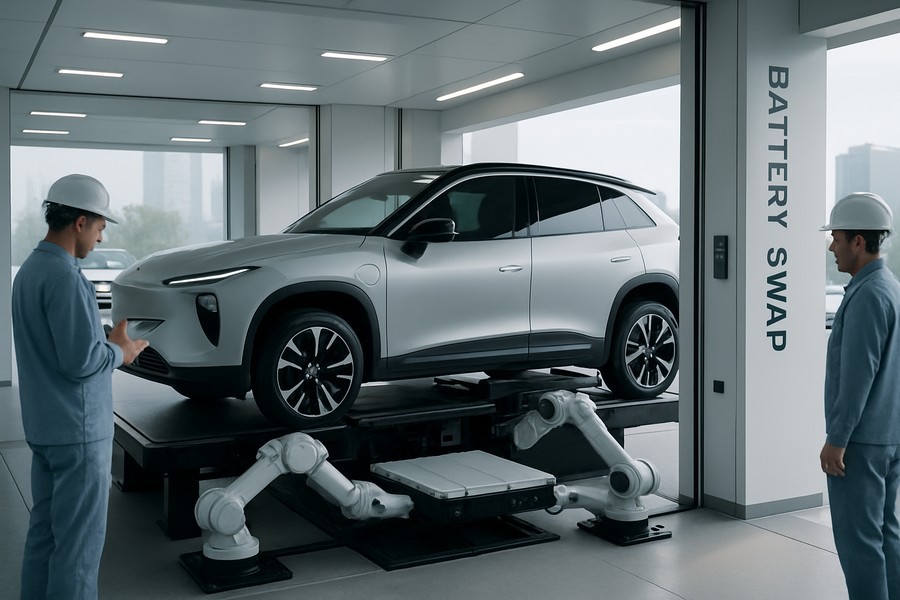
Back at the battery replacement station, the car positions itself in the port. It lifts a little, shakes a bit, and then, there's a rhythmic clanking sound followed by quiet. The metallic floor beneath the vehicle opens, and a machine ascends to the undercarriage.
The entire battery pack, weighing about 1,100 pounds - roughly the weight of a grand piano - is unbolted and sent away, underground. It is then moved to a room adjacent to the swap station where it's plugged in to recharge for future use.
Underneath the car, you can hear a sequence of clicks and clanks as a new battery gets lifted into place and securely bolted to the vehicle. The system performs some diagnostic checks. And that's it.
"OK, you can see. Green light," the executive says. "The battery swap is done."
A monitor at the swap station displays the duration of the entire process: Three minutes and eight seconds... about the same time it would take to fill up at a gas station.