
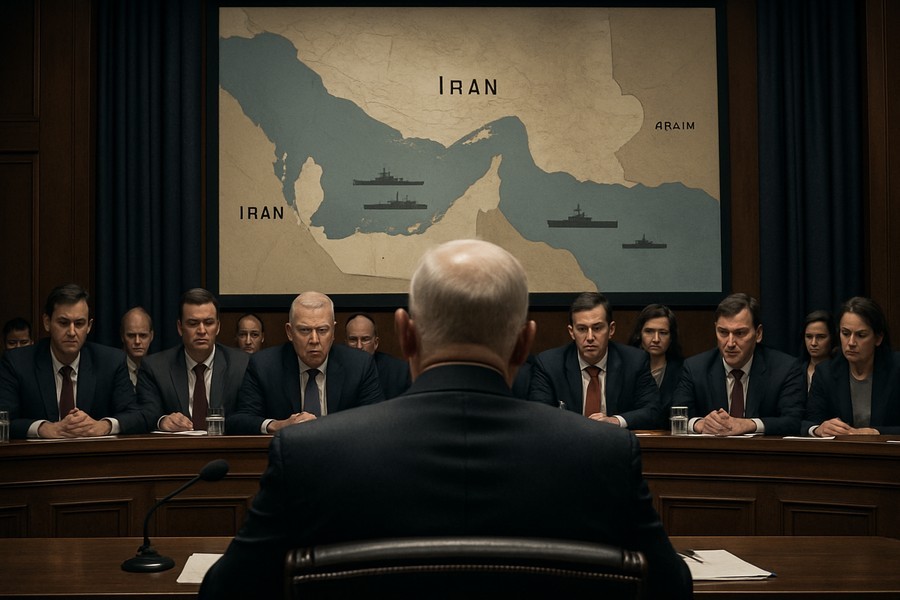
A Polarizing Congressional Hearing on the Iran War
Today marks the first time the Secretary of Defense has been grilled by Congress regarding the ongoing war with Iran, a conflict that has already cost a staggering $25 billion according to the Pentagon. While combat has momentarily ceased, the military blockade of the Strait of Hormuz persists.
It has also been revealed that one of the aircraft carriers stationed in the region is scheduled to return home soon, after spending an unprecedented 10 months out at sea.
Political Tensions Over the War
The Capitol Hill, the stage of the war today, witnessed a fierce debate over Iran. The Secretary of Defense argued that the military campaign has successfully destroyed over half of Iran's missiles and drones, a significant part of their defense industry, their entire conventional navy and air force, and now focuses on Iran's blockade of the Strait of Hormuz.
In response to criticism from Democratic congress members, the Secretary of Defense insisted that the threat of Iran is far less significant compared to what he labeled as Democratic defeatism. He argued, "The biggest challenge, the biggest adversary we face at this point are the reckless, feckless and defeatist words of congressional Democrats and some Republicans."
On the other hand, the Democratic members were the most vocal in their criticisms. One representative accused the President of landing America in another Middle Eastern war quagmire and trying desperately to rectify his own mistakes.
The Financial Cost of War
The Pentagon's Chief Financial Officer disclosed that the war has cost $25 billion so far. However, Democrats argue that this figure does not reflect the true cost of the war. They point to the increased cost of gas and food that Americans will bear due to the conflict as additional costs not included in the $25 billion figure.
Agreement Amidst Tension
Despite the heated exchanges, there was a moment of bipartisan agreement over concerns regarding the firing of several senior military and civilian leaders, including the Secretary of the Navy and the Chief of Staff of the Army.
Budget Request and China's Growing Advantage
The hearing was originally called to discuss the administration's record $1.45 trillion budget request. This budget, which represents a 40 percent increase, aims to replenish munitions used in Iran and fund new drones, missile defense, and increased boat construction.
The Chairman of the Joint Chiefs of Staff emphasized that this budget is a much-needed long-term investment as warfare is rapidly evolving. However, the budget is unlikely to be approved at its current amount.
The budget request comes in the wake of concerns over China's growing military advantage. It has been noted that China is investing heavily in military modernization and is spending a larger portion of their GDP on defense than the U.S.
The Situation in the Middle East
Meanwhile, in the Middle East, the fate of the war is being determined not by advanced technology, but by the threat of mines and drones. Iran has offered to open the Strait of Hormuz if the U.S. lifts its blockade and pauses discussions on Iranian nuclear limits. This offer was promptly rejected by the President who stated that there will be no deal unless Iran agrees to no nuclear weapons.
U.S. officials have decided to maintain the blockade and continue applying economic pressure in hopes that Iran will relax its demands. Until then, tankers remain stationary and diplomatic efforts are at a deadlock.