
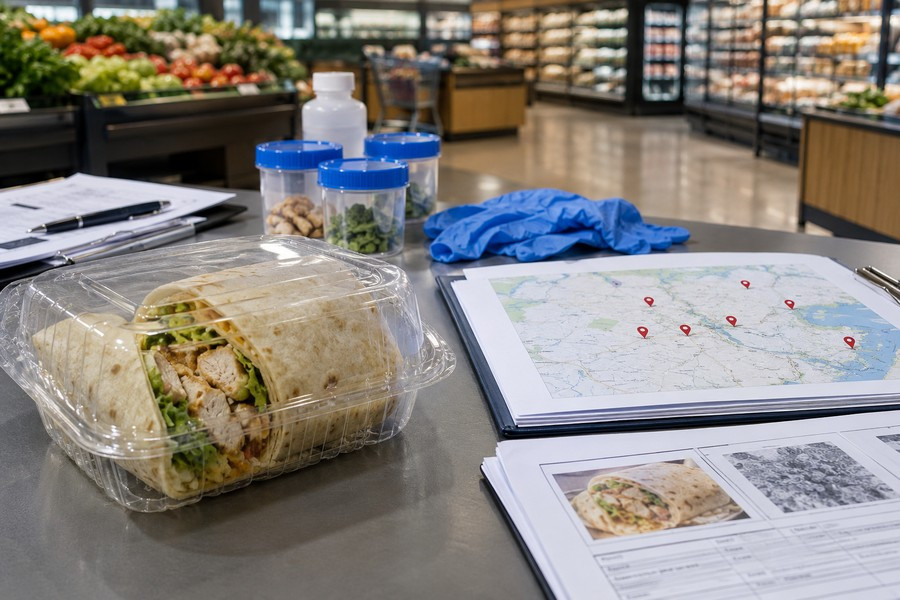
Chicken Wrap E. Coli Outbreak Grows as Key Details Remain Hidden
An investigation into an E. coli O157:H7 outbreak linked to a chicken wrap has reached 50 reported illnesses. The Food and Drug Administration and the U.S. Department of Agriculture’s Food Safety and Inspection Service are working together on the case.
The agencies have listed the food as a suspected multi-ingredient wrap made with chicken. However, the public still has not been told the name of the manufacturer, the product brand, the stores that sold it or the states where illnesses occurred. No public recall notice has been posted.
A Lawsuit Reveals the Suspected Product
A federal lawsuit has identified tarragon chicken salad wraps as the suspected food. The complaint involves a woman in North Carolina and another woman in Massachusetts. Both were hospitalized after eating the wraps, which they purchased in Myrtle Beach, South Carolina, and Allston, Massachusetts.
The lawsuit also says local health departments connected the illnesses to the outbreak. That means patients, doctors and public health workers may have learned more about the suspected food through a legal filing than through a public announcement from the agencies investigating the case.
The situation has raised questions about how much information should be shared during foodborne illness investigations. A product does not become less important to patients simply because it has been removed from store shelves.
The Illness Count Keeps Rising
The number of reported patients has increased by 12 since the last public count. Investigators are now looking at whether the chicken used in the wraps may have been added to other foods.
The FDA has started several parts of the investigation, including:
- Tracing the food through the supply chain
- Inspecting locations connected to the product
- Collecting and testing samples
- Checking whether the chicken was used in other foods
The agencies have not explained what locations are being inspected, what foods are being traced or what samples are being tested. They also have not released the patients’ ages or home states. The food safety service has not issued a separate public notice beyond directing people to the existing investigation information.
Public health investigators have also not released a separate outbreak notice with more details about the illnesses.
Why the Government Has Not Named a Company
A chicken wrap can fall under the authority of more than one agency. The chicken is regulated by the USDA food safety service, while ingredients such as lettuce, dressing and tortillas are generally regulated by the FDA.
That split can make it unclear which agency should identify the company involved. But both agencies have legal tools that can allow them to name businesses connected to a food safety investigation.
The FDA can identify a company when evidence from patient interviews, supply records, laboratory tests or genetic testing connects that company to an outbreak. The agency can do this even when no formal recall has been announced.
The USDA food safety service has also named meat producers during past outbreaks involving products that were no longer being sold. The FDA has identified farms, processors and food companies after products had already left stores.
In this case, several weeks have passed without the name of a company, product maker or retailer being released.
Questions About Store Lists
Another concern involves retail consignee lists. These lists show which stores received a recalled food. The USDA already publishes this type of information for the most serious meat and poultry recalls.
The FDA does not always publish store lists when a food is removed from the market before investigators confirm the cause of an outbreak. The wraps were described as being taken off store shelves before the connection to the illnesses was confirmed. Because the action was not labeled a recall, no public store list was released.
That process can leave families without an important piece of information. A product may be gone from the shelf, but patients may still need to know whether they bought it.
A proposed policy would treat any removal of food tied to an outbreak as a recall. The rule would apply whether a company calls the action a recall, a market withdrawal, a stock recovery or a preventive removal.
It would also require a public list of stores, even if the product had already passed its expiration date.
The Risk Continues After the Food Is Gone
Fifty confirmed illnesses represent only the cases that have been identified and linked through testing. Many people with E. coli infections are never counted in an official outbreak total. Some do not seek medical care, while others are not tested for the specific bacteria.
People who ate the suspected wraps weeks earlier may still be visiting emergency rooms, doctors and health departments. A store list could help a doctor decide whether a patient’s illness fits the outbreak. It could also help investigators find additional cases.
E. coli infections can cause severe diarrhea, stomach pain and vomiting. Some patients develop bloody diarrhea or a dangerous kidney condition called hemolytic uremic syndrome, also known as HUS.
What Should Happen Next
The FDA and USDA should release the name of the product, the maker and the retailers involved. They should also provide information about the states affected, the number of hospitalizations and any cases of HUS.
The USDA should explain whether the chicken was used in other foods and identify where those products were sent. The FDA should also create clear rules requiring public disclosure when a company connected to an outbreak is identified.
People who ate a chicken wrap and later developed diarrhea, especially bloody diarrhea, should contact a doctor. They should ask whether testing for Shiga toxin-producing E. coli is needed and report the illness to their local health department.