
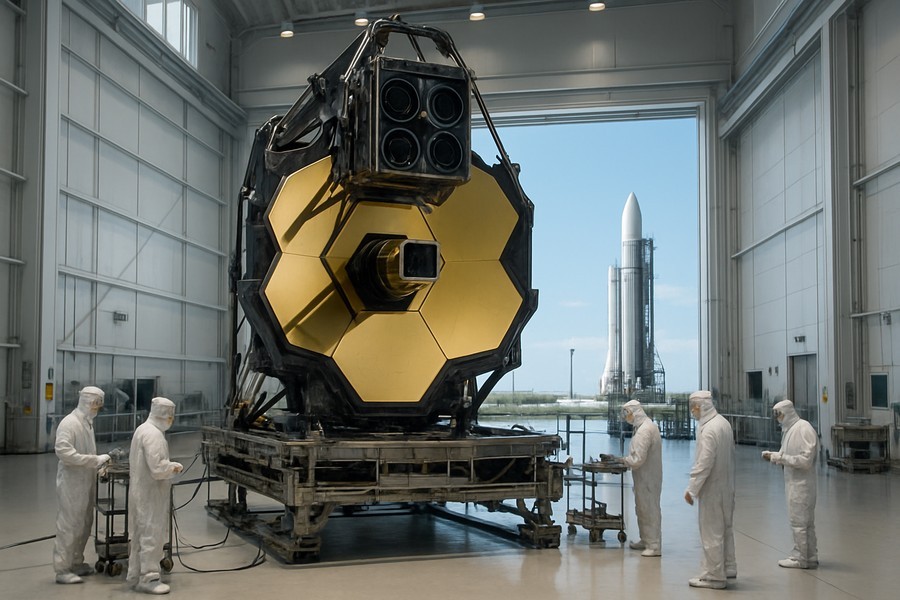
A Revolutionary Telescope Awaits Lift Off
The world of astronomy is abuzz with excitement as a cutting-edge telescope is all set to soar into space. This extraordinary telescope, christened after a pioneering figure in the development of the famed Hubble Space Telescope, is a standout in its category, boasting a remarkable wide-field view and an enormous imaging system. Once operational, the telescope is expected to transmit an astounding 1.4 terabytes of data back to Earth every single day.
From Espionage to Astronomy
Interestingly, the genesis of this telescope can be traced back to the intersection of space exploration and intelligence gathering. When a national intelligence agency decommissioned two of its spy satellites, the space agency saw a golden opportunity. The unused hardware was larger than their initial designs, necessitating a revamp of the plan. But it also offered higher resolution imaging and more room for additional imaging components.
Onward and Upward
Since the inception of this project, progress has been impressive. Initial projections for the launch date were considerably pessimistic. However, in a surprising turn of events, the launch is expected to happen much earlier and within budget. The success of this project has sparked discussions on how the lessons learned could be applied to future space projects.
What's Going to Space?
The telescope will be equipped with two instruments. The first one, a Wide Field Instrument, is designed to capture a massive portion of the sky in one go. This instrument's field of view is comparable to that of a full Moon and is about 100 times larger than the images Hubble can capture. The second instrument is a Coronagraph, which enables imaging of objects near a bright star by blocking the star's light. This will be the first time an actively adjustable coronagraph will be used in a space-based observatory.
The telescope also boasts a filter carousel, a prism, and a grism (a plane prism) that will allow for spectroscopy. This will provide a view of the wavelengths of light coming from certain sources and how much the light from distant objects has been redshifted. The telescope will start functioning as soon as 20 minutes after separation from the launch vehicle, with the commissioning process expected to take only 90 days.
What Will This Telescope Explore?
This telescope's primary goal is to observe baryon acoustic oscillations, interference patterns in matter from the early Universe that have been frozen into place as the Universe expanded. By studying these patterns on a large scale, we can gain insights into the composition of the Universe, including the roles of dark matter and dark energy. This could potentially help us understand whether dark energy is changing with time.
The telescope will also conduct a microlensing survey to detect exoplanets. It will repeatedly observe the same locations at 15-minute intervals, capturing the brightening and dimming caused by a planet acting as a small gravitational lens. This survey is expected to identify tens of thousands of planets, many of which will be further from their host star than those spotted by the Kepler mission.
While these are the planned targets, there will also be time allocated for individual research proposals that may uncover additional uses for the telescope. The most exciting prospect is the possibility of discovering something entirely new or using it to help tackle future astronomical challenges. As one astronomer aptly put it, "the most exciting science from this telescope is going to be the things that we didn’t expect that we couldn’t predict, but that will set the new, deep questions future missions to address."