
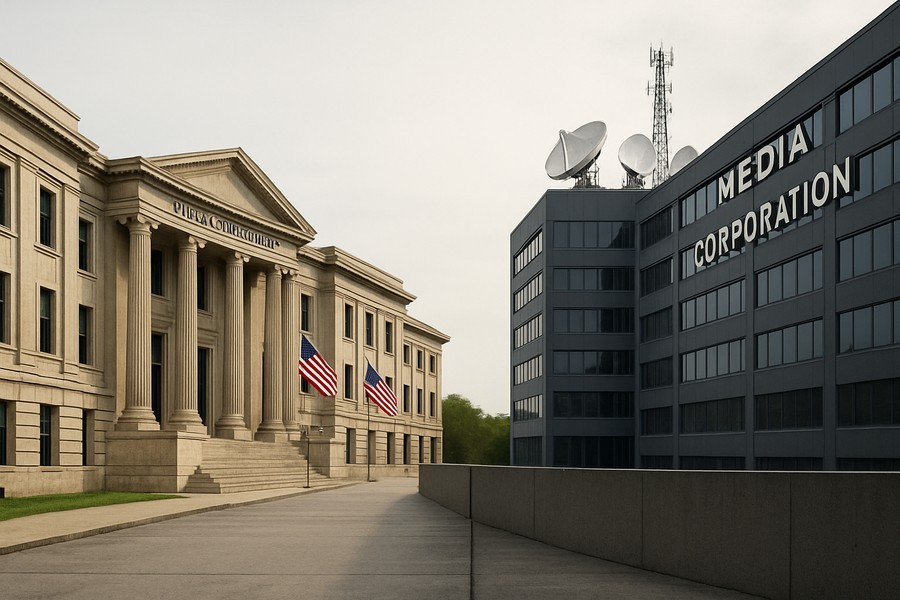
Legal Blockade on Major Media Merger
Eight US states have launched a legal challenge to prevent the joining of two broadcasting giants. The states have taken swift action following the federal government's approval of the multi-billion dollar deal that would result in the country's largest local TV station operator.
The attorneys general from the eight states, including California, New York, and Virginia, submitted an emergency motion to halt the merger. They argue that this consolidation of power is a violation of federal antitrust laws and could result in increased costs for consumers.
States vs Corporate
California's chief legal officer stood firm against the merger. In a public statement, he declared that this merger was not only illegal, but also against the interests of the American people. He warned that this deal might not be as done as the corporations would hope. He pledged to fight against the merger of these two corporate giants.
The broadcasting companies in question had previously announced they had received the green light from federal regulators to proceed with their plans. The standard waiting period was even shortened, according to a department representative.
Waiver of Ownership Rules
The head of the Federal Communications Commission (FCC) made a controversial decision to waive a rule that prevents a single company from owning TV stations that reach more than 39% of American households. With this merger, the combined assets would reach at least 60% of all US homes.
The FCC chief defended his decision, stating that it was in line with the FCC's history of promoting competition, localism, and diversity in media.
Criticism of Approval Process
However, not all FCC members agreed with this decision. One member, who is the only Democrat on the FCC, criticized the lack of transparency in the approval process. She accused the FCC of choosing to shield bureaucracy rather than being accountable to the public.
She expressed her concern that the approval of this merger was done without an open process and without consideration for the consumers and communities who would bear the brunt of its impacts.
Media Consolidation Concerns
The attorneys general are worried that the media consolidation would result in fewer people controlling more broadcast programming. They believe it could lead to the loss of local jobs, higher cable bills, and a significant disruption to the delivery of news and other media content to Americans.
In particular, two media markets in California could be significantly impacted. In Sacramento, the merged entity would own both the local Fox and ABC stations, and in San Diego, it would own the local Fox and CBS stations.
The broadcasting companies in question currently operate hundreds of stations across multiple television markets, including radio stations.
State Intervention in Media Antitrust Issues
This legal challenge is not the first time state attorneys general have stepped in on media antitrust issues. Recently, a collective of Republican and Democratic state attorneys general challenged a case involving Live Nation and Ticketmaster.
Additionally, California's attorney general's office is currently investigating a deal between two historic Hollywood movie studios that could consolidate major news networks under one corporate roof.