
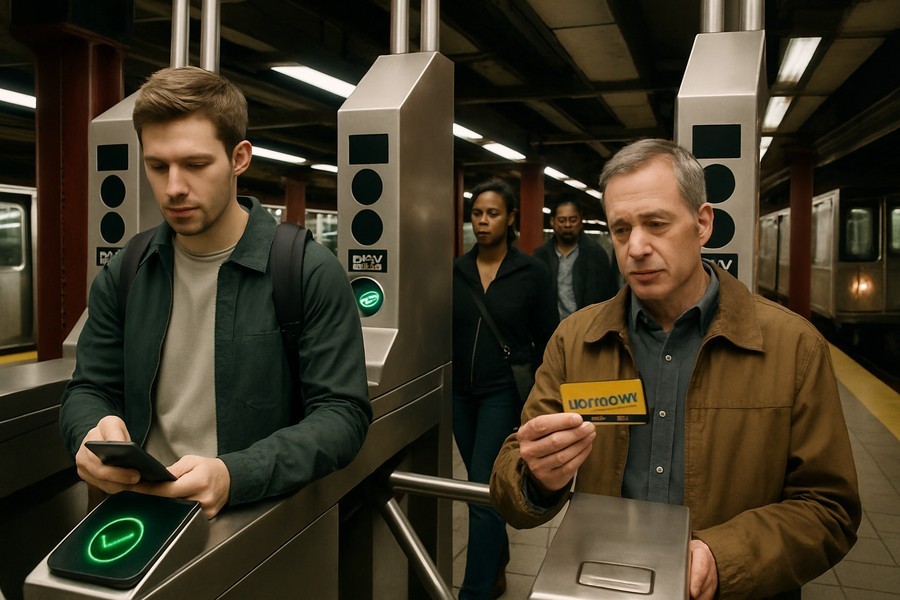
The Iconic New York Subway Card Bows Out
It's time to say goodbye to the MetroCard, a staple of New York City's subway system since 1994. The golden-hued card, famous for its temperamental magnetic strip, will stop being sold and refilled on the last day of 2025.
The city's transit system is making a full switch to a contactless payment method, OMNY. Passengers will now simply tap their credit cards, phones, or smart devices to pay for rides, a method that mirrors day-to-day transactions. Since its introduction in 2019, OMNY has been responsible for over 90% of subway and bus fares.
A Look Back at the MetroCard's History
Even though the MetroCard may have outlived its usefulness, it was a game-changer in its time. Before the advent of these cards, subway and bus users depended on tokens. These brass-colored coins, introduced in 1953, were bought from station booths. When the subway first opened in 1904, a paper ticket cost a nickel, equivalent to about $1.82 today.
There was some resistance to moving away from tokens because people were used to them. However, the MetroCard changed the way New Yorkers thought about transit. The Metropolitan Transportation Authority had to launch public education campaigns to teach commuters how to correctly swipe the initially blue-colored cards to avoid errors or lost fares.
These cards quickly became collector's items as special edition cards were released to commemorate significant events, such as the "Subway Series" between the New York Mets and the New York Yankees in the 2000 World Series. The fare was $1.50 at that time.
Celebrating New York's Culture
The MetroCard didn't just serve as a ticket; it also celebrated the city's culture. Artists like David Bowie and Olivia Rodrigo, as well as New York hip hop groups like the Wu-Tang Clan, the Notorious B.I.G., and LL Cool J, have appeared on the card over the years, along with iconic New York television shows like Seinfeld and Law & Order.
Swiping the MetroCard at the correct angle and speed also became a matter of pride, distinguishing true New Yorkers from visitors. Even Hillary Clinton, a former U.S. Senator from New York, had a hard time getting it right during her 2016 presidential campaign, needing five attempts to pass a turnstile in the Bronx.
Embracing the Future
Unlike the MetroCard introduction, the transition to OMNY has been relatively smooth. Those who don't want to use a credit card or smart device can buy an OMNY card and reload it, similar to a MetroCard. Existing MetroCards will also continue to function into 2026, allowing passengers to use up their remaining balances.
The new system is projected to save at least $20 million annually in costs related to MetroCards. It also allows for unlimited free rides within a seven-day period, with the fare capped after 12 rides. The cap will rise to $35 a week once the fare increases to $3 in January.
Concerns and Criticisms
However, the change is not without its critics. Some have raised concerns about data collection and surveillance. Older riders, like 70-year-old Manhattan resident Ronald Minor, have found the machines for reloading the OMNY card cumbersome and worry about being left behind. “Don’t push us aside and make it like we don’t count. You push these machines away, you push us away,” he said.
Others, like John Sacchetti, another MetroCard user, appreciate being able to see their balance as they swipe through a turnstile, keeping track of their spending. "It’s just like everything else, just something to get used to. Once I get used to it, I think it’ll be okay," he said.
As the end of an era approaches, the MetroCard will be remembered as a symbol of New York City's transit history, and its retirement marks a significant step into the future.
