
Canada and Europe Push for a Stronger Partnership Amid Political Uncertainty
Canada and the European Union are moving to deepen their ties in trade, defense, energy, education, and Arctic affairs. Leaders on both sides see a narrow chance to build a stronger partnership before political changes in North America and Europe make cooperation harder.
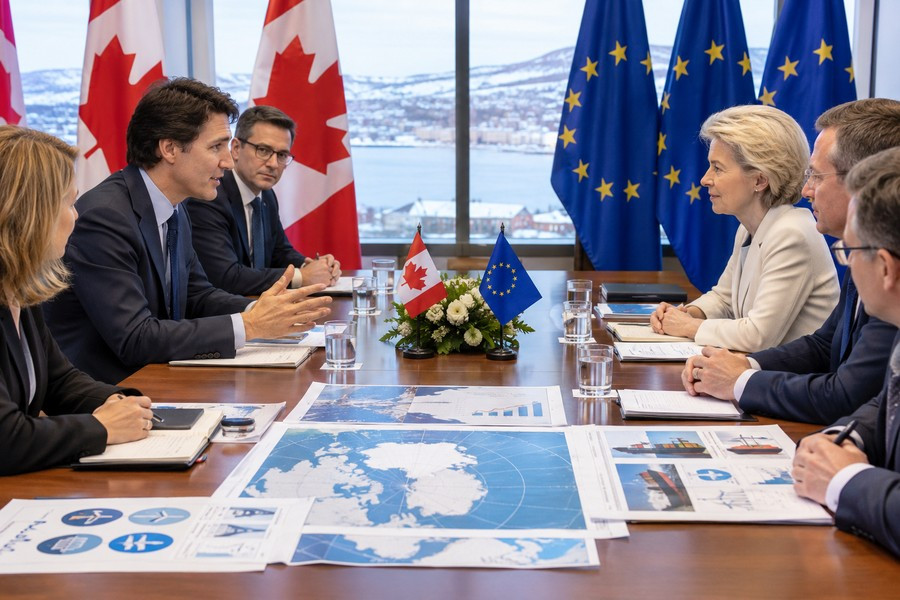
Canadian Prime Minister Mark Carney will meet with European Commission President Ursula von der Leyen and European Council President António Costa for high-level talks in Montreal. The meeting is expected to focus on a broad plan that could affect economic ties, security efforts, and cooperation between European and Canadian institutions.
A Larger Partnership Is on the Table
Canada and the EU want to expand their relationship beyond existing trade rules. Their plans include closer work in several key areas:
- Trade and investment between Canada and European countries
- Defense and security, including cooperation in the Arctic
- Energy partnerships and efforts to strengthen supply chains
- Education and research programs
- International cooperation on major global issues
- Closer links between Canadian and European institutions
The meeting is meant to show that Canada and Europe want a lasting alliance. It is not expected to be a quiet or limited gathering. Both sides are considering changes that could make their partnership stronger for many years.
Canada already has a major trade agreement with the EU, known as CETA. Ottawa now wants to build on that agreement and add deeper connections in areas that go beyond buying and selling goods.
Trump’s Position Adds Pressure
U.S. President Donald Trump has criticized the idea of Canada becoming an associate member of the European Union. He has called the proposal foolish and has warned that closer Canada-EU ties could lead to serious tariffs.
That warning has created a difficult balance for Canadian and European leaders. They want to move forward, but they also know Washington is watching their decisions closely.
European leaders have stressed that stronger cooperation with Canada is not designed to target the United States. Still, a larger Canada-EU alliance could be viewed in Washington as a challenge, especially if it includes trade and defense plans.
The American political calendar may give Canada and Europe some room to act. Trump and his Republican Party are focused on keeping control of Congress. That could limit the president’s attention for a time, but the pressure may return after the elections.
Even if Republicans lose control of Congress, Trump would still keep much of his power over tariffs and foreign policy. That means the outcome of the American vote may not prevent a strong response from the White House.
European Elections Could Change the Plan
Canada is also concerned about political changes inside Europe. Several major European countries are preparing for national elections, and the results could change how governments view cooperation with Ottawa.
Canada wants to secure real progress while European governments remain open to closer ties. Elections could shift attention toward domestic issues or bring leaders to power who are less supportive of the current trade relationship.
France is a special concern. Marine Le Pen and her National Rally party have criticized the trade agreement between Canada and the EU. The party has also been gaining support in polling. A future government led by Le Pen could take a different approach to the partnership.
Canadian leaders therefore want changes that can survive future elections. Their goal is to create a relationship with enough legal and political strength to continue even if Trump returns to a tougher position or European voters move toward nationalist parties.
Signs of Political Resistance
The push for closer ties has already faced opposition from some European lawmakers. During a speech about Canada’s plans for a stronger alliance, a far-right German lawmaker interrupted from the gallery. Supporters then began chanting in favor of the United States.
The incident showed that the proposed partnership does not have universal support in Europe. Some political groups favor closer ties with Washington and oppose new agreements with Canada or the EU.
These divisions could make it harder for European leaders to approve major structural changes. Canada is seeking more than friendly statements or public photographs. Ottawa wants specific agreements that produce clear benefits and remain in place through future political changes.
Leaders Face an Uncertain Response
The central question is whether Canada and the EU can strengthen their partnership without provoking a major reaction from Trump. The American president has already threatened tariffs and criticized the idea of closer Canada-Europe ties.
The summit could lead to major agreements, or it could produce broad promises without many details. A limited result might reduce the risk of an immediate response from Washington, while a bold agreement could send a stronger political message.
Canadian and European leaders cannot control how the U.S. president will respond. They can control the agreements they make and the type of relationship they build. For that reason, both sides are trying to act while they still have political support and room to negotiate.
The meeting represents a major test for Canada and Europe. They must decide how far to go, how quickly to move, and whether a stronger alliance is worth the possible economic and political costs.