
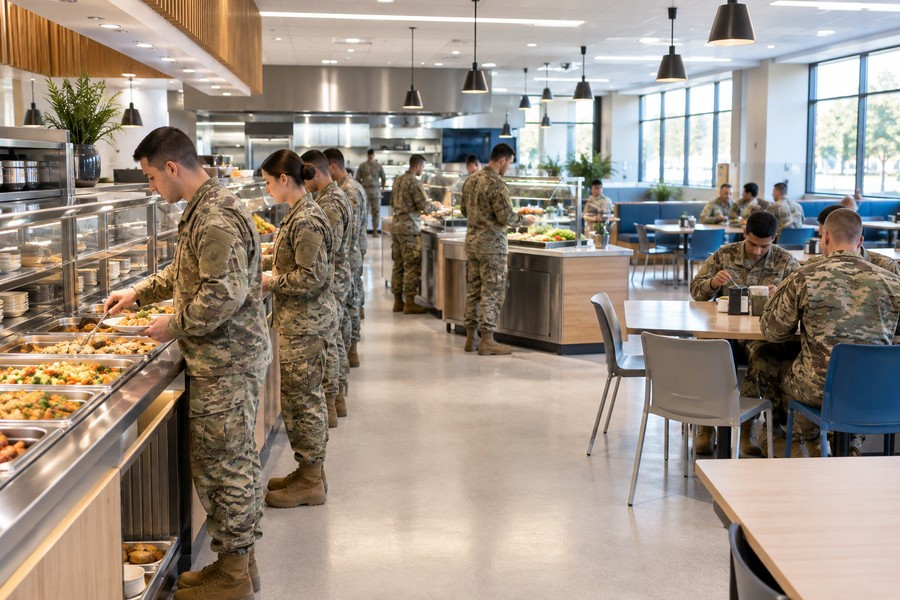
Army Expands New Dining Choices for Soldiers
The U.S. Army is testing new ways for soldiers to get meals. The changes include longer and more flexible dining hours, large dining spaces with several food choices, and deals with private food companies. Army leaders say many soldiers are using the new options and are pleased with them.
Dining That Fits Soldiers’ Schedules
Many traditional Army dining halls follow schedules that have been in place for decades. Those hours can be hard to match with the work shifts soldiers keep today. The Army is trying to make meals easier to fit into daily life by changing when and where soldiers can eat.
Two programs are part of that effort. Flexible eating and extended dining, known as FEED, offers more flexible meal access. Campus-style dining venues, or CSDVs, provide a broader dining setup at selected Army installations in the continental United States.
The new venues are run by private contractors. Traditional dining halls on Army bases, by contrast, are operated by the installation and staffed by soldiers. The Army is testing whether the contractor-run approach can offer a useful option alongside the older system.
Five Installations Have New Venues
CSDVs opened at five Army installations: Fort Bragg in North Carolina, Fort Stewart in Georgia, Fort Carson in Colorado, Fort Hood in Texas, and Fort Drum in New York. The Army plans to bring the program to more installations.
The early use numbers suggest that soldiers at some locations are choosing the new venues for a large share of their meals. At Fort Carson, about 67% of soldiers who live in barracks use the CSDV. At Fort Hood, the share is about 56% for soldiers living in barracks.
The venues also account for a substantial portion of meals served at the two locations that have been open the longest. At Fort Hood, which is a large installation, about 55% of meals are served through its CSDV. At Fort Carson, the figure is about 85%.
Families Can Join Soldiers
Soldiers may bring their dependents to eat at a CSDV. Family members must pay for their own meals. Traditional Army dining halls usually allow dependents to eat only in certain situations, such as during holidays.
This gives families more chances to share meals with soldiers at the new venues, while keeping the cost of family meals separate. The change is one way the CSDVs differ from many older dining halls.
Some Locations Offer Alcohol
At Fort Hood, soldiers who are old enough to drink can buy wine, beer, cider, and hard seltzer during certain hours. It is not clear whether the same choice will be available at other installations.
Each installation’s senior commander decides whether alcohol will be offered. That means the rules may differ from one location to another.
Contractors Pay for Equipment
Private contractors that run the new dining venues are responsible for getting them ready to serve meals. The contractors have agreed to pay for the equipment and setup needed for their work.
The Army’s use of private companies has drawn questions. Some critics point to past problems with military housing built by commercial companies and have raised concerns about turning food service over to businesses.
Even with those concerns, the Army intends to expand the CSDV program beyond its five current installations. The ongoing test will help the Army judge how the venues work at different bases and whether they can keep meeting soldiers’ needs.