
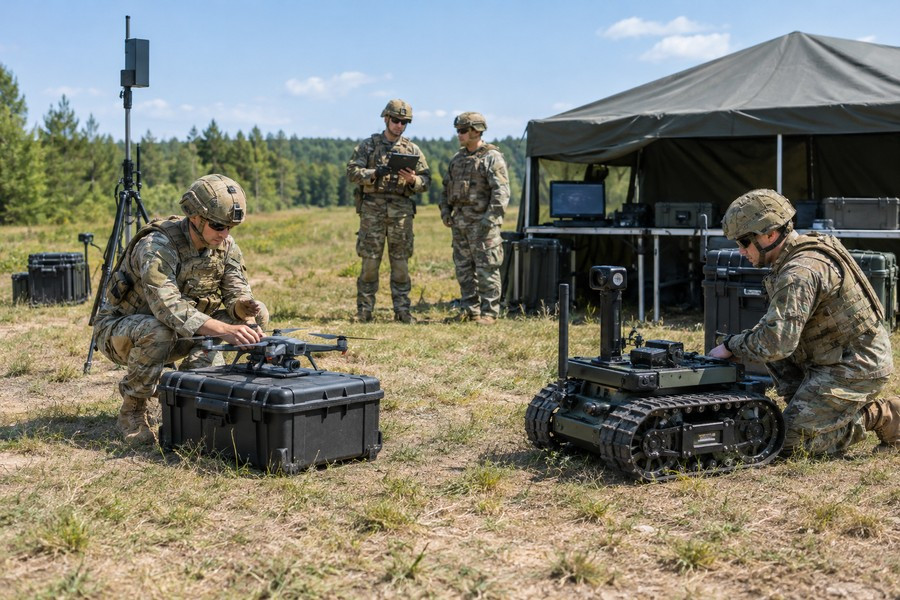
New Military Team Aims to Improve Drone Warfare
The U.S. military has created a new team focused on improving armed drones and small unmanned ground vehicles. The group, called Task Force Easy, is expected to help military units develop, test, and use these systems more quickly.
A Response to Slow Technology Development
Col. Michael Penn, an Army officer leading the task force, said the military has struggled to keep pace with the speed of technological change. New systems often take too long to design, purchase, test, and send into the field.
The task force was formed to address that problem. Its goal is to help the military adapt faster than potential enemies by creating a process that allows equipment and tactics to improve again and again.
“We’re slower, less effective,” Penn said. “We don’t outpace our enemy and our threat in how quickly we adapt new technology. So we’re trying to fix that in our task force.”
Focus on Small Unmanned Systems
Task Force Easy is concentrating on two main types of equipment:
- Small unmanned aircraft that can be controlled from the ground
- Unmanned ground vehicles that can move and operate without a person inside
One early priority is the development of first-person-view, one-way attack drones. These aircraft are guided by an operator who sees video from the drone’s camera. The drone is designed to reach a target and strike it rather than return for another mission.
The team wants to improve these systems quickly. That could include making them easier to operate, more reliable, less expensive, and better suited for changing battlefield conditions.
Military Leaders Push for a Larger Drone Effort
The new task force is part of a wider effort to solve the technical and organizational problems linked to large-scale drone use. Military leaders want forces to be able to buy and deploy affordable unmanned systems in much greater numbers.
Defense Secretary Pete Hegseth directed officials to connect drone purchases with actual battlefield use. The plan also called for the creation of a four-star combatant command focused on autonomous warfare.
That command is expected to work with the Direct Reporting Portfolio Manager for Unmanned Systems, an office created to coordinate the military’s work on unmanned technology.
The effort also includes a larger organization called the Joint Task Force-Autonomous Warfare. It grew from the Defense Autonomy Warfare Group, which was created through an earlier initiative to speed the development of autonomous, unmanned, and artificial intelligence systems for military use.
Testing New Ideas in Realistic Training
Task Force Easy is also responsible for building a specialized drone team. That group will help create training programs, establish operating standards, and develop new tactics and procedures.
Its members will work with combat training centers to prepare troops for equipment they may use in future operations. They will also help evaluate how well the systems perform during military exercises.
This work is important because buying drones alone does not guarantee success. Soldiers must know how to operate them, commanders must understand how to use them, and units must have clear rules for maintenance, training, and battlefield decisions.
Beyond Buying More Drones
Penn said the military needs more than a large supply of unmanned aircraft. It also needs a system that can learn from each mission and use that knowledge to build better tools.
“It’s not just about buying 1,000 drones,” he said. The larger goal is to create an institutional and industrial engine that can learn, update equipment, and produce improved capabilities faster than in the past.
The task force is also leading work connected to Project Swarm Forge, an effort by the military’s digital and artificial intelligence office to develop groups of systems that can work together with limited human control.
These systems may eventually share information, divide tasks, and respond to changing conditions while operating close to the battlefield. The work is aimed at bringing coordinated autonomy to troops and equipment in the field.
Adaptation as the Main Advantage
Penn said the military should not measure success only by the number of drones it owns. The more important measure is how quickly it can learn and adjust.
Military forces may gain an advantage by improving their technology, training, and tactics faster than an opponent. Task Force Easy is designed to support that process by bringing together equipment development, battlefield testing, instruction, and standards.
The team’s central idea is what Penn called “adaptation dominance.” That means staying ahead by learning faster, updating systems more often, and turning new lessons into practical tools for service members.