
Halley’s Comet Leaves Its Mark in a Brilliant Meteor Shower
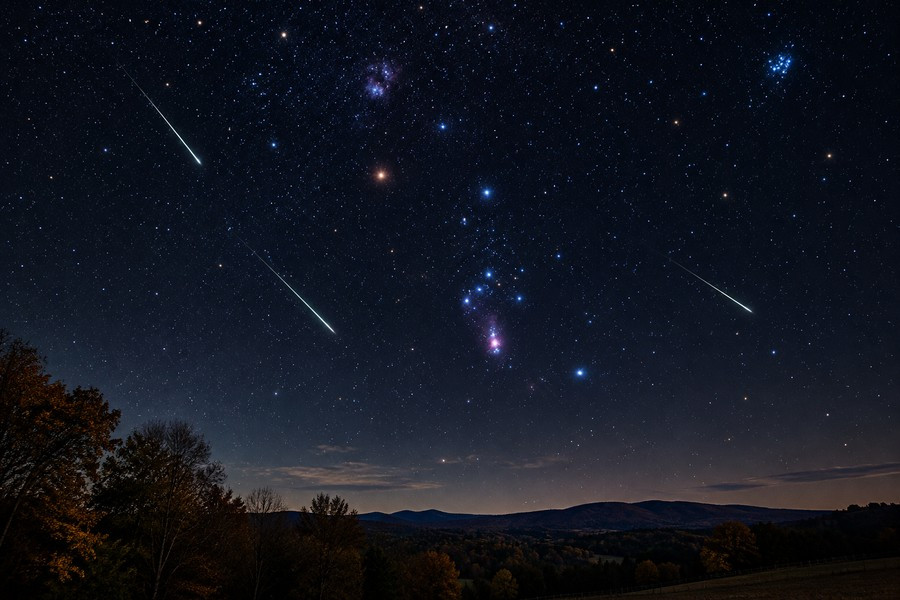
A piece of a famous comet helped create a striking show in the night sky as Orionid meteors crossed above Georgia. The bright streaks appeared alongside glowing nebulae, star clusters and some of the best-known stars in the constellation Orion.
Three Meteors Cross the Autumn Sky
Astrophotographer Tim McCollum photographed three bright Orionid meteors above Toccoa, Georgia. The meteors appeared between 3 and 4 a.m. during a period when the annual shower was becoming more active.
Each meteor seemed to move away from the same area of the sky. This point is called the radiant, and it lies near Betelgeuse, a large red star in Orion. Although the meteors appear to come from this location, they are actually entering Earth’s atmosphere along paths left behind by Comet 1P/Halley.
As the comet travels through space, it releases tiny grains of dust and rock. Earth passes through this stream of debris during its yearly trip around the Sun. When the particles hit the atmosphere at high speed, they heat up and glow. That bright flash is what people call a shooting star.
A Distant Comet Still Creates a Bright Display
Comet 1P/Halley is now more than 3 billion miles from Earth. Even at that great distance, material shed by the comet continues to shape the Orionid meteor shower. The particles follow an orbit around the Sun, creating a path that Earth crosses each year.
The comet itself was not the bright object seen in the photograph. Instead, its leftover dust produced the meteors. These short-lived flashes lasted only moments, but careful planning made it possible to record them in one detailed image.
Patience Helped Create the Composite Image
Photographing meteors requires a mix of timing, clear skies and good luck. McCollum took many exposures, with each one lasting 30 seconds. A star-tracking device kept the camera aimed at the radiant while Earth continued to turn.
The separate photographs were later combined into one composite picture. This process made it possible to show all three meteors together with the surrounding stars and deep-sky objects. Capturing several meteors in one frame is difficult because their paths and timing cannot be predicted exactly.
- The photograph was made from several 30-second exposures.
- A star tracker kept the camera pointed toward Orion’s meteor radiant.
- Three Orionid meteors were combined into one final image.
- The meteors were recorded above Toccoa, Georgia, during the early morning hours.
Orion’s Belt and Glowing Nebulae Add to the View
The image contains much more than three shooting stars. Orion’s Belt appears on the right side of the photograph, formed by three bright stars that are easy to recognize in the night sky.
Near the belt is the Orion Nebula, a large cloud of gas and dust where new stars are forming. It is one of the closest major star-forming regions to Earth. Its soft glow adds a bright patch to the dark background of the image.
The Rosette Nebula can also be seen within the crowded field of stars. This nebula is also known as Caldwell 49. It appears among thick clouds of dust and stars along the plane of the Milky Way.
The Milky Way stretches diagonally across the composite photograph. Several star clusters are scattered through the same region, giving the image layers of detail. The meteors stand out because their sharp lines contrast with the steady light of the distant stars.
More Chances to See Orionid Meteors
The Orionid meteor shower remains active through early November. Viewers may have a chance to see more of the comet’s debris by finding a dark location away from city lights.
The best viewing time is usually after midnight and before dawn. Look toward the area of Orion, but keep your eyes on a wide section of the sky. Meteors can appear far from the radiant, and watching one small spot may cause you to miss them.
Another meteor shower may also add bright flashes to the night. Earth passes through debris linked to Comet 2P/Encke during the Taurid meteor shower. Some Taurid meteors can become unusually bright fireballs, including displays that may appear around Halloween.
Tips for Photographing Shooting Stars
Anyone hoping to capture a similar scene should use a steady tripod, a wide-angle lens and a camera that allows long exposures. A dark sky is important because streetlights and other bright sources can hide faint meteors.
Photographers should take many pictures over several hours. Most frames may not contain a meteor, but a single successful exposure can reveal a bright streak. Combining selected images later can show several meteors with the stars and nebulae that filled the same part of the sky.
The result is a reminder that a comet can influence Earth’s skies long after it has moved far away. Its ancient trail continues to produce brief flashes that connect a distant object in space with observers on the ground.