
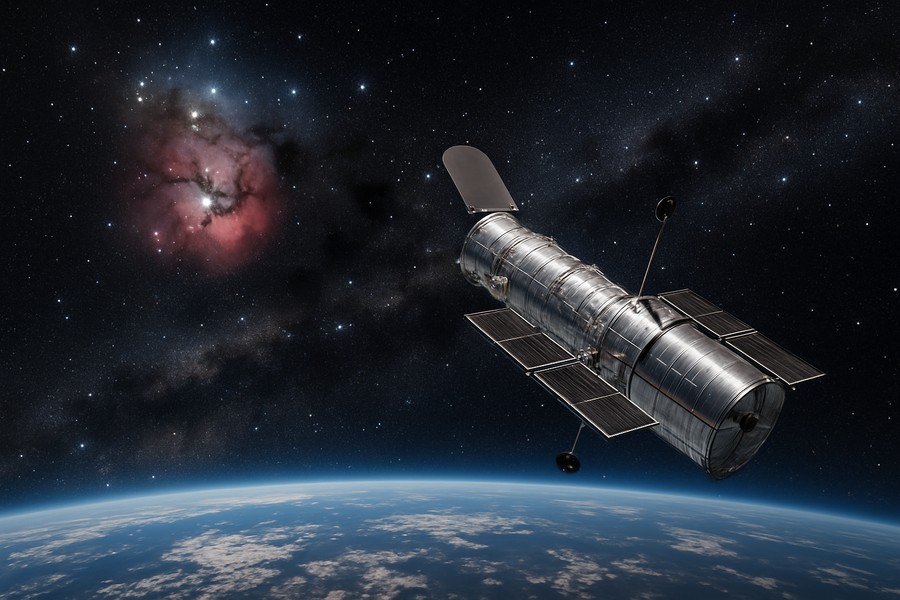
Saluting 36 Years of Space Exploration with a New Spectacular Image of the Trifid Nebula
To mark its 36th year in space, the Hubble Space Telescope has given us a beautiful and vividly colored image of a key star-forming region. This image showcases the Trifid Nebula, also known as Messier 20, one of the most admired celestial bodies in the heavens. Amateur stargazers frequently seek it out in the constellation of Sagittarius the Archer, set amidst the countless stars of the Milky Way.
The view from Hubble is quite distinct from what one may see from Earth. The telescope's 8-foot mirror allows it to see more closely and in greater detail than any ground-based telescope could.
A Closer Look at the Trifid Nebula
The new image of the Trifid Nebula focuses on just a small section at the end of one of its four large dust lanes. This region is dominated by towering columns and expansive walls of gas and dust. It features what appears to be a giant mountain with two 'spikes' extending from its peak, reminiscent of the antennae on an insect. However, these spikes represent two distinct phenomena.
The spike reaching upwards is a denser column of gas and dust that has endured the onslaught of ultraviolet light and powerful particle winds from nearby newly formed massive stars. At the apex of this column, there is a star in formation. Although it is still enshrouded in the nebula, there seems to be a circumstellar disk surrounding it, which could potentially lead to the formation of planets.
The other spike, pointing to the left, has a more cloudy and uneven look. It is a Herbig–Haro object, a jet of material propelled by a growing protostar that is collecting too much matter and expelling the excess along its rotational axis. This jet pierces through the nebula's clouds and extends light-years into space.
A Journey through Time
By comparing Hubble's first image of the Trifid taken in 1997 and this new image, astronomers have been able to track changes in the jet's size and structure over the years and measure its speed. This valuable data will help them understand better how young stars interact with their surroundings, which could influence their development.
To the left of the 'space slug', a lone tendril of gas stands apart from the rest. This tadpole-shaped object is a denser nebulosity that the Trifid's radiation field has not yet completely dispersed.
Contrasting Corners
There is a stark contrast between the top left and bottom right corners of the new Hubble image. At first glance, one might think that the bottom right corner, being black, is the clearest. But it's not space you're seeing; it's a dense patch of dusty gas that might be forming stars within it, but from outside, it still appears impenetrable.
The top left corner, in reality, is the clearest. The lovely blue hue is created by ionized gas as ultraviolet light begins to clear away the nebula. This process is visible around the head of the 'slug', where the nebula seems to be fraying. Here, the denser gas is being eroded by the radiation. In star-forming regions such as the Trifid, radiation molds the nebulosity in a way that's somewhat similar to wind sculpting rocks in a desert.
The Trifid's Name and Legacy
The name 'Trifid' refers to an object with three lobes. This name was given to the nebula by a nineteenth-century British astronomer, John Herschel, who observed three lobes through his telescope. However, the nebula actually has four lobes — Herschel's telescope wasn't capable of resolving the fourth dust lane.
This latest image from Hubble is one of more than 1.7 million observations made by the telescope over its 36-year mission. These observations have resulted in approximately 23,000 research papers authored by nearly 29,000 astronomers worldwide, with about 1,100 of those papers being written in just one year.