
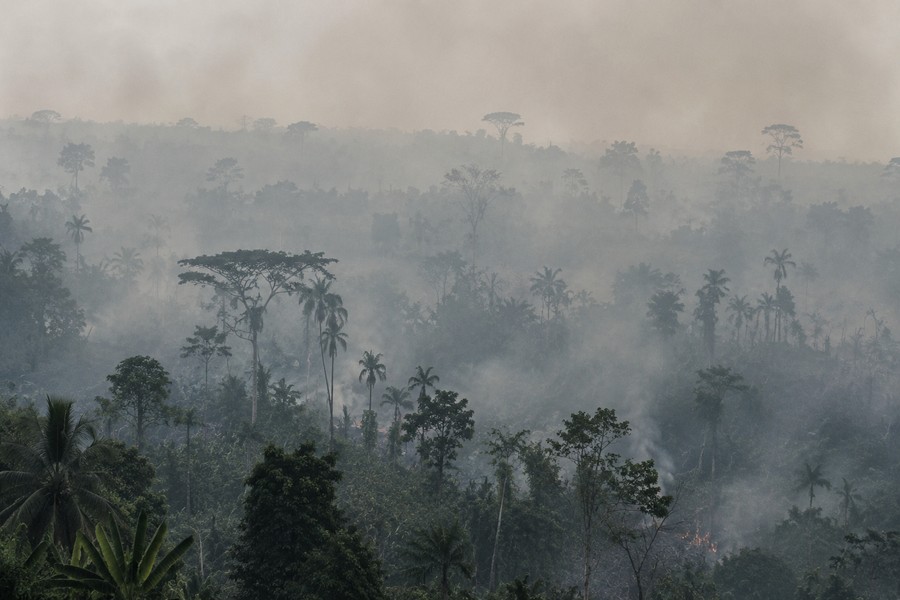
Thick Smoke and Rising Flames: How Forest Fires Are Affecting Millions in Southeast Asia
Imagine stepping outside your front door and only being able to see a few feet ahead of you. For people living in the Indonesian part of Borneo, this is the daily reality. The air is so thick with smoke that breathing feels like inhaling cigarette smoke all day long. For weeks, massive fires have been burning across tens of thousands of acres of land, including ancient rainforests. This has created a giant blanket of smog that is now moving across borders and affecting neighboring countries.
A Growing Health Crisis in the Region
The thick smoke is making many people sick. In one part of the island, emergency rooms have seen a massive jump in patients with breathing problems. Since the dry season began, about 5,000 people each week have gone to the hospital for help. Earlier in the year, that number was only about 500 people per week. This ten-fold increase shows how dangerous the air has become.
Despite the hazardous air, many adults still have to go to work, and children are still sent to school. This constant exposure has parents worried about the long-term health of babies, pregnant women, and the elderly. In response to the worsening conditions, some schools have stopped in-person classes, and parents are asking for lessons to move online to keep their children safe indoors.
Why Are the Forests Burning?
Every year, fires break out in this region. Many of these blazes are started on purpose using a method called "slash and burn" clearing. This is a cheap way for companies and individuals to clear large areas of forest to plant crops. Most of this land is used to grow oil palms. Indonesia is the top producer of palm oil in the world, which is a common ingredient in many household products. In just one month, nearly 232,000 acres of land burned across the country.
This year, the fires are much worse due to a powerful weather pattern known as El Niño. This climate event brings unusually hot and dry weather to the region, with conditions expected to peak in the late summer. The dry season is expected to last through October, and experts do not expect any significant rainfall to help put out the fires until November. This means the worst of the burning could still be ahead.
This is not the first time this weather pattern has caused such damage. During a similar dry cycle in 2015, more than 6 million acres of land were destroyed by fires, causing similar air quality issues for neighboring countries.
The Smoke Spreads Across Borders
The smoke is no longer just a local problem. It has traveled across the sea to neighboring nations like Malaysia and Singapore. Government officials in the region have met to discuss how to handle the shared air pollution. Recently, major cities in the area were ranked among the most polluted places on Earth due to the drifting haze.
The impact on daily life in neighboring countries includes:
- School closures: Nearly 600 schools in a Malaysian state on the island of Borneo had to close down because of the hot, dry, and smoky conditions.
- Health alerts: Nearby Singapore has put its citizens on high alert for worsening air quality.
- Community damage: On social media, residents have shared videos of massive fires spreading not just in Borneo, but also in Sumatra, West Papua, and Lombok, where a fire recently destroyed a traditional village.
Government Actions and the Battle for the Soil
In response to the crisis, the Indonesian government has taken several steps to stop the burning. The president ordered officials to cancel the business licenses of any companies suspected of starting fires to clear land. Additionally, police have arrested 72 people suspected of starting fires in Borneo and Sumatra, with most accused of clearing land for plantations.
The government has also promised to send help to the affected areas, including water pumps and helicopters to dump water on the flames. However, many residents are frustrated because they feel the government is not doing enough to punish the large companies responsible for the damage.
A big part of the problem lies deep in the ground. The local rainforests sit on top of peatlands, which are thick layers of decayed plant matter. Naturally, these peatlands are very wet and do not burn easily. However, companies have built drainage canals to dry out the land for farming. Once dried, peatlands become highly flammable.
Peat fires are incredibly difficult to extinguish because they burn deep underground, sometimes for weeks, releasing huge amounts of thick, smelly smoke. Climate experts warn that simply fighting the fires after they start is not enough. To truly solve the problem, the dried-out peatlands must be restored to their natural, wet state, and further land clearing must be stopped.
For residents living near the flames, the danger is immediate. Recently, a new fire started very close to a local factory, burning down nearby homes. People are panicking as the smoke and flames creep closer to their neighborhoods, leaving them worried about what the future holds.