
Trump Administration Points to Century-Old Court Case in Birthright Citizenship Debate
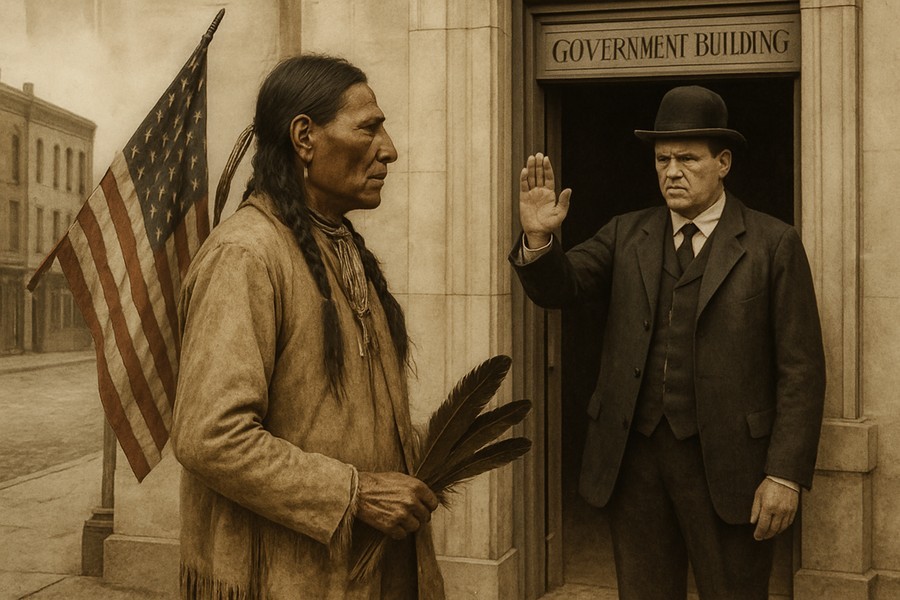
In a move that's stirring up fresh debate nearly 150 years later, the recent refusal of an Omaha election official to register a Native American man named John Elk to vote has been thrust back into the spotlight. The official had contended that John Elk, thought to be a member of what is now the Winnebago Tribe of Nebraska, wasn't an American citizen because of his Native American heritage.
Elk didn't take this lightly and contested it. He argued that he had willingly placed himself under U.S. jurisdiction by severing all ties with his tribe. Furthermore, he stated that his birth within U.S. territory automatically made him a citizen. However, the Supreme Court disagreed. In the 1884 case, Elk v. Wilkins, it was ruled that Native Americans born within the U.S. did not automatically become citizens. They were instead considered as children of foreign government subjects born within the domain of that government.
Revisiting the Past to Shape the Future
Today, this case is being invoked by the current administration to support its plan to end automatic birthright citizenship. This move puts a new twist on how the 14th Amendment of the Constitution, which grants birthright citizenship, has been interpreted for years. The administration's argument has led to oral arguments being presented before the Supreme Court.
The administration's executive order, issued at the start of its second term, aims to restrict birthright citizenship to only those people who have at least one parent who is a U.S. citizen or a legal permanent resident. As of now, this order is not in effect as it has been temporarily halted by lower courts.
Government representatives have referred to the Elk case in court papers. They argue that the Supreme Court has previously dismissed the notion that anyone born on U.S. soil, regardless of circumstances, automatically becomes a citizen as long as they can be regulated by the federal government.
An administration spokeswoman has stated that this case presents the Supreme Court with an opportunity to "restore the meaning of citizenship in the United States to its original public meaning."
Contested Interpretations
The administration's stance on the relevance of the Elk ruling to this case has been fiercely contested. Civil rights groups leading the challenge to the executive order argue that the case is fundamentally about the government's attempt to strip children of immigrants of their citizenship. They claim that the issues raised about Native American citizenship are not the main point.
Interestingly, none of the numerous briefs filed in this case contain any input from Native American tribes or organizations. However, two law scholars specializing in Native American law have filed a brief supporting the civil rights groups' challenge.
Experts in Native American law argue that the administration's reliance on the Elk case is both rhetorically and legally problematic. They believe that the government is misunderstanding and misreading the case. They argue that the decision in Elk v. Wilkins is based solely on the specific nature of quasi-sovereign tribal government and should be limited to that context.
A Complex History
The legal status of Native Americans within the U.S. has been a controversial issue throughout history, especially as the nation expanded westward. The U.S. government often treated tribes poorly, yet considered them somewhat independent nations while also exerting authority over them.
Native American tribes and organizations likely did not file briefs in this case for two main reasons, according to experts. First, they do not have a stake in the case because Native Americans have been guaranteed birthright citizenship by statute since 1924. Second, the more than 500 tribes likely have diverse political views on whether the administration's executive order is good policy.
The Argument Over Citizenship
This unusual case looks at the meaning of the "citizenship clause" of the 14th Amendment, ratified in 1868 after the Civil War. The clause states that "All persons born or naturalized in the United States, and subject to the jurisdiction thereof, are citizens of the United States." The administration has focused on the phrase "subject to the jurisdiction thereof," arguing that it excludes the children of people who entered the country illegally and those born to people with temporary legal status.
The administration has repeatedly referenced the Elk case in its brief, stating that it shows birthright citizenship only applies to people who fall under the "political jurisdiction" of the United States. Those challenging this view point to another 19th-century ruling, United States v. Wong Kim Ark, in which the court declared a man born in San Francisco to Chinese parents living in the U.S. to be a U.S. citizen at birth.
Legal experts are unsure how much weight the Supreme Court will give to the Elk case in making its decision. However, they agree that the case's relevance to the current birthright citizenship debate is ambiguous.