
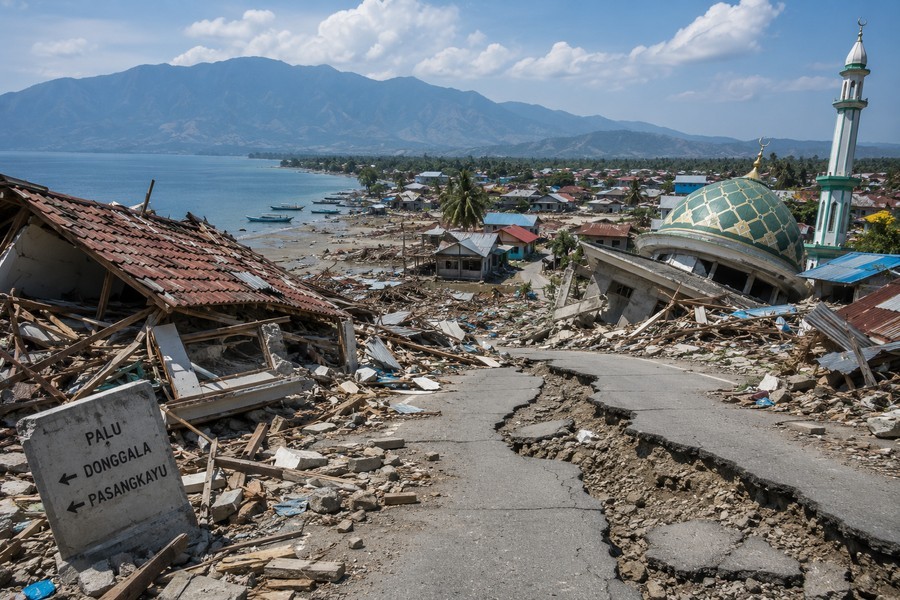
Powerful Undersea Earthquake Rocks Indonesian Islands Causing Heavy Damage and Casualties
A massive earthquake with a magnitude of 7.7 recently struck off the coast of eastern Indonesia. The powerful shaking happened underwater near the Flores region. The center of the quake was located about 42 miles north-northwest of the city of Ende, which is in the province of East Nusa Tenggara. The sudden movement of the earth sent shockwaves through nearby islands, leaving residents terrified as buildings began to crumble.
At least 38 people lost their lives because of the disaster. In addition to the deaths, two people suffered severe injuries, and 11 others had minor injuries. The shaking was so violent and frightening that about 2,000 residents ran away from their homes to find safety in open areas and on higher ground. Many families had to leave everything behind as they fled into the hills.
In the busy port town of Maumere, search and rescue teams worked quickly through the wreckage. In this town alone, emergency workers found 20 people dead and six others injured. They also discovered two people trapped alive under collapsed concrete and worked hard to pull them to safety. Maumere is the main town in the Sikka area on Flores Island, which is located in the eastern part of the country.
Emergency Rescues and Blocked Roads
The earthquake caused widespread chaos across the region. Many people became trapped inside damaged homes and businesses. At the same time, large landslides triggered by the violent shaking blocked several main roads. This made it very hard for emergency vehicles and rescue workers to reach the hardest-hit areas.
Local hospitals had to take quick action to protect their patients. Workers evacuated patients out of the buildings to keep them safe from falling debris and collapsing walls. Nurses and doctors carried medical equipment outside, including:
- Hospital beds and rolling cots
- IV stands and medicine bags
- Oxygen tanks and breathing masks
Medical staff set up temporary treatment areas on the grass and pavement outside the hospitals. They treated the injured under the open sky to adapt to the dangerous emergency conditions.
Eyewitnesses Describe the Panic
The shaking was felt across most of Flores Island, and early accounts showed that the damage was severe. A local resident in the Sikka area described the terrifying moments when the ground began to move. She saw many buildings fall apart, including the waiting room at a local shipping port terminal, which completely collapsed. She explained that people panicked and ran toward higher ground as fast as they could to escape potential danger.
At a local Catholic seminary school, students and nuns were attending a morning church service when the disaster struck. The roof of the main meeting hall began to cave in. Everyone inside ran out in a panic to escape the falling ceiling. During the chaos, one priest broke his leg after jumping from the second floor of a building to escape the collapsing structure.
Tsunami Warnings and Aftershocks
Because the earthquake happened underwater and was relatively shallow, there was a major concern that a giant wave might hit the coast. Emergency officials quickly issued tsunami warnings for several nearby provinces, including:
- East Nusa Tenggara
- West Nusa Tenggara
- South Sulawesi
- Southeast Sulawesi
People living near the ocean were told to stay far away from beaches and rivers. They were urged to climb up to high ground immediately. Fortunately, neighboring countries reported that there was no danger of a tsunami hitting their shores. Soon after the main earthquake, two smaller earthquakes, known as aftershocks, shook the area again, keeping residents on edge.
Why This Region Faces Frequent Earthquakes
Indonesia is a huge nation made up of more than 17,000 islands. Earthquakes and volcanic eruptions are very common there. This is because the islands sit directly on the Ring of Fire. The Ring of Fire is a large, horseshoe-shaped area in the Pacific Ocean where many tectonic plates meet, causing frequent volcanic activity and shifts in the earth's crust.
This is not the first time the region has faced a deadly natural disaster. Decades ago, a magnitude 7 earthquake struck the exact same island of Flores. That historic event triggered a massive tsunami that took the lives of about 2,500 people. This latest disaster in Indonesia occurred shortly after another powerful magnitude 7.4 earthquake shook the South American nation of Colombia, causing severe damage on the other side of the world.