
A Breakthrough Discovery: Unprecedented Organic Molecules Found on Mars
The Red Planet, Mars, is home to a rock that houses a unique set of life's fundamental elements, including seven that have never been identified there before. This exciting information has been confirmed by recent research.
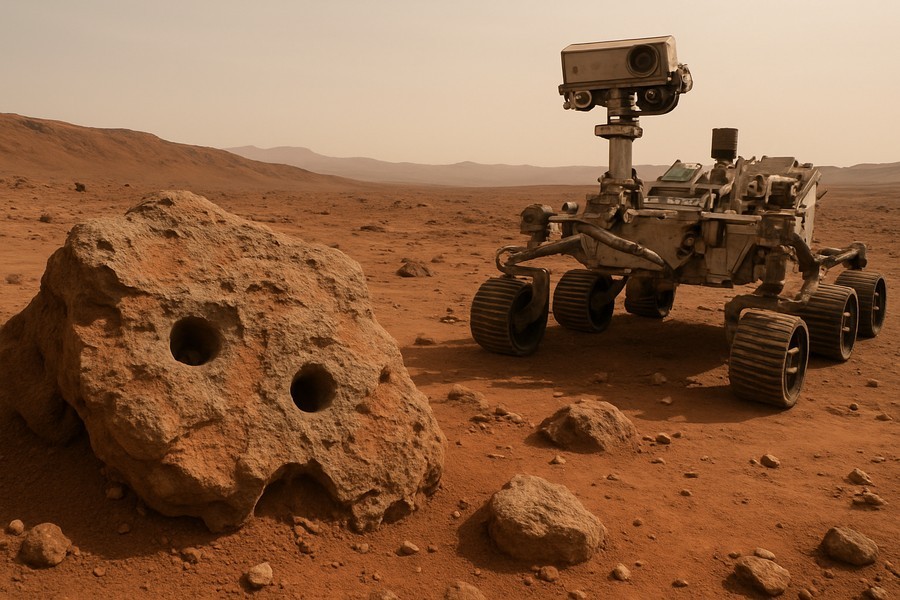
A few years ago, a robotic rover on Mars discovered and drilled into this intriguing rock. It's now confirmed that the rock contains organic molecules, which include the life-supporting element, carbon. While it's not yet possible to determine if these molecules were formed because of biological or geological activities, this discovery lends further support to the idea that ancient Mars could have supported life.
The discovery further strengthens the idea that ancient Mars had the right chemical makeup to support life. Furthermore, these molecules add to the growing list of compounds that can be preserved in rocks, even after billions of years of exposure to Mars' radiation, which can degrade these molecules over time.
Discoveries by the Martian Seashore
The latest analysis, which was published in a well-respected scientific journal, reveals that the rock sample contained 21 carbon-containing molecules, seven of which had never been discovered on Mars before. These newly discovered molecules included nitrogen heterocycle (a precursor to RNA and DNA) and benzothiophene, which may have played a crucial role in introducing life-supporting chemistry to planets in the solar system via meteorites.
The sample was affectionately named "Mary Anning 3," after a renowned English paleontologist who discovered the first fossil ichthyosaur and plesiosaur. Similar to the aquatic fossil environments explored by Anning, the organic molecules on Mars were discovered in a region that was once filled with lakes and streams before the planet became arid billions of years ago.
This area was a hub of activity and dried up multiple times in the planet's ancient history, leading to a buildup of clay minerals in the region. These minerals are particularly efficient at preserving organic compounds.
Searching for Life Via Drilling
In the previous year, the same rover made another groundbreaking discovery. It found the most massive organic molecules on Mars, which were long-chain hydrocarbons, including decane, undecane, and dodecane.
These discoveries were made using a specialized instrument on the rover known as the Sample Analysis at Mars (SAM). The process begins with the rover drilling into rocks with its robotic arm. The rocks are then converted into powder samples, which are allowed to fall into SAM. The instrument contains a high-temperature oven that heats the powder, allowing for the analysis of the gases inside the rover.
SAM also includes small cups of solvent that can perform "wet chemistry." The Mary Anning 3 sample was the first to use a substance called tetramethylammonium hydroxide (TMAH)—a compound that breaks apart organic molecules. The rover only carries two cups of this substance due to the high value of the sample.
The discoveries made by the rover were cross-verified on Earth using a well-known space rock, the Murchison meteorite, which is 4 billion years old and contains organic molecules.
A Murchison sample exposed to TMAH was found to break much larger molecules into some of the ones seen in Mary Anning 3, including benzothiophene. This result confirms that the Martian molecules found in Mary Anning 3 could have been generated from the degradation of even more complex compounds relevant to life.
The rover, which has been on Mars for a decade, recently used its last TMAH cup on intriguing weblike boxwork ridges that were formed by ancient groundwater. The data gathered from this final experiment will be analyzed and published in a future study.