
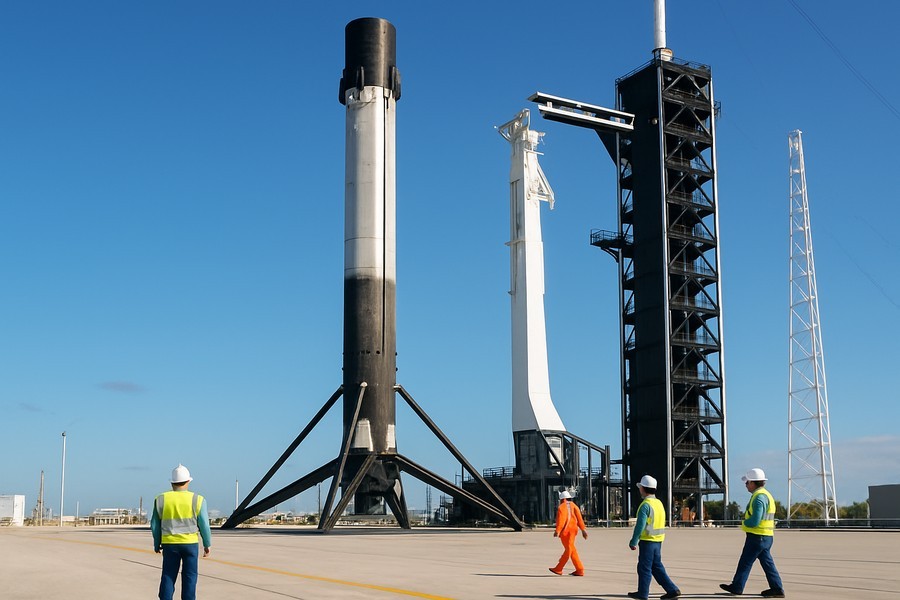
A Monumental Leap in Space Exploration
Imagine a rocket that can be launched into space, return, and be used again. Well, that's not science fiction anymore. A space company has just made a significant stride by achieving this feat for the first time with its giant rocket, New Glenn.
The rocket was launched into space for its third mission, but what made this launch unique was the use of previously used hardware. This mission, dubbed NG-3, transported a massive payload, the BlueBird 7 satellite, to low Earth orbit. And the most exciting part? It did so using the same first-stage booster core that was used in the NG-2 mission, albeit with new engines.
The Journey of NG-3
The NG-3 mission launched from a space station in Florida. Initially, there were plans to initiate the launch earlier, but it was delayed due to undisclosed reasons. However, the countdown resumed, and the launch proceeded without further hitches.
Approximately 3.5 minutes into the flight, the first stage of New Glenn shut off its engines and separated from the rocket's upper part. It then landed back on a droneship in the Atlantic Ocean around six minutes later. As the booster made its return to Earth, space engineers from all over the nation cheered in jubilation, chanting "GS-1" during landing, the technical name for the booster.
Prepping the Rocket for Reuse
Before the launch, the space company's engineers refurbished the rocket's thermal protection system, enabling it to withstand the heat of reentry. They also made a few tweaks in the rocket's guidance system to ensure its smooth reentry.
The successful reuse of New Glenn's first stage is a significant leap towards the space company's vision of creating rockets that can be used multiple times. The first stages of these rockets are designed to fly at least 25 times each.
A Glimpse into the Payload
The payload for this mission, BlueBird 7, is the second "Block 2" satellite in the internet constellation. It's gigantic, with an antenna that spans 2,400 square feet and mirrors the dimensions of its predecessor, BlueBird 6.
The first five BlueBird satellites, the "Block 1" version, were significant in size but didn't measure up to the size of BlueBird 6 and 7. Their antennas covered a more modest 693 square feet each.
The Future of Space Missions
New Glenn's successful launch and reusability mark a significant milestone for the space company. This capability enables it to compete with other space companies that have already proven the reusability of their rockets.
The space company is betting on New Glenn to launch its lunar lander, Blue Moon, as part of a notable space program. During the recent launch, officials announced that an uncrewed version of the lander, Mark 1 Blue Moon, would launch to the moon by the end of this summer. The lander recently finished environmental testing and is now back for final work.
Both the lunar landers have a list of qualifications and technology demonstrations to complete before they can support astronauts. But with each passing day, they are making progress, bringing us one step closer to the future of space exploration.