
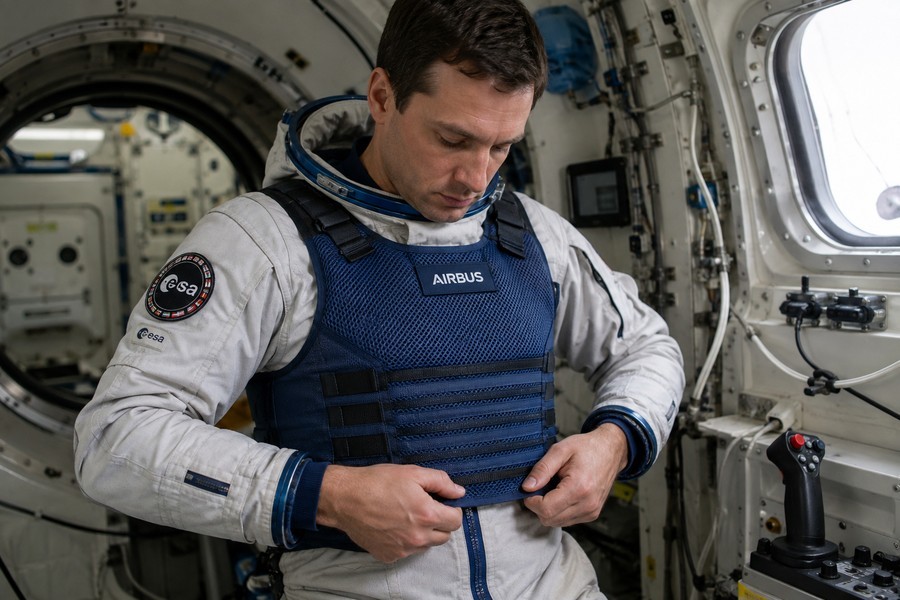
How a New Wearable Vest Could Protect Astronauts from Deep-Space Radiation
Space is a dangerous place for human travelers. When astronauts leave the safety of our planet, they lose the natural protection of Earth's atmosphere and magnetic field. One of the biggest threats they face comes from solar storms. These storms shoot out bursts of tiny, fast-moving particles called protons. These particles can damage cells, cause radiation sickness, and increase the risk of cancer.
Right now, spaceships do not have enough heavy shielding to block this radiation. To solve this problem, researchers tried a different approach: instead of trying to shield the entire spacecraft, they built a special vest to shield the astronaut instead.
Targeting the Most Sensitive Organs
For a long time, people thought that a protective suit would have to cover the entire body. It was assumed that the gear would need to be made of heavy metal, like lead, making it almost impossible for an astronaut to move around. However, engineers realized that the human body does not react to radiation the same way all over. Some parts of the body are much more sensitive than others.
The new vest focuses on protecting these key areas:
- Bone marrow: This tissue is found inside bones, especially the hips. It makes blood cells and is highly sensitive to radiation. Protecting even a portion of it helps the body heal and survive a high dose of radiation.
- Vital organs: The vest covers the stomach, colon, breasts, and reproductive organs. Protecting these areas helps lower the long-term risk of cancer.
By leaving the head, arms, and legs uncovered, the vest is much lighter and easier to wear, while still blocking a major portion of the radiation dose.
A Flexible Shield Made of Plastic
Finding the right material for the vest was a big challenge. The best materials for blocking radiation are rich in hydrogen. Water is great at this, but carrying liquid in a vest is risky because it could leak. Instead, the design team used a special type of solid plastic that contains a lot of hydrogen.
To make sure the stiff plastic did not stop astronauts from moving, engineers got creative. They cut the plastic into thousands of tiny, six-sided shapes called hexagons. They then arranged these pieces like a mosaic between two layers of stretchy fabric. This allows the vest to bend and twist easily, behaving almost like a liquid while remaining completely solid.
Testing the Vest in Deep Space
To see if the vest actually works, it was sent on an uncrewed test flight around the Moon. Since there were no humans on board, the vest was worn by one of two identical test dummies. These dummies were made of materials that mimic human tissue and bone. One dummy wore the protective vest, while the other went completely unprotected. Both dummies were packed with thousands of tiny sensors to measure radiation.
During the flight, the spacecraft passed through a naturally occurring belt of radiation around Earth. The sensors recorded how much radiation reached each dummy. Researchers used this real-world data to run computer simulations of different types of solar storms.
The results showed that:
- During a typical large solar storm, the vest reduced the radiation dose by about 60 percent.
- During an extremely strong, high-energy storm, the vest still cut the radiation dose by about 40 percent.
Helping Astronauts Work Safely
Normally, during a solar storm, astronauts would have to hide inside a small, heavily shielded shelter built into the spacecraft. However, these shelters are very cramped, and astronauts cannot do their normal work while inside them.
The vest offers a great alternative. It provides about the same level of protection as the ship's shelter, but it allows astronauts to walk around and keep working during a storm. Using the vest during a major solar event could significantly extend the total amount of time an astronaut is allowed to spend in space over their career.
While the vest is promising, it does have some limits. It does not protect against cosmic rays, which are constant, high-energy particles from deep space. Additionally, the original test vest was very heavy, weighing about 57 pounds.
To fix the weight issue, engineers have already designed a newer version. By looking at the flight data, they managed to cut the weight down to about 35 pounds without losing much of its protective ability. The goal is to make it light enough for astronauts to wear comfortably for several days in a row.