
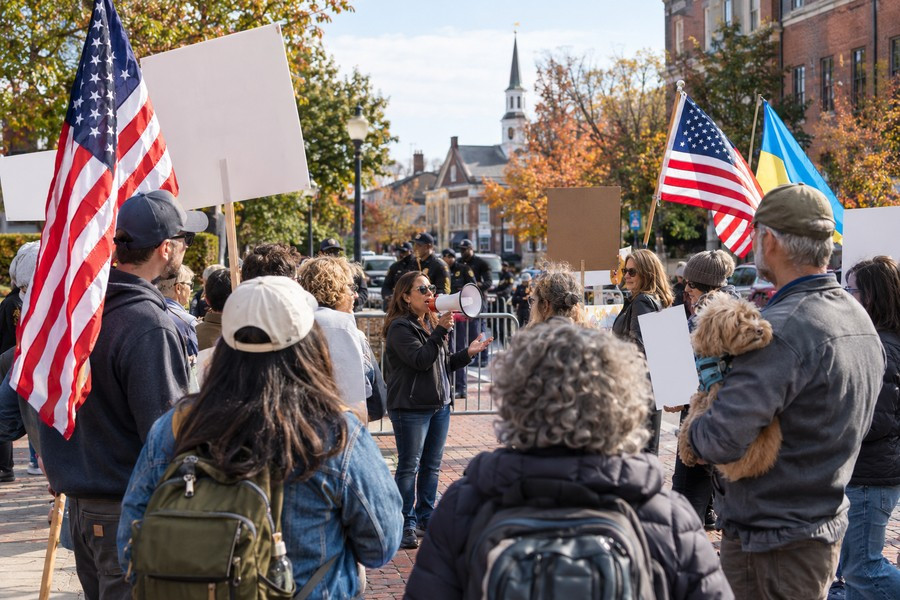
Protesters Call for Democratic Wins Despite Organizers’ Nonpartisan Rules
At a protest in Alexandria, Virginia, some people openly urged voters to support Democrats, even though the event’s national organizers had told participants not to endorse candidates or political parties.
Nayely Cruz Hernandez, a 26-year-old environmental engineer, stood with protesters along South Washington Street and called on voters to choose Democrats. She said the party needed to win control of both chambers of Congress, in Virginia and across the country.
Her boyfriend, Noah Schwarzott, stood beside her as she held their small dog, Maybellene. Hernandez said organizers could call the gathering nonpartisan, but she believed the protest was aimed at President Donald Trump and Republicans. She ended by saying her dog supported voting for Don Beyer, a Democratic member of Congress who represents Alexandria, Arlington and other communities in Northern Virginia.
Signs and Speeches Showed Clear Political Views
Other protesters also displayed messages that took sides. One sign called for a large wave of Democratic victories. A man carried a sign demanding that Trump leave office. Another protester held a balloon that mocked the president as a baby wearing a diaper.
A separate sign read “86 47,” a phrase previously posted online by former federal law enforcement director James Comey. Federal prosecutors had described the message as an open threat against Trump.
The national protest organizers had instructed participants not to call for voters to “vote Blue,” urge people to elect Democrats, endorse candidates or target individuals. The rules were intended to keep the events nonpartisan and comply with laws that limit political activity by some nonprofit groups that provide funding.
Organizers described the demonstrations as peaceful, nonpartisan gatherings where millions of Americans could support democracy, defend their freedoms and oppose authoritarian rule. They also said some partisan events using the movement’s name were not officially connected to the organizers. The Alexandria gathering, however, had been listed on the organizers’ official event site.
Another Protester Rejected the Nonpartisan Label
At a separate official gathering near the White House, protester Nadine Seiler said the event was partisan. Seiler, who describes herself as a professional protester and had recently been mentioned by Trump, was wearing an inflatable costume when she spoke.
She argued that people who support Trump were not taking part in the march, so the event could not truly represent both sides. She said demonstrators were resisting policies of the Trump administration that she viewed as illegal. Asked directly whether the protest was partisan, she answered yes.
Seiler summed up her view by saying the gathering was “as partisan as you can get.” Her comments echoed the signs and political appeals seen in Alexandria, where several participants made no effort to hide their preferences.
Organizers’ Rules and Political Goals
The protest network had issued detailed guidance against partisan slogans, campaign materials, candidate endorsements and coordination with political parties. At the same time, leaders of a nonprofit involved in the network had spoken publicly about differences between Democratic and Republican candidates and how activists could criticize Trump without directly endorsing Democrats.
One co-founder said Democratic candidates were strong across the country while Republican candidates were poor. In another online discussion, he advised activists to criticize Trump and let listeners draw their own conclusions about which candidates to support.
A second co-founder described the movement as a nonpartisan coalition meant to welcome people from across the political spectrum. The tension between that description and the statements made by some protesters and leaders has raised questions about how the movement’s political aims are understood.
Individual Views Do Not Automatically Break the Law
The legal distinction is important: a protester’s personal political speech does not by itself prove that event organizers broke election laws. Tax-exempt charities also face different limits from groups formed mainly to engage in political advocacy.
At the demonstrations, signs included messages opposing Trump and rejecting the idea of a crown or monarchy. From Northern Virginia to the area near the White House, some protesters said plainly that they opposed the president and wanted political change.
The events’ organizers continued to describe the broader movement as nonpartisan. But some participants saw the gatherings differently, arguing that opposition to Trump and his administration made their political position clear.