
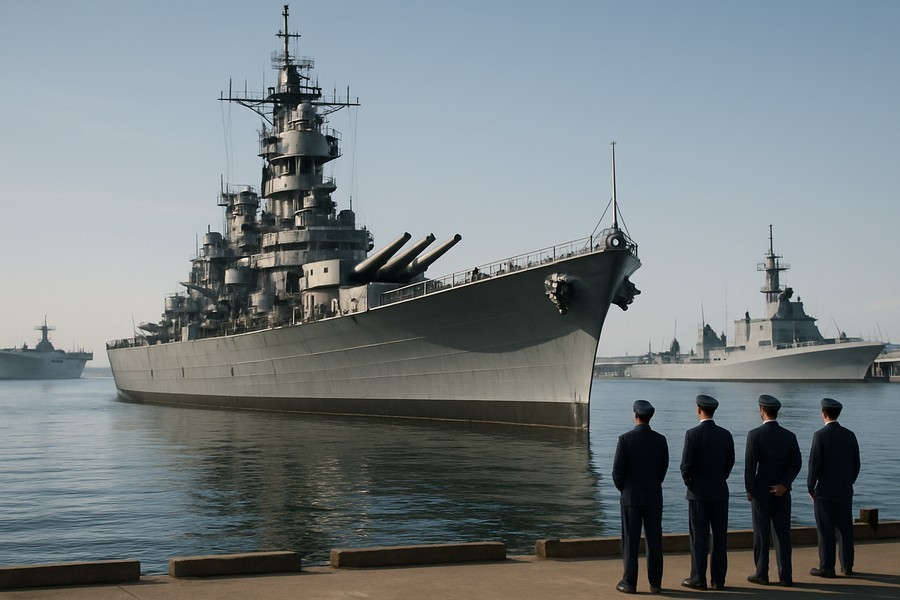
A New Generation of Battleships: Dream or Delusion?
Plans have been unveiled for a new type of battleship, being touted as "the fastest, the biggest, and 100 times more powerful than any battleship ever built." This new breed of warship is being hailed as a lethal force in surface warfare, promising to maintain military supremacy and instill fear among adversaries worldwide.
However, there's a significant hitch in these ambitious plans: the era of battleships has long since passed. The last of these ships was constructed over 80 years ago, and the last Iowa-class ships were retired nearly three decades ago. Once symbols of naval power with their heavy artillery, battleships have been overshadowed by aircraft carriers and modern destroyers equipped with long-range missiles.
Strategic Questions and Practical Concerns
Even though these new surface combatants are being referred to as "battleships," defense experts have identified several discrepancies between this vision and the reality of modern naval warfare. They argue that the program would take too long to design, be too expensive, and contradict the Navy's current strategy of distributed firepower.
One prominent defense advisor has gone on record, stating that "this ship will never sail." He predicts that the program will be axed before the first ship ever hits the water. Another senior fellow at an international studies institute described the proposal as more of a vanity project than anything practical.
Historically, the bigger the battleship, the more powerful it was perceived to be. However, the size of this proposed battleship - which would displace more than 35,000 tons and measure over 840 feet - could make it a prime target for enemies. The ship's size and prestige could increase its vulnerability on the battlefield.
Symbolic Power Versus Practical Use
There's a possibility that the allure of battleships, which were the most visible symbols of naval firepower in the 20th century, is what's driving this idea. An example of this is the USS Missouri, completed in 1944 and the last U.S. battleship built, which is famous for hosting Japan's surrender in 1945.
Battleships made their last appearance in combat in 1991, during the first Gulf War, providing shore bombardment fire support to coalition forces. Despite this, some argue that the ship classification matters less than the weapons it carries.
Technical Feasibility and Cost Implications
The proposed battleship, touted as part of a new "golden fleet," is set to be equipped with weapons such as conventional guns and missiles, electronic rail guns, laser-based weaponry, as well as nuclear and hypersonic missiles. Essentially, it would function like a large destroyer, regardless of its "battleship" label.
However, one defense expert counters that such a design contradicts the Navy's distributed operations model, which aims to reduce vulnerability by dispersing firepower across numerous assets. This proposal would do the opposite, creating a small number of large, expensive, and potentially vulnerable assets.
Even if the new breed of battleship is technically achievable, cost is expected to be the primary obstacle. U.S. weapons programs are notorious for exceeding timelines and budgets. For instance, the largest surface combatants currently in service had their numbers reduced from 32 to three ships due to skyrocketing costs. The cost of a new battleship could be two to three times more than today's destroyers, with a single battleship potentially costing over $8 billion. The continuous cost of crewing and maintaining the ships would also significantly strain the Navy's budget.
A Strategic Mistake?
Some have criticized the decision to pursue this new breed of battleship, labeling it a strategic error. They argue that the concept is rooted in strategic hubris and does not take into account the realities of modern naval warfare and the financial implications of such an undertaking.