
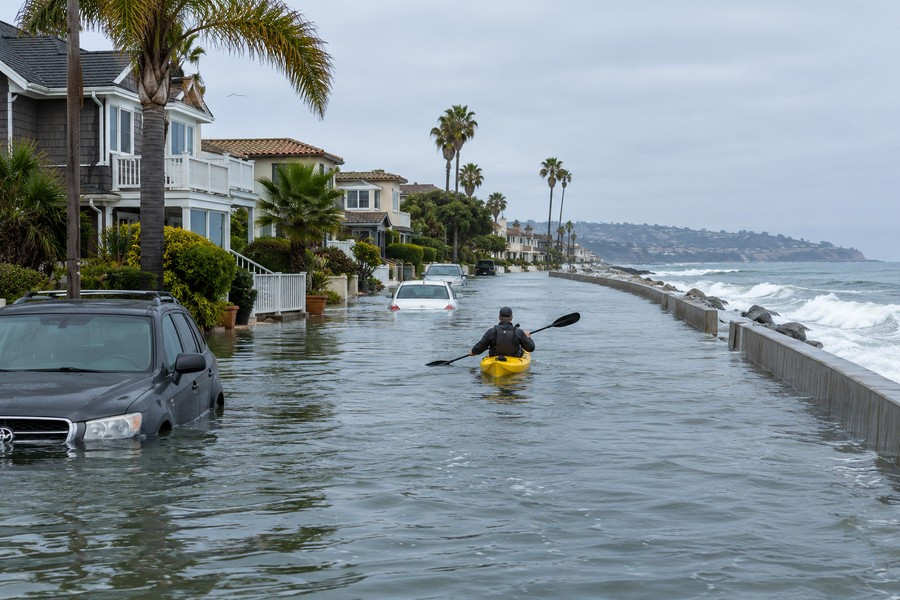
Rising Coastal Waters Flood California Communities
Unusually high tides have sent seawater into coastal neighborhoods across California. From San Diego to the San Francisco Bay Area, water has covered roads, entered homes and businesses, and disrupted major travel routes, including train lines.
Floodwater Turns Streets Into Waterways
In Marin County, north of San Francisco, people used kayaks and paddleboards to move through streets that are usually busy with cars. Several drivers had to be rescued from vehicles caught in the water. Some cyclists who tried to ride across the flooded area ended up standing in water up to their waists.
Farther south, in places such as Newport Beach, waves pushed against barriers built to hold back the ocean. Water found its way past sandbags, seawalls, and raised banks, reaching areas that the barriers were meant to protect.
The high water also broke records in several parts of the state. Near Los Angeles and San Diego, tides climbed above eight feet. In San Francisco, water reached its highest October level on record, surpassing the mark set the previous day.
More Flooding Expected Along the Shore
Flood alerts cover many coastal areas and are expected to remain in place for several days. In San Diego and Orange counties, more coastal flooding is expected during high tides through Thursday. Roads could close, while homes, businesses, and important services in low-lying areas may be flooded.
In Los Angeles, a moderate risk of flooding could continue into the weekend, though tides are expected to start falling after Thursday. Erosion along the shoreline is also expected in parts of California.
Southern California has faced repeated coastal flooding during the past two months. Los Angeles has already had 12 days of coastal flooding in 2026. That is more than any year in the past 50 years, and the year is not over.
Water Levels Could Rise Further
The danger may not end when this round of high tides recedes. The records set this week could be broken again, and the most serious flooding may still be ahead as a powerful El Niño develops in the Pacific.
Climate scientist Daniel Swain said the current conditions could be an early sign of much more disruptive events later in the year. He expects water levels to rise above this week's levels multiple times during winter.
Several forces are adding to the higher water. The ocean has been unusually warm, causing seawater to expand. Human-caused warming has also raised average sea levels. In addition, a large band of warm water has traveled across the Pacific and moved north along the coast of North America. This type of ocean wave can push coastal water levels higher, and more such waves may reach California during winter and early next year.
Some coastal communities face a high chance of flooding during December high tides. San Diego, La Jolla, Los Angeles, and Santa Monica each have a greater than 80% chance. Many coastal locations farther north, as far as the Canadian border, have a 60% to 80% chance.
Holiday Tides May Bring New Risks
The flooding this week did not happen during the year's highest predicted tides, often called king tides. Those tides are expected around busy holiday periods near Thanksgiving and Christmas, as well as around January 20 to 23 next year.
King tides can add another one or two feet to water levels. Average sea levels are already about a foot higher because of human-caused warming, while El Niño and the warm-water waves may add more. If these factors line up, sea levels could reach as much as five feet above average in many places at the same time.
Swain described the current conditions as already extreme and record-breaking. A storm arriving while the water is high could turn coastal flooding into a disaster. He estimated there is at least a 30% to 40% chance that all these conditions will overlap at some point this winter, possibly more than once.
El Niño Could Strengthen Storms
El Niño happens when parts of the equatorial Pacific become warmer than usual. A strong event can affect weather around the world. In California, it can bring powerful storms, with Southern California often receiving especially heavy rain.
If a major storm arrives during the highest tides, waves and floodwater could reach much farther inland. With already elevated seas, fragile coastal barriers, and more high tides ahead, communities may face dangerous conditions well beyond this week's flooding.