
A Milestone in Church History: The First Woman Takes on the Role of Archbishop of Canterbury
In a significant moment for the Church of England, the first woman has formally assumed the role of Archbishop of Canterbury. This event marks the beginning of her public service, bringing a wave of change to the church's leadership.
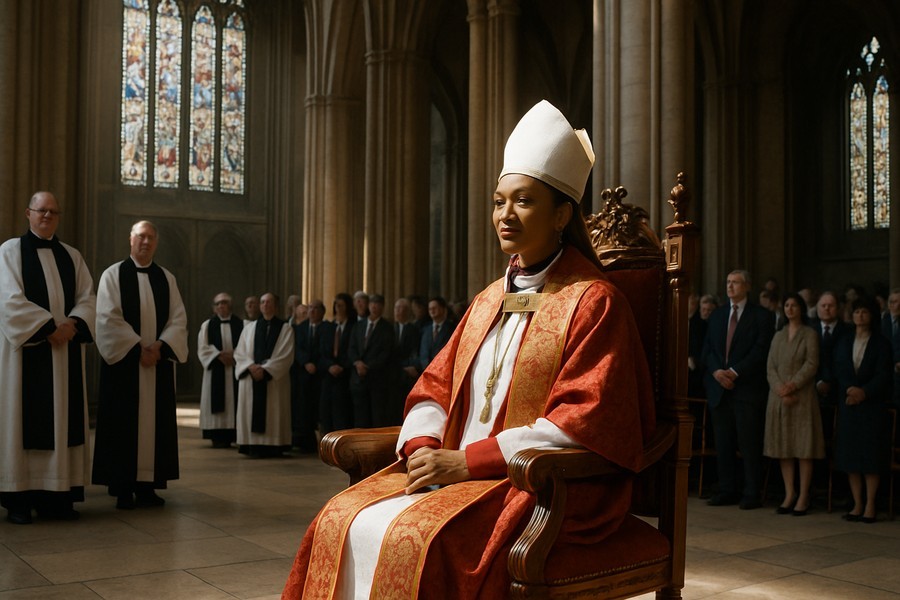
The woman, who served as a nurse before stepping into the religious field, recently took her place in the 13th-century St Augustine's Chair at Canterbury Cathedral. This momentous occasion was witnessed by over 2,000 attendees, including prominent personalities, religious leaders, and even the future king of Britain.
Breaking Boundaries and Celebrating Progress
The Church of England began ordaining women as priests in 1994, and 21 years later, in 2015, women started being appointed as bishops. Now, the newly installed Archbishop of Canterbury is moving forward as the spiritual leader of the global Anglican Communion, a religious community comprising approximately 85 million members around the world.
Despite formally assuming her role earlier in the year, the recent installation ceremony symbolizes the true beginning of her spiritual leadership.
The new Archbishop expressed her dedication to her role in her inaugural sermon, stating, "Here I am" to her God as she embarks on her journey. Dressed in a golden mitre, she prayed for peace to reign in parts of the world suffering from conflict and war.
Addressing Past Mistakes and Looking Towards the Future
The 63-year-old Archbishop acknowledged the church's past failures in safeguarding its members, emphasizing the importance of truth, compassion, justice, and action. Her predecessor had to step down following a scandal involving the cover-up of child abuse.
As the ceremony began, she knocked on the cathedral's west door, draped in a cape secured by a clasp reminiscent of the belt she wore as a nurse. She was welcomed by children, and prayers and readings in various languages echoed through the cathedral.
She also wore a ring that was given to a previous Archbishop by Pope Paul VI in 1966, symbolizing the strengthening relationship between the Anglican and Catholic churches after their split centuries ago.
The ceremony was held on the Feast of the Annunciation, a day celebrating the biblical story of an angel telling Mary she would be the mother of Jesus. This story served as the central theme of the service.
A Historic Shift in Church Leadership
The new Archbishop's appointment has been viewed as a historic event, signaling a significant shift in the Church's life.
While her appointment drew criticism from conservative groups that oppose women's leadership and same-sex blessings, these groups have since abandoned plans to appoint a rival figurehead. Instead, they've established a new council, made up of bishops, clergy, and lay members with voting rights, uniting provinces that have distanced themselves from Canterbury.
The global representative body of the Anglican Consultative Council also discarded a proposal that would have diminished Canterbury's traditional leadership role, after concerns it could create a rival authority center.
Addressing Divisions and Emphasizing Unity
The new Archbishop's role is primarily symbolic and relies on persuasion, unlike the Pope, who has clear authority over Catholics worldwide. Previous archbishops have grappled with deep divisions over LGBTQ issues and women's leadership between the progressive Church of England and more traditional provinces.
The new Archbishop has emphasized unity in diversity, saying, "We're a family with a shared root, and with any global church, there is great diversity in it."
The Church of England separated from Rome nearly 500 years ago. Since then, the Archbishop of Canterbury has served as the symbolic head of the Anglican Communion, which has grown worldwide, particularly in countries that were once part of the British Empire.