
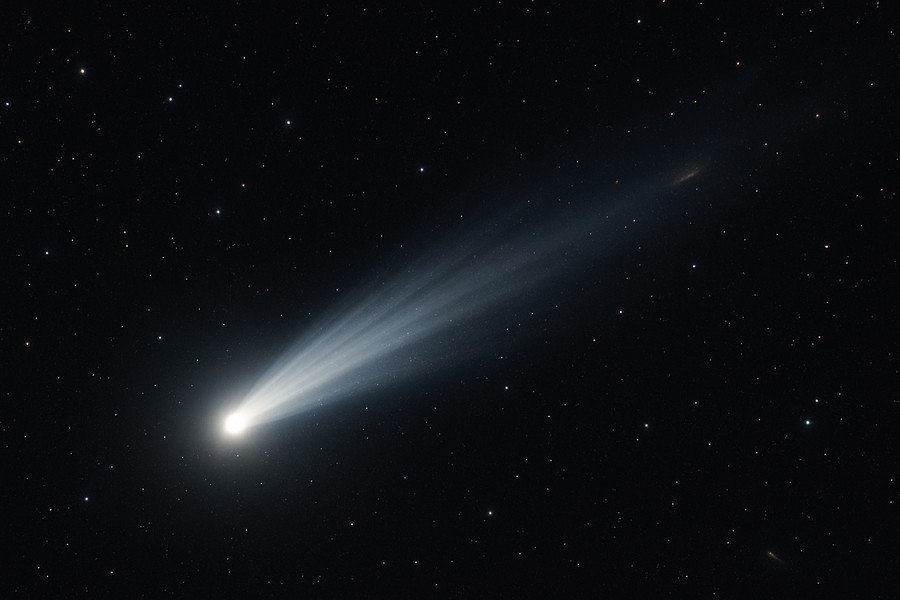
Exploring the Mysterious Origins of the Interstellar Comet 3I/ATLAS
It's not every day we get a visitor from another part of the galaxy, but last year, a comet whizzed by us before disappearing into the cosmic void. This comet wasn't an ordinary comet. It hailed from a distant and isolated part of the galaxy, probably from a region yet to mature into a solar system, according to latest studies.
Termed as the Comet 3I/ATLAS, this cosmic traveler is the third confirmed visitor from outside our solar system, and quite possibly one of the oldest known objects in the universe.
Interstellar Visitor with an Ancient Past
Researchers believe that this comet could be as old as 11 billion years, which is more than twice the age of our Sun. It offers a unique opportunity to learn more about the early universe and its various celestial phenomena.
It was first spotted last summer, a discovery that gave space agencies ample opportunity to study it as it raced past Mars. It made its closest approach to Earth in December, before speeding off beyond Jupiter, heading out of our solar system.
The Cold Origins of Comet 3I/ATLAS
The researchers found unusually high levels of deuterium, also known as heavy hydrogen, in the water of Comet 3I/ATLAS. This significant finding indicates that the comet was formed in a much colder place than our solar system, likely before the star of this solar system had even formed.
This suggests that the comet's home star might have been somewhat of a recluse, without many neighboring stars. This lack of neighboring stars, in turn, means less heat and therefore colder conditions.
Nevertheless, the exact birthplace of the comet remains a mystery.
Unraveling the Mystery of 3I/ATLAS
Studies using the Hubble Space Telescope have estimated the size of the comet's nucleus to be somewhere between a quarter-mile and 3.5 miles. The comet is currently speeding away from us at an astounding 137,000 mph.
By piecing together all these findings, astronomers hope to gain insight into how planets formed in the early universe.
Not the First Interstellar Visitor
Comet 3I/ATLAS is not the first interstellar object to enter our celestial neighborhood. The first known interstellar object, Oumuamua, was discovered in 2017. The second one, named Comet 2I/Borisov, was discovered in 2019 by an amateur astronomer.
These interstellar visitors provide a rare opportunity to learn about the conditions and processes at work in the distant corners of our galaxy, thereby enriching our understanding of the universe.
