
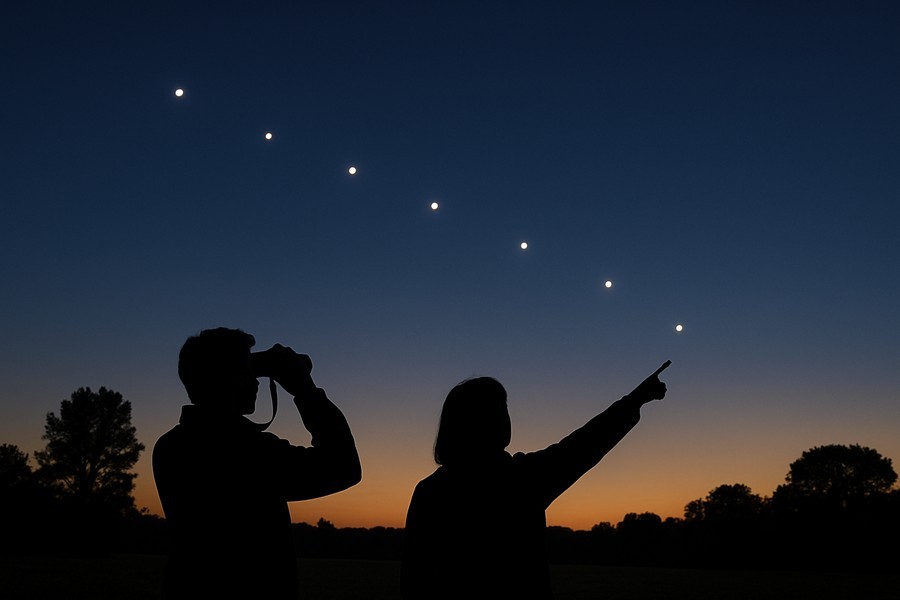
A Spectacular Parade of Planets Coming Up
If you're a fan of stargazing, get ready for a remarkable celestial event. An extraordinary line-up of six planets is set to grace the western sky after sundown. This planetary parade will feature Mercury, Venus, Jupiter, Saturn, Uranus, and Neptune.
However, it's worth noting that Uranus and Neptune might be a bit tricky to spot. You'll need the help of a telescope or binoculars to catch a glimpse of these distant planets. As for the rest, you'll be able to see them with your naked eye.
Planetary Alignment in Progress
This arrangement of six planets is already inching towards its position. The ideal time to witness this celestial spectacle will be on a forthcoming Saturday. From our viewpoint here on Earth, the planets won't form a flawless straight line, but they will seem pretty close to each other.
Don't Miss This Brief Opportunity
Here's a word of caution though - the best time to observe this planetary procession will be shortly after sunset. It's crucial to make sure the sun has completely set before you start watching to avoid any harm to your eyes.
All these planets will be situated low in the western sky. Mercury and Venus will be the lowest and will disappear below the horizon shortly after sunset. Thus, the window to see all six planets together will be quite brief.
Just above Mercury and Venus, you'll find Saturn and Neptune. To the left and a little higher up in the sky will be Jupiter and Uranus. Adding to the beauty of this scene, the moon will also be visible, positioned to the left of Jupiter and Uranus.
The previous time such an alignment of planets occurred was in the same month of the previous year, when Mars also joined the line-up.
Tips for Watching the Planetary Parade
This six-planet alignment towards the end of February means weather conditions will play a significant role. Will the western sky be clear just after sunset during this time?
If long-term weather predictions hold, a pause in the upcoming period of rain this weekend should allow a clear view of the sky, just in time for this event. The flow of air moving towards the Pacific Ocean should result in clear skies.
However, the region's complicated terrain could pose a challenge. For example, the Olympics might block the view of the lower western skyline. But don't worry, there's a solution - the ocean beaches will provide an unobstructed view to the west as this event takes place.
So, if you're a fan of such unique celestial events, there's a good chance you'll be able to witness it with clearing skies on the aforementioned Saturday, especially if you're near the ocean beaches.