
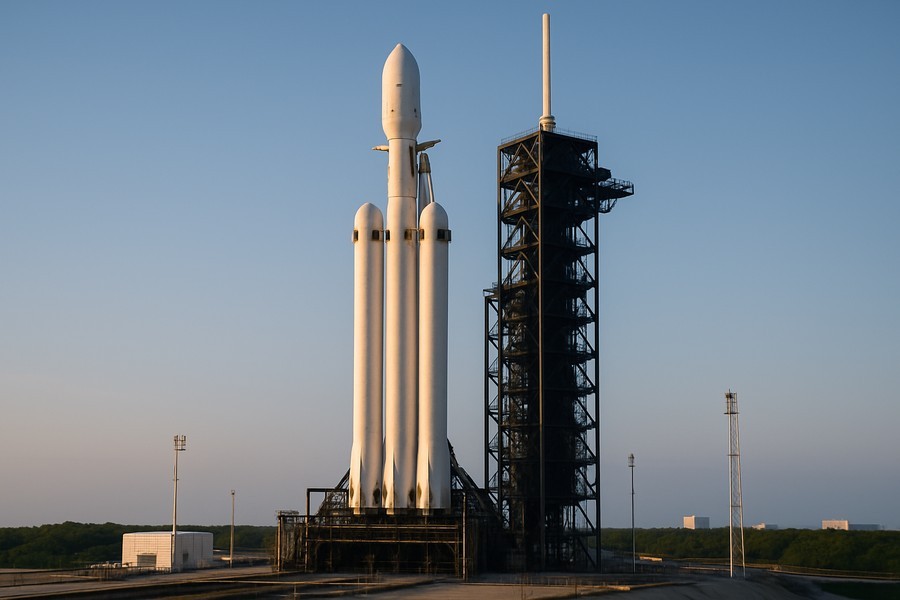
Reviving the Mighty Falcon Heavy Rocket After a Long Hiatus
After a long wait of 18 months, the powerful Falcon Heavy rocket is set for a spectacular launch. This event marks the first time the rocket will take to the skies after such a long break.
For this mission, the Falcon Heavy has been entrusted with the task of carrying the large ViaSat-3 F3 communication satellite. The launch site is the Kennedy Space Center in Florida, and the window for takeoff is set for 85 minutes starting at 10:21 a.m. EDT.
Witnessing the Liftoff
If you wish to experience the excitement of the liftoff, you can do so live. The coverage will start around 15 minutes prior to the launch.
Understanding the Power of Falcon Heavy
Falcon Heavy boasts three modified first stages of the Falcon 9 rocket. These stages are strapped together, with the central booster hosting an upper stage that is integrated with the payload.
At the launch, these three boosters together generate a massive thrust of about 5.1 million pounds. This makes the Falcon Heavy the second most powerful launcher in operation today. The first place is held by NASA's Space Launch System moon rocket, which generates a thrust of 8.8 million pounds.
The Journey of Falcon Heavy So Far
The Falcon Heavy rocket first took to the skies in February 2018. Its maiden flight involved launching a cherry-red Tesla Roadster into an orbit around the sun. Since that successful test flight, the rocket has completed 10 more successful missions.
However, it has been quite some time since the Falcon Heavy last launched. The previous launch happened in October 2024 when it was used to send NASA's Europa Clipper spacecraft towards the Jupiter system.
The Mission of ViaSat-3 F3
The ViaSat-3 F3, a 6.6-ton satellite, is destined for a geostationary orbit, which is 22,236 miles above the Earth. At this altitude, the satellite's orbital velocity matches the Earth's rotational speed, allowing it to "hover" over the same area continuously. This satellite is set to provide high-speed broadband services to customers throughout the Asia-Pacific region.
This will be the third ViaSat-3 satellite to reach orbit, following the ViaSat-3 F1 and ViaSat-3 F2. The former currently provides services to customers aboard airliners, and the latter is set to serve people in the Americas when it becomes operational next month.
Post-Launch Plans
After the launch, the Falcon Heavy's two side boosters are expected to return to Cape Canaveral Space Force Station in Florida about eight minutes later. The central booster, however, will not be recovered and is set to plunge into the Atlantic Ocean after its job is done.
Meanwhile, the upper stage of the Falcon Heavy will continue its journey, carrying the ViaSat-3 F3 to its geosynchronous transfer orbit. It will deploy the satellite there approximately five hours after the launch.