
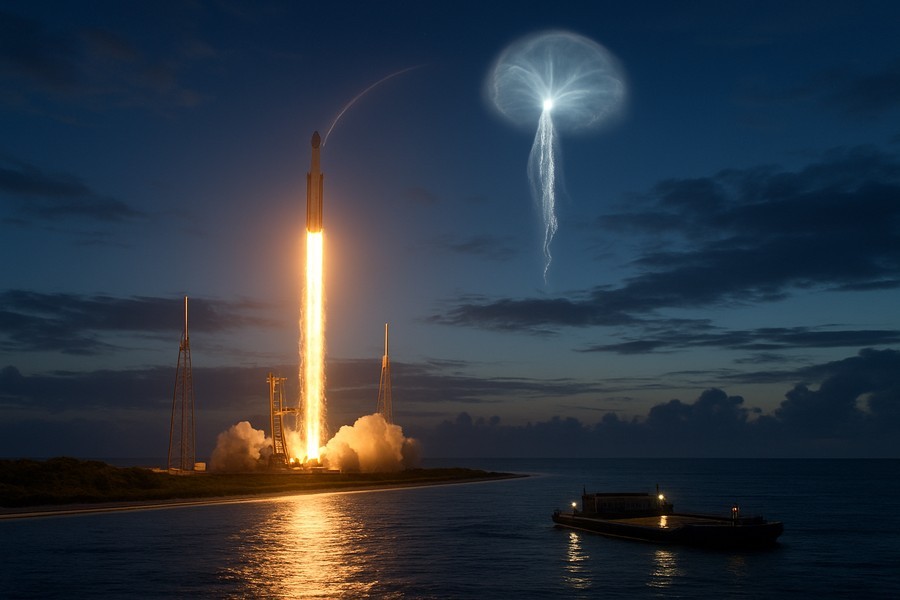
Thrilling Recap of Recent 'Jellyfish' Space Launch
An exciting pre-dawn rocket launch recently took place, with the liftoff creating an amazing 'jellyfish' effect in the sky. This mission, which consisted of launching a heavy-duty rocket carrying multiple communication satellites, started off at a military space station.
The majestic rocket soared towards the northeast, along the Eastern Seaboard, under partly cloudy skies and gentle easterly winds. The weather was just right for the launch with the temperature around 64 degrees.
Landing of the Rocket Booster
The rocket took off successfully, marking the 25th flight for this particular model's first-stage booster. This booster has a track record of launches including multiple communication satellite missions. The booster's landing was executed on a drone ship in the Atlantic Ocean, a routine procedure for this type of launch. Interestingly, no sonic booms were expected in the nearby county during this mission.
The Jellyfish Effect
Shortly after the rocket's liftoff, a visual phenomenon known as the "jellyfish effect" was observed. This effect, created by the expanding exhaust plume of the rocket, was visible in the sky, creating a breathtaking spectacle for viewers on the ground.
Countdown to Liftoff
The launch was preceded by a series of countdown milestones. Seven minutes before liftoff, the rocket's engines began to chill in preparation for the launch. At the one-minute mark, the flight computer initiated final prelaunch checks, and the propellant tank pressurization to flight pressure commenced. With 45 seconds remaining, the launch director gave the green light for the launch. Finally, the engine ignition sequence was started three seconds before zero, marking the liftoff of the rocket.
Pre-Launch Activities
Prior to the countdown, the rocket was loaded up with fuel at the launch complex. The countdown was fixed for an early morning liftoff. If any delays occurred, the launch would have had to be postponed to a later date. In addition to fueling, the rocket's booster was prepared for its landing on the drone ship in the Atlantic Ocean.
Future Launch Plans
Following this successful launch, the team is already looking forward to their next mission. This future mission will involve the launch of a powerful new generation of satellites using massive rockets. This constellation of satellites, already consisting of hundreds in low-Earth orbit, will be accessible to over 1.7 billion people around the globe, offering data, voice, video, and messaging services across six continents.
Launch Frequency and Weather Conditions
With this recent launch, the total number of orbital rocket launches from this space station and a nearby space center so far this year has reached sixteen, all of which were successfully carried out. The weather conditions during the launch were fair, as reported by the National Weather Service, with a mild breeze and a visibility of ten miles at the space station.
Pre-Launch Preparations
Before the launch, local Emergency Management officials activated their launch operations support team in anticipation of the upcoming liftoff. This activation is a standard procedure to ensure the safety and success of every launch.