
Deadly High-Speed Train Collision Leaves Spain Facing Tough Questions
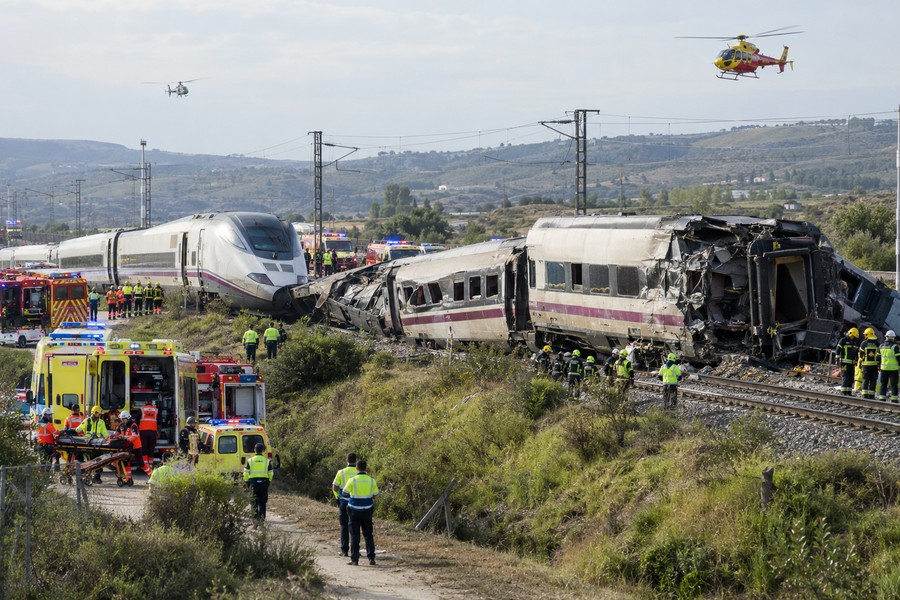
A high-speed train crash in central Spain has killed at least 68 people and injured many others. Two passenger trains collided on a rail line south of Madrid, leaving several cars damaged and some pushed down an embankment.
What Happened on the Rail Line
The crash took place between the towns of Mora and Orgaz, about 140 kilometers south of Madrid. It happened at 8:53 in the morning on a high-speed route that connects the capital with southern parts of the country.
A privately operated passenger train was stopped near the town of Urda when a state-operated train struck it from behind. The second train was traveling at high speed when it hit the stationary train.
The force of the crash caused several carriages to leave the track and fall down a slope beside the rail line. Emergency crews quickly arrived at the scene, while helicopters and fire teams helped with rescue efforts.
Rail service along the route was stopped. Trains traveling between Madrid, Ciudad Real and the southern region of Andalusia were suspended as investigators and rescue workers examined the area.
A passenger described feeling a powerful impact roughly 40 minutes after the journey began.
Questions About the Signaling System
Early information points to a failure in the rail control system before the collision. A computer problem stopped six moving trains, including the two involved in the crash.
When the system fails, a central control center takes charge of train movement. The transport minister said the control center allowed the trains to continue without placing a speed limit on them. He called the decision difficult to explain.
Recordings of conversations between train drivers and rail controllers appear to show that one train was cleared to move even though another train had stopped about 25 kilometers farther along the track.
One driver was told to disconnect and reconnect the train's automatic speed-monitoring equipment before continuing at normal speed. The driver asked whether normal speed was allowed, and the controller confirmed that it was.
Under standard emergency rules, the train should have moved much more slowly. The driver would normally be expected to travel at no more than 40 kilometers per hour while watching the track ahead. The rail line is built for speeds of up to 200 kilometers per hour.
The backup signaling method is used when automatic signals or data connections stop working. Investigators are examining whether the system was used correctly and whether the train received the right instructions.
The Train Ahead Could Not Move
Another recording appears to show that the train in front was stopped at an entry signal near Urda. A controller told its driver to continue the journey normally.
The driver later said the train could not start because its safety system would not allow the controls to operate. The train remained stopped in front of the signal.
This exchange suggests that rail controllers may have known the first train was still stopped when the second train was moving toward it. Investigators will need to determine what each controller knew, when the information was received and why the trains were allowed to continue.
More Than 540 People Were on the Trains
More than 540 passengers were traveling on the two trains. The privately operated train carried 146 passengers and one baby. The state-operated train had 397 passengers on board.
A former government minister was also listed among the missing. The head of a business group's foundation was reported to have been on one of the trains.
At least 80 people received medical treatment. About 50 injured passengers were in serious condition, while 15 others were considered critically injured.
- At least 68 people were confirmed dead.
- More than 540 people were aboard the two trains.
- At least 80 people were treated for injuries.
- Several dozen passengers suffered serious or critical injuries.
- Rail service on the route was halted after the crash.
Emergency Crews Search for Missing Passengers
Firefighters, medical teams and helicopters worked at the crash site. Authorities also opened offices in Madrid, Toledo, Seville and Córdoba to collect information about missing people.
The Civil Guard said its main goals were to identify those who had died and collect DNA samples so families could be connected with missing relatives.
Officials began a formal investigation into the crash. The government said it would examine the cause of the system failure, the decisions made by rail controllers and whether safety procedures were followed.
National Mourning and Political Pressure
The prime minister said the crash had caused deep pain across Spain and left families devastated. He promised a full investigation and said any negligence would be exposed. He also said that failures in the rail safety system would be addressed firmly.
The main opposition leader said the public deserved clear answers about the country's rail infrastructure. He added that the time for assigning political blame would come later.
Most political leaders canceled public events and stopped their election activities. One far-right party refused to join, saying mourning should not prevent criticism of the country's rail system.
Spain's royal family expressed shock and offered sympathy to the victims' relatives. European officials said help would be available if Spain requested it.
A Second High-Speed Rail Disaster
The crash is the second deadly high-speed rail tragedy in Spain in a short period. Earlier, another high-speed train derailed in the south of the country, sending its rear cars into the path of a state-operated train. That disaster killed 46 people.
The latest collision has renewed concerns about Spain's rail safety systems, emergency procedures and the way trains are controlled when computer and signaling equipment fails.