
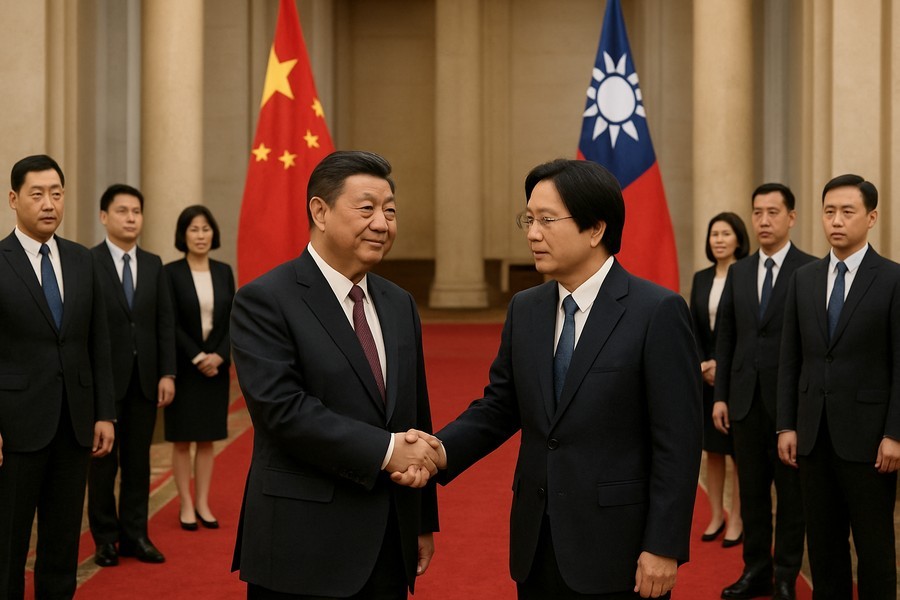
High-Level Talks Seek Peaceful Resolution for Taiwan
In a historic meeting, the opposition leader from Taiwan and the Chinese President met in Beijing to discuss the future of Taiwan. Both leaders expressed their shared belief in maintaining Taiwan as part of China and their mutual desire to achieve a peaceful resolution to the ongoing dispute over the status of the island.
This gathering, which included an open discussion and a private meeting, took place in the Great Hall of the People. The leaders also took the opportunity to take photographs together and share public statements.
A Rare Encounter
This event marks the most significant meeting between a Taiwanese leader and the Chinese President since a similar encounter occurred in Singapore in 2015. On that occasion, the Taiwanese leader later held a second meeting with the Chinese President while he was a private citizen in China.
Both Taiwanese leaders are members of the conservative-leaning Kuomintang, a political party in Taiwan that supports stronger engagement with China by the self-governed democratic government of Taiwan.
Building Bridges, Not Walls
The Taiwanese opposition leader emphasized in her public remarks that leaders on both sides should strive to rise above political conflicts and mutual animosity. She expressed a vision for the Taiwan Strait to function as a bridge that joins family ties and cultures, rather than a potential point of conflict or a chessboard for foreign powers.
She highlighted the importance of ensuring that the strait becomes a symbol of peace jointly maintained by the Chinese people on both sides. She also praised the Chinese Communist Party's achievements, including its successful mission to eradicate extreme poverty and its ambition to rejuvenate the Chinese nation.
Shared History and Culture
The Chinese President focused on the shared history and culture of Taiwan and China during their open discussion. He stated that all ethnic groups, including the Taiwanese, have played a part in creating the magnificent history of China. He further added that the Chinese roots and spirit, deeply rooted in history and blood ties, are shared by all Chinese people, and these cannot be erased or forgotten.
He pledged that along with the Kuomintang and other Taiwanese society members, Beijing is prepared to strive for peace across the Taiwan Strait.
Non-Interference
Both leaders expressed their opposition to foreign intervention in Taiwan-China relations. The Taiwanese leader hinted at a slower pace of Taiwan’s military build-up, suggesting a less defence and deterrence-oriented approach to preventing warfare.
This statement implies that under her leadership, the Kuomintang would slow down on defence buildup and purchasing US arms.
An Ongoing Controversy
The issue of Taiwan's military expansion has stirred up a heated debate in the legislature. For several months, the opposition party has stalled a massive budget intended for acquiring US weapons, arguing that the defense bill is overly large and vague. They proposed a significantly smaller alternative instead.
Despite promises of peace from the Chinese President, China has continuously increased its military presence in the waters and airspace surrounding Taiwan over the years. The Chinese armed forces have conducted multiple rounds of live-fire military drills in the Taiwan Strait, which separates Taiwan from the Asian mainland.
Identity Crisis
Over the past decade, the Democratic Progressive Party in Taiwan has strived to elevate Taiwan's profile on the global stage by promoting a distinct Taiwanese identity. This has sparked anger in Beijing, which accuses the party's leadership of pushing a separatist agenda.
Formal communication between Chinese leadership and Taipei was severed shortly after the Democratic Progressive Party came to power in 2016. However, communication continues through various groups, including the Kuomintang.
When asked about her position on the unification of Taiwan and China after the meeting, the Taiwanese opposition leader avoided giving a direct answer. Instead, she stated that her primary objective was to seek reconciliation based on shared history and culture.
Despite their current dialogue, the Kuomintang and the Chinese Communist Party have a history of conflict. They engaged in a brutal civil war during the republican era of China, only pausing to fight the Japanese during World War II.
This conflict remains unresolved as the Chinese Communist Party continues to claim Taiwan as a province and is committed to annexing it, either peacefully or by force.
However, in recent years, Taiwan, while still formally known as the Republic of China, has experienced a significant cultural and political transformation since its democratization in the 1990s, accompanied by a rise in Taiwanese nationalism.
A national identity survey by a Taiwanese university in 2025 found that the percentage of respondents identifying as Taiwanese has significantly increased since 1992. Meanwhile, the percentage of respondents identifying as Chinese or both Taiwanese and Chinese has decreased.