
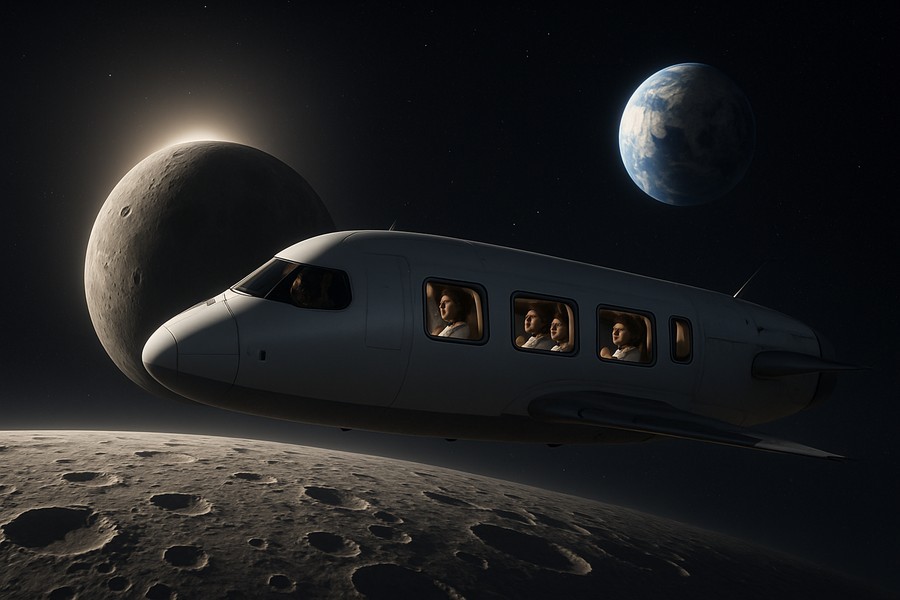
Unseen Lunar Beauty Captured by Artemis II Astronauts
In a groundbreaking lunar mission that propelled the four astronauts further from Earth than any human has ever been, the crew from Artemis II has shared breathtaking photographs from the unexplored side of the Moon.
The photographs reveal a remarkable view of Earth peeking over the edge of the Moon, setting and rising again. They also show a rare solar eclipse in space when the Moon came between the spaceship and the Sun. Additionally, they include detailed images of the heavily cratered far side of the Moon, which is quite different from the relatively smooth near side.
The Lunar Journey of Artemis II
The crew's lunar flyby lasted seven hours, with a 40-minute loss of communication as the Moon blocked the signal. As they flew behind the Moon, the four astronauts captured images of the far side from their closest distance of 6,545 kilometers (4,067 miles) from the lunar surface. The spaceship then reached its farthest distance from Earth at 406,771 kilometers.
When the spaceship reemerged and reestablished communication with Earth, the crew witnessed a total solar eclipse for almost an hour. This rare event revealed details in the Sun's corona, usually hidden by its bright light. In the absence of the Sun's glare, the crew also saw the faint flashes of six meteorite impacts on the Moon's surface.
The Mysteries of the Lunar Far Side
The far side of the Moon intrigues scientists due to its stark contrast with the near side. While the near side features large, flat, dark plains of volcanic basalt that seeped from below the lunar surface millions of years ago, the far side has little basalt and is heavily scarred by craters. The reason behind this difference is still unsolved, and scientists hope advanced technology will help find answers.
Back on Earth, scientists are already studying the photographs. They are particularly interested in the impact craters, ancient lava flows, and surface fractures captured by the crew. These images will help them understand the Moon's geological evolution. The crew also documented color, brightness, and texture variations across the terrain, observed an earthset and earthrise, and captured solar eclipse views of the Sun's corona.
The Journey Home and Beyond
The spaceship is now on its return journey to Earth, with a landing scheduled in the Pacific Ocean near San Diego. This part of the mission is arguably the most dangerous, as the craft will experience a high-speed reentry into the Earth's atmosphere and splashdown in the ocean.
The knowledge gained from the mission will be invaluable for the upcoming stages of the Artemis program. The observations of the Moon will provide insights into the target itself, while the nearly 10-day journey will help refine the spaceship and mission design for future crews.
The next part of the program, Artemis III, is planned for 2027. It will involve launching a crew in a spaceship on a rocket to low Earth orbit to test rendezvous and docking procedures with commercial spacecraft planned for future lunar landing operations. The fourth stage, Artemis IV, is targeted for early 2028. It will aim for a crewed landing near the Moon's south pole, where astronauts will conduct scientific observations and collect samples.
The Impact of Artemis II
Regardless of the future stages, the data collected by the Artemis II crew is a scientific treasure. The astronauts' journey has taken humans further from Earth than ever before, and the wealth of knowledge they've brought back promises to revolutionize our understanding of the Moon and beyond.