
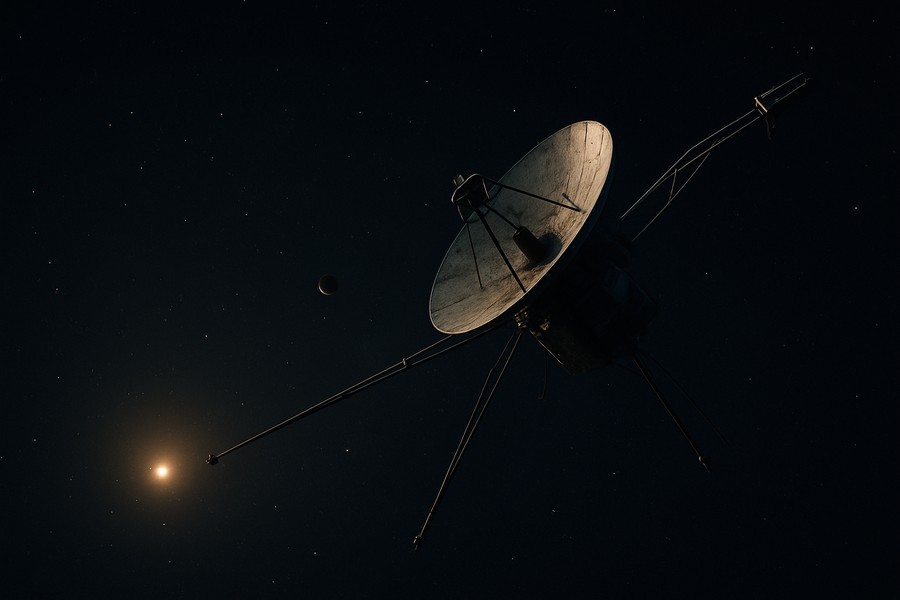
Powering Down to Extend the Life of a Historic Space Probe
About five decades ago, a small car-sized spacecraft embarked on what was planned as a five-year journey originating from the Florida coast. Now, in a bid to extend its life span, one of the remaining scientific instruments on this spacecraft has been turned off. Interestingly, this was not driven by failure, but a strategic move to conserve power.
A Machine Defying Expectations
The spacecraft in question, Voyager 1, holds the record as the farthest human-made object from Earth. Despite being designed to last just five years, it has been functioning for nearly fifty. Its engineers, based in Southern California, are pulling out all the stops to ensure it keeps going for as long as possible.
The probe was launched with a mission to leverage a unique planetary alignment that would not recur for about 175 years. This alignment of Jupiter, Saturn, Uranus, and Neptune allowed the spacecraft to use each planet's gravity to gain speed and change direction without wasting fuel. This technique, known as gravity assist, made it possible for Voyager 1 to embark on its ambitious journey.
A Journey of Discovery
Originally, the Voyager program was meant to explore all outer planets in an initiative known as the "Grand Tour". However, due to budget constraints, the program was restructured to a simpler, intensive fly-by of Jupiter and Saturn. Despite these changes, the two Voyager spacecraft have outlasted their initial five-year lifespan by nearly a decade.
Voyager 1 made significant discoveries during its journey. It revealed active volcanoes on Jupiter's moon, Io, in 1979, marking the first observation of volcanic activity beyond Earth. In 1980, it provided detailed studies of Saturn’s rings and its moon Titan.
In 1990, Voyager 1's mission was extended and it was tasked with reaching and studying the edge of the Sun's influence and the space beyond. In 2012, it crossed the heliopause, the boundary where the Sun's charged-particle wind gives way to interstellar space, becoming the first human-made object to wander between the stars. Its twin, Voyager 2, achieved the same feat in 2018.
Powering Down to Keep Going
As of now, Voyager 1 is over 15 billion miles away from Earth. At this distance, it takes a radio signal traveling at the speed of light more than 23 hours to reach the probe. Its power source, a radioisotope thermoelectric generator, converts heat from decaying plutonium into electricity. With no solar panels or rechargeable batteries, the generator's power has diminished about 4 watts each year over the past five decades, leading to a critical decline.
During a routine maneuver, Voyager 1's power levels fell unexpectedly, which would have triggered an automatic fault-protection shutdown. To prevent this, the team decided to deactivate the Low-energy Charged Particles experiment (LECP), one of the remaining scientific instruments on Voyager 1. This instrument has helped to map the structure of interstellar space in a unique way by measuring ions, electrons, and cosmic rays from our solar system and beyond.
Voyager 1 now operates with two functional scientific instruments: one that listens for plasma waves, and one that measures magnetic fields. The engineers hope that by shutting down the LECP, they can extend the mission by another year.
The Future of Voyager 1
The team is also working on a comprehensive power conservation plan, unofficially known as "the Big Bang". This plan involves a coordinated swap of several powered components for lower-power alternatives. If tests on Voyager 2 planned for the near future are successful, the same procedure will be implemented on Voyager 1.
There's even a slim chance that the LECP could continue its work if the power conservation strategy is successful. The team hopes to keep at least one instrument operating on each spacecraft into the 2030s, allowing both to continue reporting from uncharted territories.