
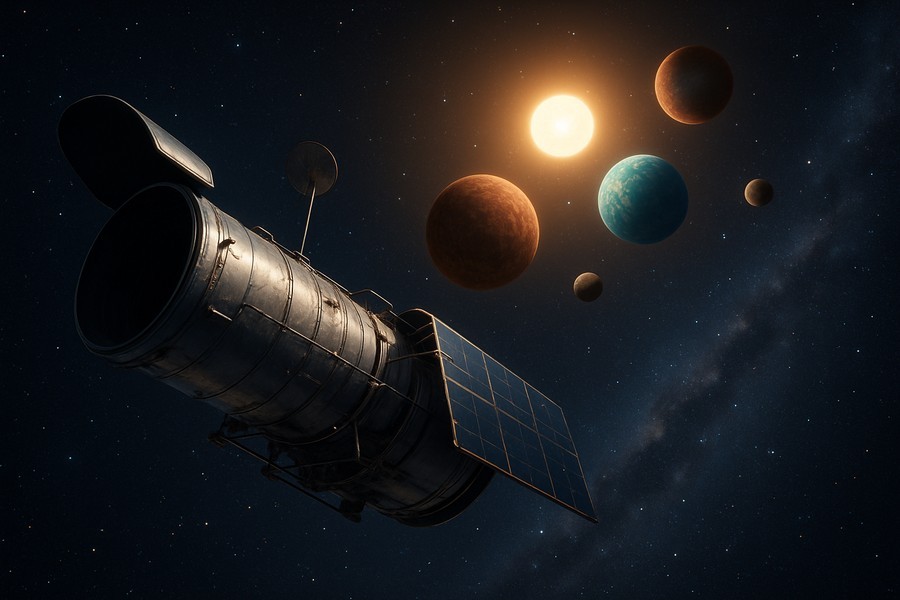
A Year of Remarkable Discoveries in the Search for Exoplanets
Over the past year, the list of confirmed exoplanets - planets beyond our solar system - has grown significantly, surpassing the 6,000 mark. The discovery of these celestial bodies, some of which have properties and characteristics unlike anything in our own solar system, has expanded our understanding of the Milky Way. The hunt for these exoplanets has been largely powered by the use of space telescopes.
Unusual Planetary Systems
One of the most notable discoveries has been the identification of multiple planets that orbit two suns. These so-called "Tatooine" worlds, named after Luke Skywalker's home planet in Star Wars, have challenged previously held notions about planetary formation. Some of these planets, like one located about 120 light-years from Earth, orbit their two stars in an unusual way, moving above and below the poles of the stars, rather than along a flat plane.
The Question of Life on Exoplanets
The exoplanet K2-18b attracted significant attention due to claims of potential biosignature gases in its atmosphere. However, these claims have been disputed, with some studies suggesting the gases could be nonbiological, and others arguing that the data is too weak or noisy to draw definitive conclusions. Despite the debate, K2-18b remains a high-value target for understanding planets in our universe.
Challenges to Habitability
Further studies of TRAPPIST-1e, an Earth-size planet about 40 light-years from Earth, suggest the planet may lack a substantial atmosphere, complicating hopes that it could support life-friendly liquid water. These findings serve as a reminder that even in the most promising worlds, the search for life is complex and challenging.
Probing Our Closest Stellar Neighbor
In the past year, astronomers have gained a clearer view of the planetary system around Proxima Centauri, our closest stellar neighbor, located just 4.2 light-years away. A new high-resolution spectrograph installed at an observatory in Chile confirmed the presence of an Earth-size planet in the habitable zone of the star, and also helped to refine the census of the nearest planetary system.
Disintegrating Worlds
Some of the most intriguing exoplanets discovered over the past year are those that orbit so close to their stars that they have long tails of material. One such planet, located about 140 light-years from Earth, orbits its star at a distance roughly 20 times closer than Mercury orbits the sun. At such proximity, intense stellar heat vaporizes material from the planet's surface, which then streams into space, forming a comet-like tail that stretches up to 5.6 million miles.
A Long-Living Atmosphere on a Lava World
A surprising discovery was made on TOI-561b, a small, scorching lava planet that orbits one of the oldest stars in the Milky Way. Despite its proximity to its star and its extreme age, observations suggest that this planet still has a substantial atmosphere, challenging assumptions about the conditions in which planetary atmospheres can survive.
From Formation to Destruction
This year, astronomers have captured two astonishing moments in the life of a planet. In one study, an image was taken of a planet forming about 437 light-years from Earth. In another, observations of a dead star's remains reveal the ongoing destruction of a planetary relic, possibly a body roughly 120 miles wide, being torn apart by the star's intense gravity.
These discoveries highlight the incredible diversity of exoplanets and the fascinating mysteries they hold, underscoring how much there still is to learn about the universe.