
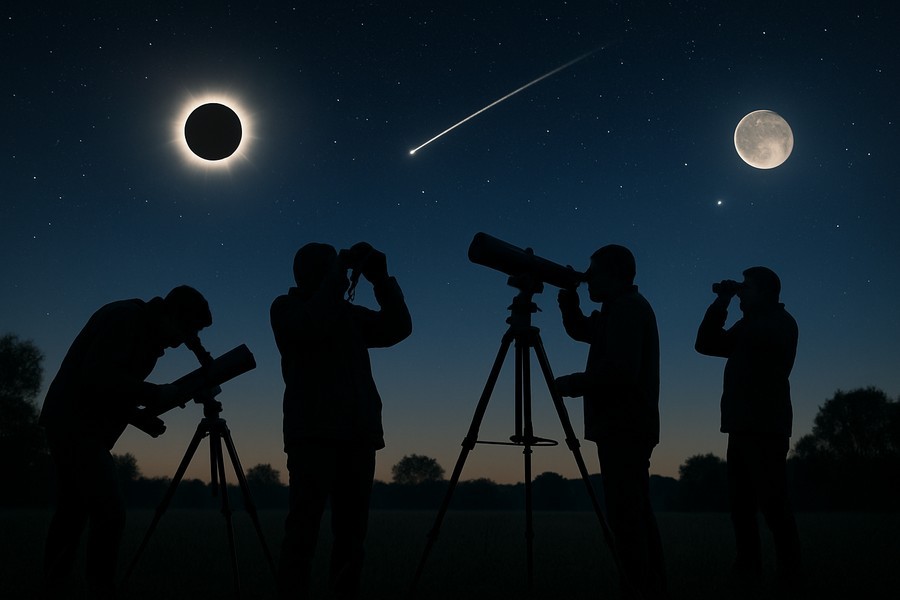
An Exciting Year Ahead for Skygazers in 2026
Prepare to be amazed by a host of celestial events in 2026. Skywatchers can look forward to a year filled with eclipses, meteor showers, and more. The universe never disappoints with its constant show of cosmic wonders.
A Year of Eclipses
Keep an eye out for several exciting eclipses in 2026. One of the highlights will be a total solar eclipse on August 12th. This celestial event will be visible across Greenland, Iceland, and northern Spain. Additionally, there will be a total lunar eclipse visible from North America and the Pacific Region on March 3rd.
- You'll also witness the incredible sight of Jupiter's moons eclipsing each other.
- On June 17th and September 14th, the Moon will occult Venus during dusk.
- Eastern North America will have the chance to see the Moon occult Jupiter on October 6th.
Stellar Meteor Showers
Star enthusiasts can also anticipate two spectacular meteor showers. The Perseid and Geminid meteor showers promise to put on a fantastic show, especially since the Moon will be near new during these events.
Moon, Planets, and Stars
The Moon will also have exciting interactions with other celestial bodies in 2026. The Moon will occult both Antares and Regulus, two bright stars, and it will also meet with Saturn in the dusk sky on April 20th.
A fascinating spectacle will be the Moon's interactions with the Pleiades, a famous star cluster.
Several significant lunar, planetary, and stellar groupings will occur in November, as the Moon moves past various planets and bright stars.
Celestial Bodies in Focus
The Sun will continue to be active in 2026 with ongoing solar cycles producing sunspots and other space weather phenomena.
Meanwhile, the Moon's path will continue to transition. This change is due to the Moon's orbit's 5-degree tilt versus the ecliptic, leading to a cycle transitioning from hilly to shallow and back to hilly.
On the planetary front, the paths of the planets will continue to wander from the dawn to dusk sky and back again, creating an ever-changing celestial landscape for observers on Earth.
Look Out for Comets
As for comets, a good binocular comet known as C/2025 R3 PanSTARRS will make a brief appearance in Spring 2026. Remember, the universe can always surprise us with a sudden appearance of a bright comet on a long period orbit.
So, prepare your telescopes and binoculars for a year filled with breathtaking celestial events. No doubt, 2026 promises to be a fantastic year for all skywatchers.