
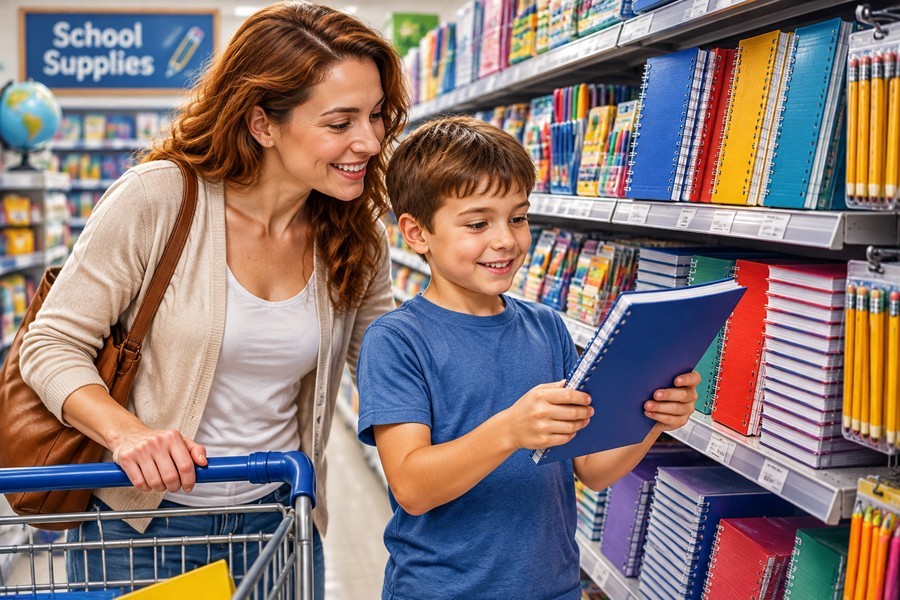
The Growing Financial Burden of Sending Kids Back to School
For many families, preparing for a new school year has become a major financial challenge. Parents who once focused on buying durable, high-quality items are now forced to search for deep discounts and cheaper alternatives just to get by.
In Salt Lake City, Brandi McGrath has experienced this firsthand. As a mother of a nine-year-old son, she has always tried to buy sturdy supplies that would last. Now, she is hunting for every sale she can find because basic items have become incredibly expensive. She noted that the rising costs have put a significant strain on her household budget.
Across the country in Daytona Beach, Florida, Karin Kaiser faced a similar shock when shopping for her two daughters. She and her husband spent more than $100 just on basic notebooks and looseleaf paper. That total did not even cover other essential school expenses like new clothing, shoes, or haircuts.
The Rising Cost of Classroom Basics
A typical list of school essentials—including paper, pencils, notebooks, and glue—now averages nearly $175. This represents an increase of almost 8% compared to the prior year. Some of the most common products have seen even steeper price jumps:
- Everyday essentials like lunch boxes, notebooks, and tissues cost 20% more than they did a year ago.
- Electronic items, including student headphones, have gone up by 6.6%.
- School lunch foods, such as deli meats and fruit, have risen by 10.9%.
A major factor behind these rising prices is import tariffs, which have increased the cost of goods manufactured overseas for American shoppers.
Why School Supplies Cost More
Many of the largest companies that manufacture school supplies have raised their prices. These businesses point to inflation, high fuel costs, and import tariffs as the main reasons for the increases.
One major corporation that produces popular glue, markers, and pens raised its prices to cover more than $170 million in tariff expenses. Another large manufacturer of school notebooks warned that global conflicts and shipping issues are driving up costs, which will likely lead to even higher prices for consumers worldwide.
A government spokesperson stated that as shipping routes normalize, energy costs and overall inflation should decrease, which will allow wages to grow. The administration defended its economic policies, stating they are designed to support job and wage growth.
Families Search for Deals and Cut Back
With prices rising, many parents are changing how they shop. A study found that 72% of shoppers feel that clothes, electronics, and school supplies are much more expensive now. To cope, 62% of parents are actively searching for sales, and a quarter of them plan to spend less overall.
Jenni Craig, a mother of three in Ormond Beach, Florida, spent hundreds of dollars more on supplies this year. To save money, she had to make trade-offs. Instead of buying nicer, decorated folders for $1.50, she bought plain ones for 49 cents.
In Salt Lake City, Brandi McGrath did the same. She had to leave the colorful, animal-themed notebooks on the shelf, even though her son loved them. Instead, she bought the cheapest folders available and planned to let her son decorate them with stickers.
Many families cannot afford these supplies at all. Across the country, thousands of parents are lining up at charity events to get free backpacks and school supplies. One charity in Florida saw the number of students needing free backpacks jump from about 3,100 to nearly 5,000 in just a year. Representatives from the charity noted that teachers frequently see students arrive on the first day without basic learning tools.
Struggling to Pay for Everyday Needs
The high cost of school supplies arrives at a time when many household budgets are already stretched thin. Many people are using up their savings or taking on debt just to pay for rent and food.
Studies show that 57% of parents are starting the school year with credit card debt, and nearly half expect to apply for new credit cards or loans to cover school costs. Additionally, 30% of people recently reported using credit cards for basic living expenses while knowing they might not be able to pay off the balance.
In Indian Lake, Ohio, Chase Miranda and his wife have fallen behind on utility bills and rent just to keep food on the table. Their situation grew worse after their government food assistance was cut in half.
A policy change reduced funding for food assistance programs, causing more than 4 million people to lose benefits. Because of chronic back pain, Chase cannot work. He said his family could not afford any new supplies for his 12-year-old son, who will have to reuse his old supplies from the previous year.
Overall consumer prices have climbed more than 25% over a five-year period. This inflation started during the recovery from the global pandemic and has continued due to international conflicts and import tariffs.
In Peoria, Arizona, Emily Saeteurn is trying to feed her two children. She said grocery prices are so high that she is considering stopping packing her daughter's lunch because buying school-provided meals might actually be cheaper.
Classrooms and Teachers Feel the Pinch
Teachers are also hurting. Many educators have to spend their own money to buy tissues, paper, pencils, and hand sanitizer for their classrooms.
In Perryville, Kentucky, Jarrett Peavler shared that his wife, a third-grade teacher, had to ask for donations online to stock her classroom. Her school only gave her a $200 budget for the entire year. Jarrett pointed out that $200 is barely enough to fill his truck's gas tank a few times, let alone supply a classroom for a year.
Schools are also seeing fewer donations. Brandi McGrath, who helps organize supply drives for her local elementary school, said she only collected about a third of the donations she usually gets. She worries that schools will have to cancel field trips and that supply closets for needy students will remain empty.