
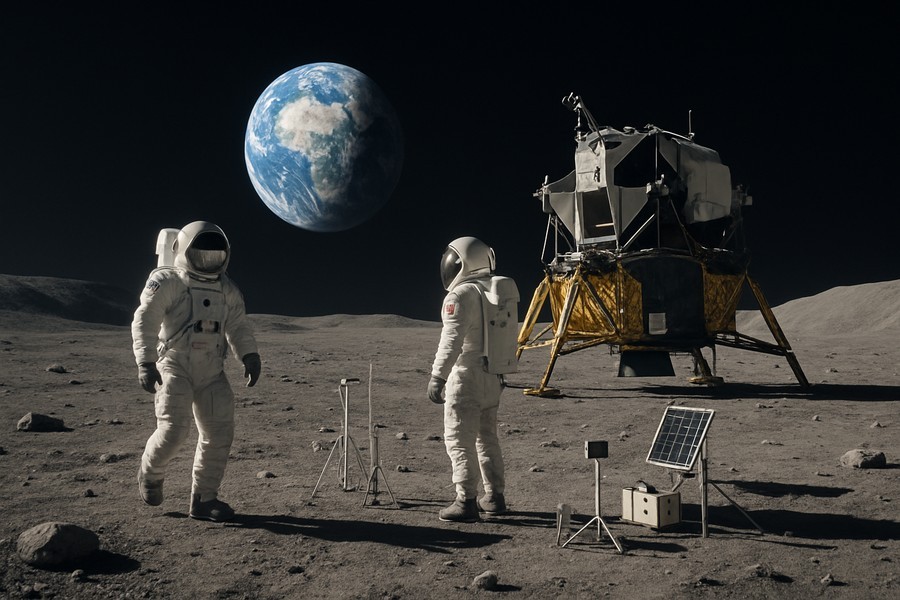
A New Chapter in Lunar Studies: The Significance of the Artemis II Mission
For generations, the moon has been a symbol of fascination and curiosity. It has played various roles throughout our history - a celestial clock, a navigational beacon, a divine figure, and a subject of scientific exploration. A new chapter is about to unfold in our relationship with the moon as astronauts gear up to revisit the lunar system after more than half a century. This mission, known as Artemis II, promises to alter our perception of our closest celestial neighbor.
Unearthing the Moon's Influence on Our World
Renowned science writer, Rebecca Boyle, in her insightful book, "Our Moon: How Earth's Celestial Companion Transformed the Planet, Guided Evolution, and Made Us Who We Are", sheds light on the profound impact of the moon on our planet and our understanding of our place in the cosmos. The book offers a historical voyage through time from the perspective of lunar influence, seamlessly intertwining scientific facts with cultural and civilizational narratives.
In a recent conversation, Boyle touched upon the enduring allure of the moon, the transformative potential of the Artemis program, and how our perception of our lunar partner could change.
Evolution of Humanity's Perception of the Moon
Boyle was asked about the significant shifts in humanity's view of the moon over the centuries. She replied by highlighting that one of the earliest and most crucial utilities of the moon was in timekeeping. The moon's predictable phases allowed early humans to mark the passage of time and plan for the future - a characteristic believed to be uniquely human. Lunar calendars were developed on every continent and some are still in use today, such as the Hebrew calendar and the Islamic calendar. In Asia, the Lunar New Year still follows the lunar calendar.
Following this practical use, the moon was often personified and revered as a watchful deity in many cultures. This perception, Boyle believes, has certainly evolved since the Apollo missions, when the moon became a tangible reality. Yet, she hopes that people still hold onto these ancient perspectives.
The Moon: A Scientific Marvel and a Cultural Icon
The moon's prominence in the night sky, its constant presence, and the illumination it provides have made it an object of curiosity and importance. When humanity discovered that other planets also had moons, it sparked questions about what made our moon unique and how it influenced Earth.
Impact of the Apollo Missions on Our Lunar Understanding
The Apollo missions, according to Boyle, brought a tangible reality to the moon that was previously unimaginable. These missions transformed our understanding of the moon, revealing its composition and offering insights into the history of Earth. The lessons learned from the Apollo missions continue to shape our knowledge of the moon.
The Promise of the Artemis II Mission
Boyle sees the upcoming Artemis II mission as an opportunity for the current generation to comprehend the connection between the moon and our planet in a new light. The unique properties of our moon, its size, distance, and the role it plays in Earth's climate and geological history, suggest that life on Earth may not have been possible without it. The mission, therefore, provides a chance to rethink our relationship with our lunar companion.
The Cultural Implications of Returning to the Moon
Discussing the cultural implications of revisiting the moon and future lunar missions, Boyle emphasized the importance of not taking space exploration for granted. She praised the dedication and intelligence of people involved in these missions and stressed the importance of supporting their efforts. She hopes that the Artemis mission serves as a reminder of the hard work and long-term planning that goes into space exploration.
In conclusion, the Artemis II mission is more than just a return to the moon. It's a chance to reevaluate and redefine our relationship with our closest celestial neighbor. It's a testament to human curiosity, perseverance, and our ceaseless quest for knowledge.